

You need three technical details for an expert article. You message your colleague in development, and two days later he replies with a paragraph that is technically correct and unreadable for your target group.
You rewrite it. He reads the revised version and finds it inaccurate. You go back and forth twice. In the end, there is a compromise that both of you find only half good, and five working days have passed.
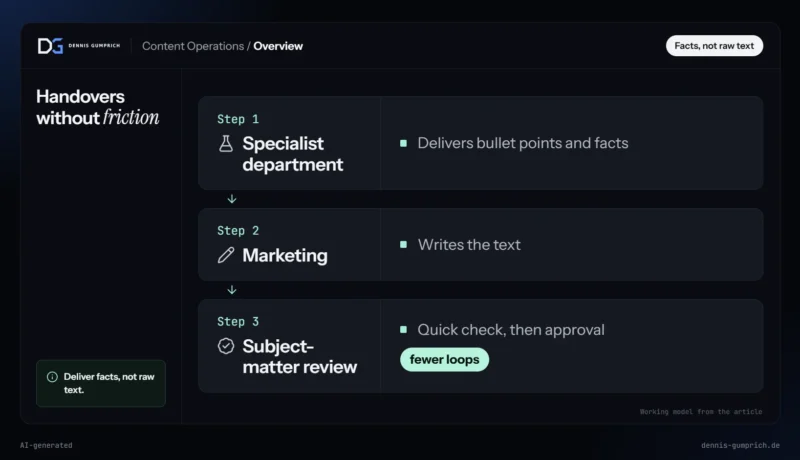
Friction between marketing and specialist departments rarely comes from unwillingness, but from unclear handovers. Three agreements work: the specialist department delivers content rather than text, marketing does the writing, and the review covers only factual accuracy, not style. What the style can then be measured against is described in Brand-compliant AI content: the guide for marketing leaders.
Why both sides work past each other
Marketing and specialist departments judge the same text by different standards. The specialist side checks for completeness and accuracy, because a shortened statement can become technically wrong. Marketing checks for clarity and relevance, because a complete text nobody reads has no effect.
Both standards are legitimate. The problem arises when they are applied to the same object at the same time without it being clear who looks at what. Then every simplification is read as inaccuracy and every clarification as overcomplication. Who is responsible for this translation in the newsroom model is described in Newsroom roles: what the managing editor, topic desk and media desk actually do.
The second reason lies in role expectations. Many specialist departments believe they should deliver finished text. This is rarely their strength and costs them a lot of time. They then write in their own technical language, marketing rewrites it, and the feedback is that the text is no longer correct. Both sides have invested work, and both are dissatisfied.
The way out is not more coordination but less overlap. When it is clear who delivers content and who does the writing, most loops disappear on their own.
What do you need to agree before a handover?
Three things: the specialist department delivers content as bullet points, not finished text. The wording is up to marketing, without consultation in each individual case. And the review covers only accuracy; questions of style are explicitly not part of the approval.
Content, not text
The specialist department delivers bullet points, connections, examples and limits. No finished prose.
Relieves both sides: less effort there, less rewriting here.
Wording is up to marketing
Structure, form of address, length and examples are decided by the editorial side, without consultation in each individual case.
Prevents: debates about wording that nobody can decide.
Review for accuracy only
The specialist department checks whether statements are correct. Questions of style are explicitly not part of the approval.
Without this rule: every approval turns into text criticism.
One contact per topic
One named person on each side, with a deputy. No open distribution lists.
Works immediately: ends contradictory feedback.
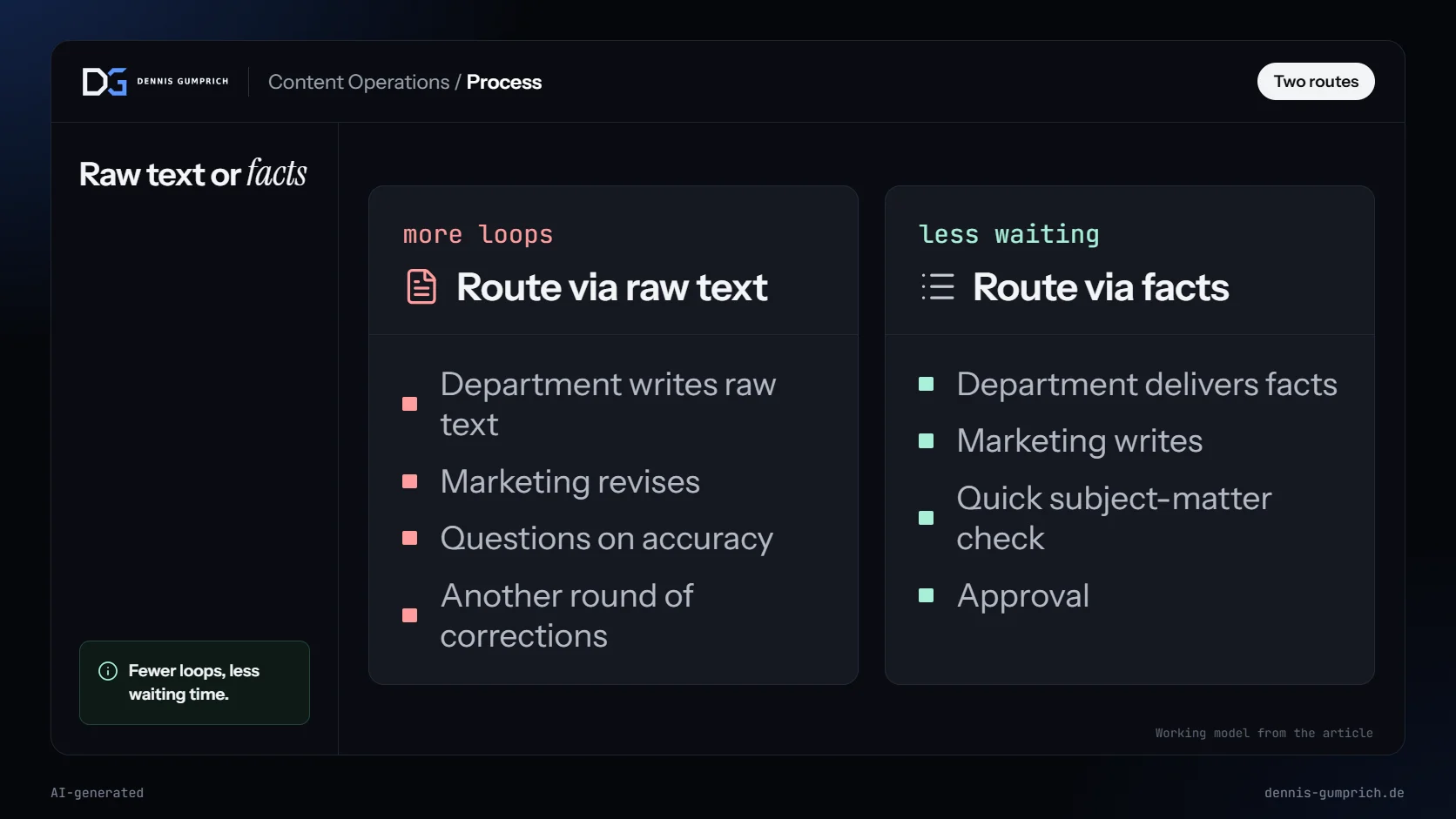
The third agreement is the most important and the most uncomfortable. It requires the specialist side to leave a phrase in place that they would have written differently themselves, as long as it is not wrong. This is exactly what decides whether your lead times go down.
A similar division of labor is described in the newsroom model by Christoph Moss, which Nils Becker explains in the Mediamoss post "The standard process in the corporate newsroom" (in German). There, the specialist department signs off on the base document in terms of content, and only then does media management adapt it for the individual channels. The specialist side thus checks the core before channel versions are created. This is a consulting model, not an empirical study. For your handovers, this means: submit the content core to the specialist department for review and keep channel versions out of their approval.
The easiest way to record who delivers, reviews and decides at which point is the free RACI matrix template.
What does a briefing that relieves the specialist department look like?
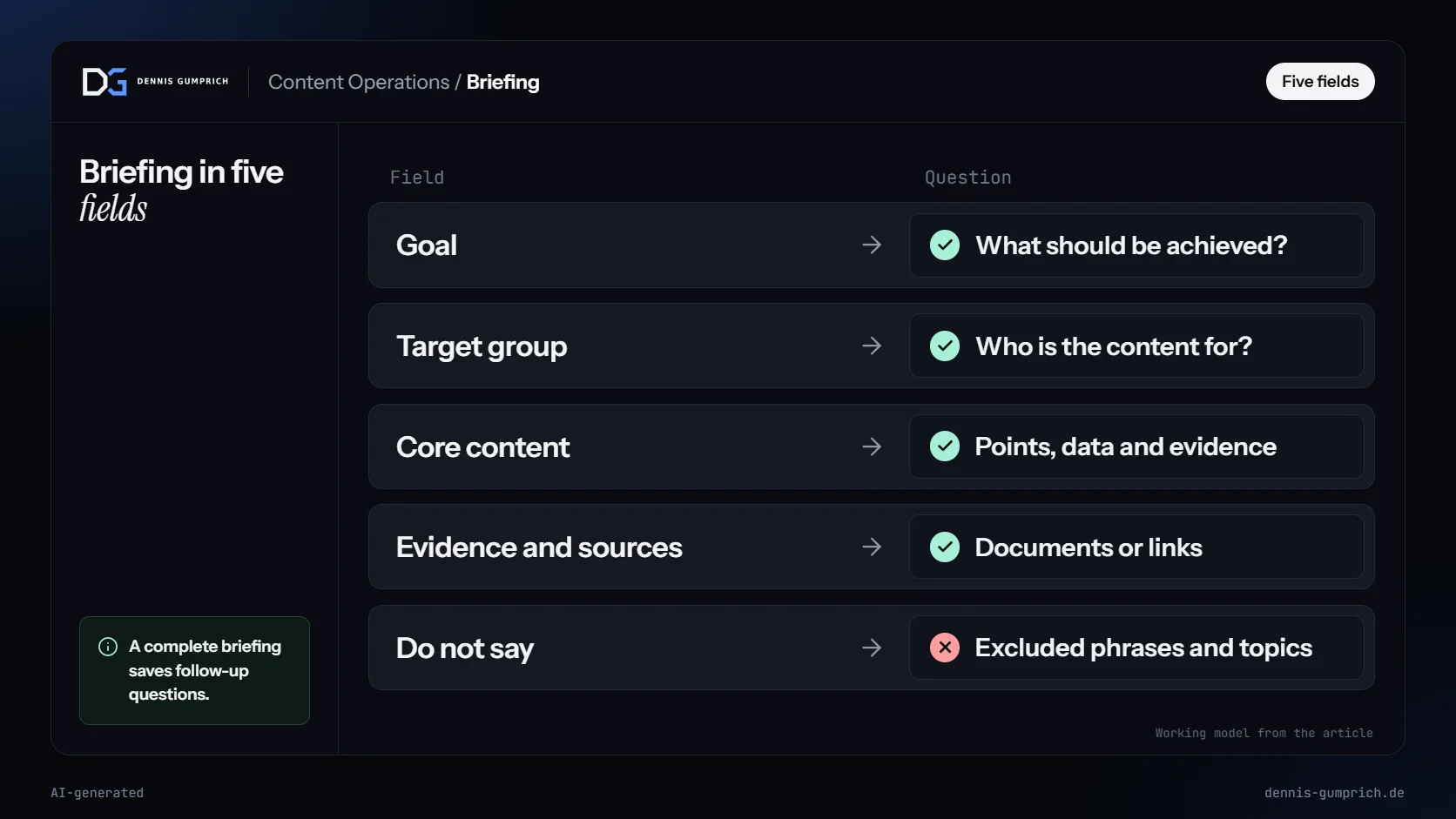
It consists of a few fixed fields: who the content is for, what the person should be able to do afterwards, what exactly you need from the specialist department, by when, and what explicitly does not belong in it. The last field is often the difference between a complete briefing and late corrections.
A request like "can you write something about this" creates effort and poor results. A briefing with five fixed fields takes two minutes longer to write and in practice saves days.
Hi, we need something on the new module for the blog. Can you write a few sentences by Friday?
Who it is for: heads of purchasing in mid-sized companies, no technical background. What the person should be able to do afterwards: judge whether switching is worthwhile. What we need from you: three bullet points on the benefit, one concrete example, the two most common misunderstandings and everything we must not claim under any circumstances. Bullet points are enough, we will do the writing. By Friday, 12 noon.
The last field is the most valuable and is almost never asked: what must we not claim under any circumstances? Experts answer this question immediately and precisely, because they know exactly where statements tip over. This prevents the objections that otherwise only come up during approval.
What you should offer the specialist department
Handovers only work if both sides get something out of them. From the specialist department's point of view, content work is extra work without any visible benefit of its own. Three things in return change this perception noticeably.
First: less effort than before. Anyone who only has to deliver bullet points instead of text invests 20 minutes instead of two hours. That is an argument that is understood immediately.
Second: visible impact. A short note on how the piece performed, how often it was read or used in sales, turns a contribution into participation. This information costs you five minutes and significantly changes the willingness to respond to the next request.
Third: reliability. When the specialist side knows that its limits are respected and nothing is published that it has flagged as wrong, the need for control drops. This need for control is exactly what causes detailed text criticism.
The collaboration often runs in both directions. In the "B2B Marketing Budgets 2026" study by the German B2B marketing association bvik (in German), 74 percent of 115 B2B marketers surveyed say their marketing also works as an internal service provider, for example for HR or sales. The sample is small and comes from an association context in one market. But it shows that in many companies, other departments themselves draw on marketing services. For you, this means: bring this reciprocity into the conversation, because clear handover rules then relieve both directions.
What to do when the specialist department does not deliver?
Name a deadline with a consequence instead of sending reminders, for example: without feedback, we will publish without the technical details. The most common case is not refusal but delay, because the request competes with day-to-day business and has no consequence.
The most common case is not refusal but delay. The request is legitimate, but it competes with day-to-day business and has no deadline with a consequence.
| Situation | Effective response | Not effective |
|---|---|---|
| No response to the request | Name a deadline with a consequence: without feedback, we will publish without the technical details | Reminder without consequence |
| Contribution too brief | Targeted questions with answer options instead of an open request for more | Request for additions without specifics |
| Long prose instead of bullet points | Accept with thanks, shorten, review for accuracy only | Discussion about the format |
| Style criticism during approval | Refer to the agreed rule and ask the accuracy question specifically | Negotiate wording |
The first row works surprisingly reliably, provided the consequence actually happens. A piece that has once been published without the technical details noticeably changes the response time to the next request. It is important that this consequence is announced in advance and not used as a means of pressure.
What to do when the specialist department wants to write itself?
There is also the reverse case: a specialist department explicitly wants to do the writing itself, because accuracy matters to it or because it wants to represent its own area externally. That is not a problem, as long as responsibilities stay separate.
What works then is a reversed division of roles: the specialist side delivers the draft, marketing takes over the editorial work and decides on structure, length and form of address. Responsibility for content stays with the specialist department, responsibility for impact with marketing.
It is important to agree on this in advance rather than let it develop on its own. If an expert text comes back heavily shortened without warning, it causes resentment. If it was clear beforehand that editorial work is part of the deal, the same shortening is expected.
A practical tip: in this case, explicitly ask for a draft, not a finished text. The word draft signals that editing is planned and spares you the discussion about whether shortening is allowed at all.
Five mistakes in handovers
- Asking for finished textExperts write in technical language. That costs them a lot of time and you the rewriting. Bullet points are better for both sides.
- Making style an approval questionIf wording is part of the subject-matter approval, you negotiate taste instead of accuracy. Separate the two explicitly.
- Briefing without limitsThe question of what must not be claimed under any circumstances prevents most later objections and is almost never asked.
- Using open distribution listsThree people answer differently and nobody decides. One named contact per topic, with a deputy.
- Giving no feedbackAnyone who never learns what became of their contribution will give the next request lower priority.
Five steps to low-friction handovers
- Step 1Make the effort visibleShow the specialist side how much time it currently spends on text work and how much of it disappears if it only delivers content.
- Step 2Agree on a briefing templateFive fields, agreed jointly. Not imposed by marketing, otherwise it will not be accepted.
- Step 3Define the approval criterionIn writing: subject-matter approval covers only the accuracy of statements.
- Step 4Name contactsOne person per topic area with a deputy on both sides, by name and in writing.
- Step 5Introduce feedbackAfter publication, a short message on what the piece achieved. Two sentences are enough.
The first step decides acceptance. A new template initially looks like extra effort. If you start with the relief instead and show that finished text is no longer expected, you get agreement instead of resistance.
Self-check: how good are your handovers?
Tick everything that applies to you.
A proposal for how we make our collaboration on expert content easier for you:
From now on, you no longer need to write finished texts. What we need from you are bullet points: the technical core, one concrete example, common misunderstandings and, above all, what we must not claim under any circumstances. We will do the writing.
During approval, you only check whether the statements are technically correct. We are responsible for wording, length and structure. This eliminates the rounds in which we discuss word choice.
This significantly reduces your effort. In return, after publication we will briefly let you know what the piece achieved.
Conclusion: separate responsibilities, do not increase coordination
The usual reaction to friction is more coordination: another meeting, another loop. The opposite works. When it is clear that one side delivers content and the other does the writing, and when the approval answers only one question, most rounds disappear on their own. It costs an agreement, not additional capacity. Defined handovers belong to the production and approval building block, one of six building blocks in content operations.
Frequently asked questions
What if the specialist department insists on certain wording?
Ask specifically: is the statement wrong, or do you just not like it? If it is wrong, it gets changed; if it is just not liked, it stays. This question settles most cases in one sentence, because it is factual and does not override anyone.
And if it is technically correct but hard to understand?
Then it is your job to make it understandable, and the specialist side checks the simplified version again for accuracy. That is exactly what the division is for. It is important that you do not put the simplification up for discussion but present it as a proposal.
How do we deal with several specialist departments?
One contact per topic area, not per piece. Otherwise you renegotiate responsibility with every request. For cross-departmental topics, define in advance who decides in case of doubt.
Should we name experts as authors?
If they contributed in substance and agree, yes. Being named noticeably increases the willingness to contribute in future and strengthens the credibility of the piece. Clarify in advance whether the attribution should remain in place after later changes.
How much time should we give the specialist side?
Three working days are usually enough for bullet points, and the same for the accuracy check. What matters is less the length of the deadline than how binding it is and what happens when it expires.
Where does your content process lose time today?
In 30 minutes, we look together at where unnecessary coordination, manual tasks, tool switching or repetitive content work cost you time today.
You get a concrete assessment of which tasks you can simplify, automate or organize better, and where AI and tools actually help instead of adding complexity.
Analyze your content process in 30 minutes Free of charge. You take away concrete starting points you can use internally right away.
Dennis Gumprich
Dennis helps marketing and communication teams fit generative AI into existing content processes without undermining quality, brand voice and approvals. Focus areas: content operations, AI governance and tool selection in mid-sized companies and corporations.
Transparency note: Dennis works for contentbird, a provider of AI-powered content software. Product mentions are marked in the article. More about Dennis (in German) · LinkedIn
Read more
Sources
- Content Marketing Institute: How To Get Great Content Without Asking Your Subject Matter Experts To Write, article from September 17, 2026: interview experts with prepared questions instead of having them write texts, and send only the relevant section for review. Accessed October 31, 2026.
- IT@Cornell, Cornell University: RACI and RASCI Definitions, IT service management guide, undated: only one accountable person with decision authority per task or decision; consulted people provide knowledge before the decision. Accessed October 31, 2026.
- Google Search Central: Creating helpful, reliable, people-first content, documentation, as of October 5, 2026: recognizable authorship with an author byline supports trust in content. Accessed October 31, 2026.
- Nils Becker, Mediamoss: Der Standardprozess im Corporate Newsroom (in German), blog post from May 21, 2026: seven-step model by Christoph Moss; during approval, topic management has the specialist department sign off on the base document in terms of content, and only then does media management adapt it for the channels. Consulting model from a self-publication, not an empirical study. Accessed October 31, 2026.
- bvik: bvik study B2B Marketing Budgets 2026 (in German), results page from September 3, 2026, survey of 115 B2B marketers in Germany, 95 percent of them heads of marketing or decision-makers, mostly from industry: 74 percent also see marketing as an internal service provider, for example for HR and sales. Association survey with a small sample. Accessed October 31, 2026.
How this article was created
This article was created with the help of AI. Structure, research and draft wording were developed with AI support. Professional assessment, review of the statements and the final version are the responsibility of Dennis Gumprich. The English version was translated with AI and reviewed. Read the original German version.
How reliable are the statements?
Evidence exists for the approach of having experts deliver content rather than write texts and showing them only the relevant sections for review (Content Marketing Institute), the rule of clear decision ownership (RACI definition by IT@Cornell) and Google's recommendation to make the authorship of content recognizable, as well as sign-off on content by the specialist department before channel adaptation (standard process by Christoph Moss, consulting model by Mediamoss) and the share of 74 percent who also see marketing as an internal service provider (bvik study B2B Marketing Budgets 2026, small sample from Germany). The agreements, the briefing pattern and the deadlines given are explicitly marked as working models and are not an industry standard. The time figures, such as 20 minutes for bullet points instead of two hours for a text, are experience values from consulting practice, not measured values. As of October 31, 2026.


