
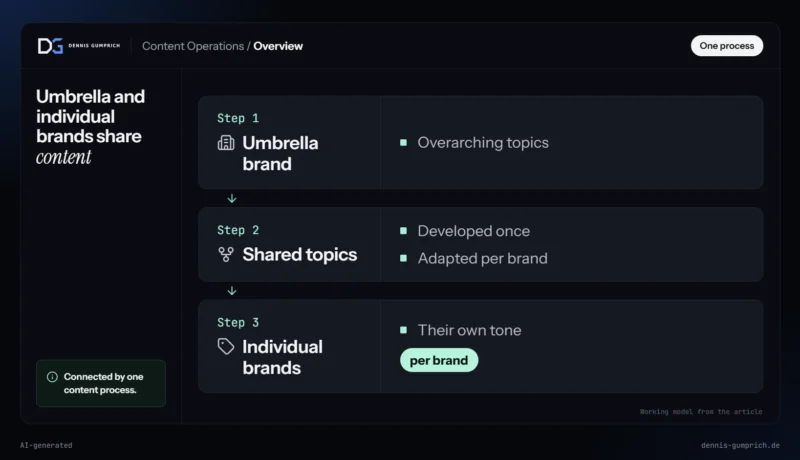

Brand architecture describes how a company's brands relate to each other: as a strong umbrella brand, as a family of independent individual brands or as a mixed form. For communications, it determines which content is created centrally, which is shared and adapted, and which each brand is responsible for itself. Most friction arises with topics that concern several brands. If you develop these topics once centrally, approve them and then adapt them per brand, you avoid duplicate work and contradictory statements, and you launch new brands much faster.
What is brand architecture?
Brand architecture is the strategic order of all of a company's brands. It defines which role each brand plays, how closely it is connected to the umbrella brand and how the brands differentiate themselves from each other.
Four basic models have become established in brand management. They differ mainly in how visible the umbrella brand is and how independently the individual brands appear. In practice, the boundaries are fluid, and many companies move between models over the years, for example through acquisitions or new business areas.
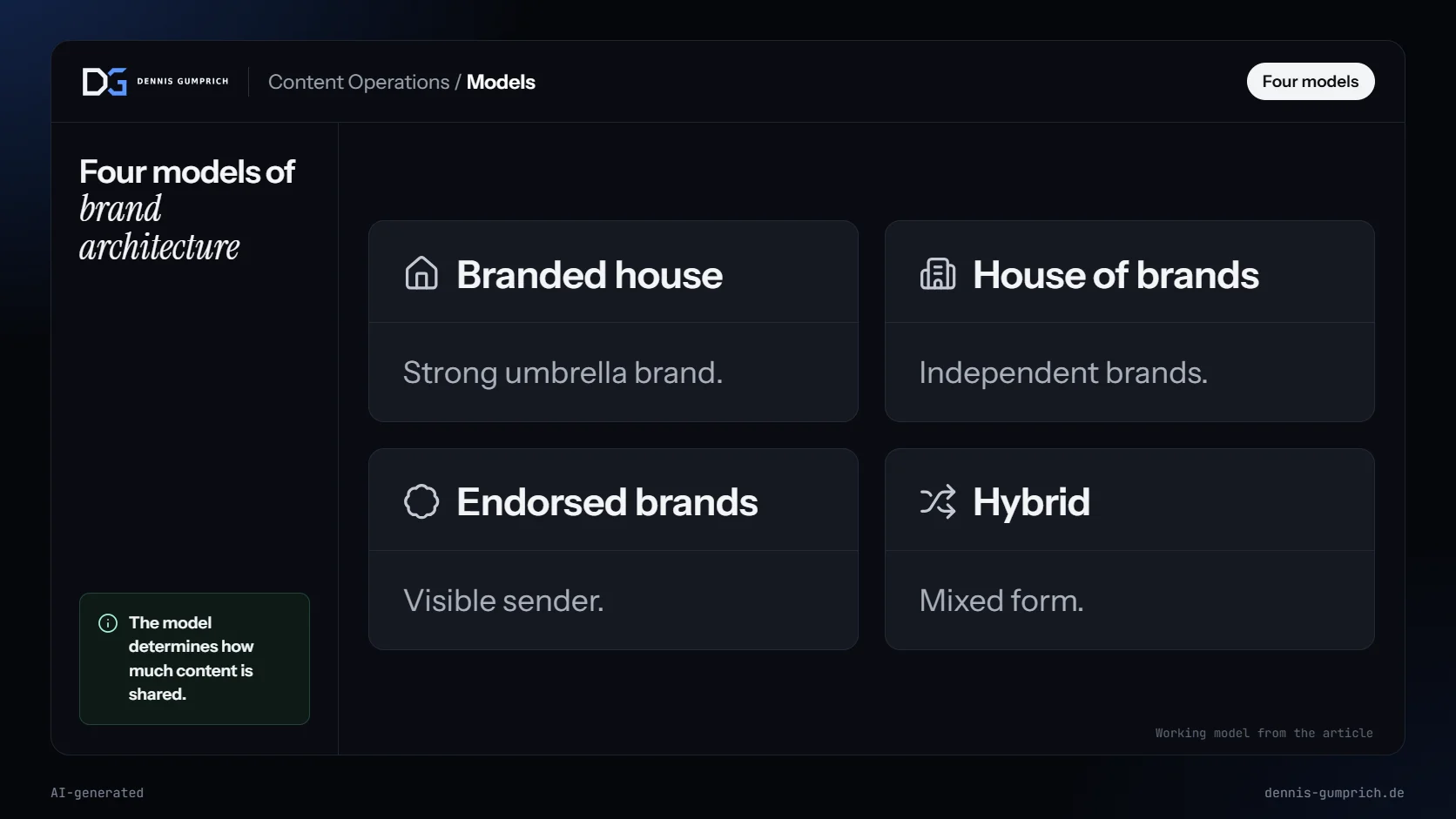
| Model | Principle | Well-known example | Consequence for content |
|---|---|---|---|
| Branded house | One strong umbrella brand carries all offerings | Virgin with its airline, mobile and other businesses | Much content central, one tone |
| House of brands | Independent brands, the umbrella brand stays in the background | Procter & Gamble with brands such as Pampers or Ariel | Content largely separate, but shared topics still exist |
| Endorsed brands | Own brands with a visible umbrella brand sender | Courtyard by Marriott | Shared core messages, own expression per brand |
| Hybrid | A mix: some brands close to the umbrella brand, others independent | Common after acquisitions | Rules per brand needed, otherwise sprawl |
Umbrella brand, individual brand, multi-brand strategy: what is the difference?
The terms describe different strategies within brand architecture. With an umbrella brand strategy, all offerings appear under one brand. With an individual brand strategy, each offering has its own brand. A multi-brand strategy runs several brands in the same market segment. The family brand strategy lies in between.
| Strategy | What it means | Typical content challenge |
|---|---|---|
| Umbrella brand strategy | All products and services under one brand | Many topics, one sender: prioritization and channel planning |
| Family brand strategy | One brand per product group, several families in the company | Recognizing shared topics between families |
| Individual brand strategy | Each product or service with its own brand | Separate teams, duplicate work on overarching topics |
| Multi-brand strategy | Two or more brands in the same market segment | Clear distinction in tone and target group on similar topics |
For communications work, it matters less which textbook model you follow than what consequences it has for your content. The more independent the brands, the more likely separate teams work in separate structures. That is often right, because a product for families has little in common with an offering for industrial customers. But it becomes expensive as soon as topics concern all brands at the same time.
The basic types: branded house, house of brands, endorsed brands
The basic types of brand architecture are usually described with these terms. They largely correspond to the strategies above, but differ significantly in what they mean for your content.
| Type | Corresponding strategy | Principle | Consequence for content |
|---|---|---|---|
| Branded house | Umbrella brand strategy | All offerings appear under one brand | One context, one brand voice, one set of channels. Topics are easy to bundle. |
| House of brands | Individual or multi-brand strategy | Independent brands, the company stays in the background | Own context and tone per brand. Shared topics easily lead to duplicate work. |
| Endorsed brands | Individual brands with a visible umbrella brand sender | Own brands visibly backed by the umbrella brand | A shared basis plus brand-specific additions. Clear rules are needed on when the umbrella brand speaks. |
| Hybrid architecture | Mixed form | Different types depending on the business area | Centrally maintained foundations, with each brand defining what it adopts from them. |
What does brand architecture mean for your content?
It determines on which level a piece of content is created. Every topic can be assigned to one of three levels: umbrella brand topics, topics shared by several brands and brand-specific topics. Each level needs a different responsibility and a different process.
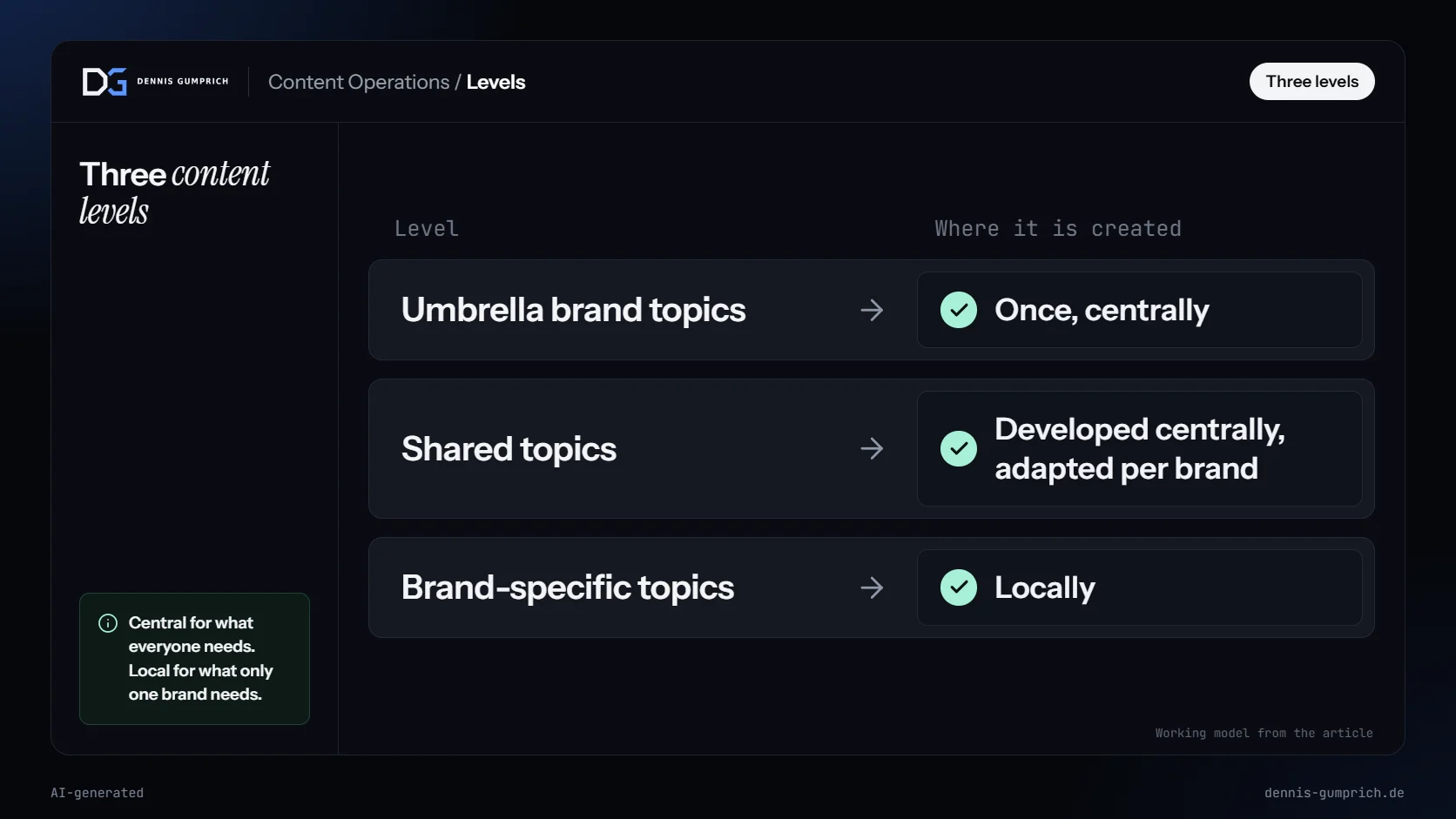
- Level 1Umbrella brand topicsTopics that concern the company as a whole: strategy, values, sustainability, employer topics, company figures. They are created once centrally and adopted by the brands, at most with slight adjustments. Corporate communications is responsible.
- Level 2Shared topicsTopics that concern several brands but need to be told differently per brand: new regulations, service offerings, industry developments, joint campaigns. They are developed and approved centrally, then adapted per brand in tone and examples.
- Level 3Brand-specific topicsTopics that concern only one brand: products, events, community, customer stories. They are created locally in the respective brand team, following shared quality rules.
Most friction arises on the second level. Umbrella brand topics usually have a clear sender, and brand-specific topics a clear team. Shared topics, on the other hand, fall between responsibilities. Each brand works on them separately, often without knowing that another team is doing the same thing right now.
How do you notice that content is being created twice across brands?
Through recurring patterns: the same question is answered several times, statements contradict each other, and existing content is not found but rewritten. If three or more of the following points apply, it is worth taking a closer look.
- A topic that concerns all brands is worked on by several teams in parallel.
- There is no shared place where you can see which content already exists on a topic.
- Colleagues prefer to rewrite a text because finding the existing one takes longer.
- Figures, wording or approval status differ between brands.
- Specialist departments are asked about the same thing by several brand teams.
- Setting up a new brand takes weeks, because templates, processes and rules are created anew every time.
- Other departments such as service or sales communicate with the same customers without coordination.
The last point goes beyond brand architecture, but it belongs here. From the customer's point of view, there are no departmental boundaries. If marketing, service and sales send different messages at the same time, it looks uncoordinated, even if each individual message is correct. A shared topic plan that shows who communicates on which topic when is the first step here. How it differs from the classic editorial plan is described in the article From editorial plan to topic plan.
How do several brands share content without sounding the same?
With a two-stage process: a topic is developed once centrally and approved in its key statements. Then each brand adapts it to its tone, target group and channels. The substance is shared, the storytelling is independent.
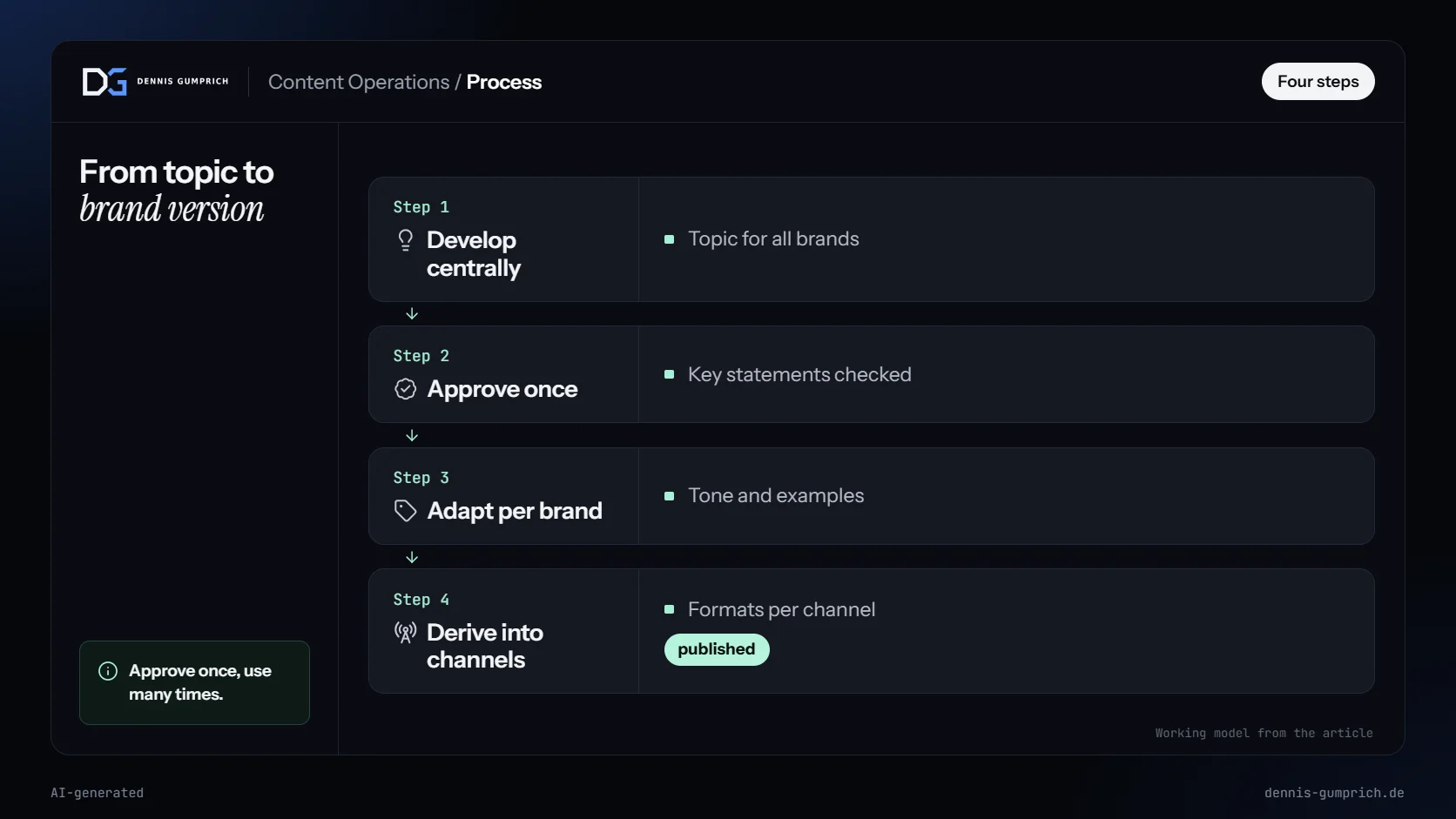
- Step 1Develop the topic centrallyOne team, usually corporate communications or a central topic desk, researches the topic and creates a briefing with goal, key statements, facts and sources. The brand teams see early on that the topic is coming.
- Step 2Approve the key statementsThe specialist department and, if necessary, legal approve the key statements once. That eliminates the parallel coordination each brand team would otherwise do separately.
- Step 3Adapt per brandEach brand team takes over the briefing and adapts tone, examples and address. A stored brand profile per brand with target groups, wording and tone rules helps. AI can speed up this adaptation if the profiles are properly stored.
- Step 4Derive into channelsThe brand version is used to create content for the website, newsletter and social channels. Because the substance is the same, statements remain consistent across all brands.
Four teams research the same topic, ask the specialist department the same questions and have four versions approved separately. In the end, four different statements are online.
One briefing, one approval of the key statements, four brand versions in their own tone. The specialist department is asked once, and the statements remain consistent.
This process is often described as content repurposing or content recycling, i.e. reusing content in a different form. With several brands, however, it is about more than reuse: it is about deliberately separating substance and storytelling. A similar principle is described in the article Create content centrally, publish locally for companies with several countries. How to store brand voice so that people and AI apply it the same way is covered in the guide Brand-compliant AI content.
How do you connect a new brand quickly?
With a starter kit containing everything every brand needs: a brand profile, templates for content types, processes and approval routes, and a list of shared topics it can adopt. Instead of starting from scratch every time, the proven setup is copied and adapted.
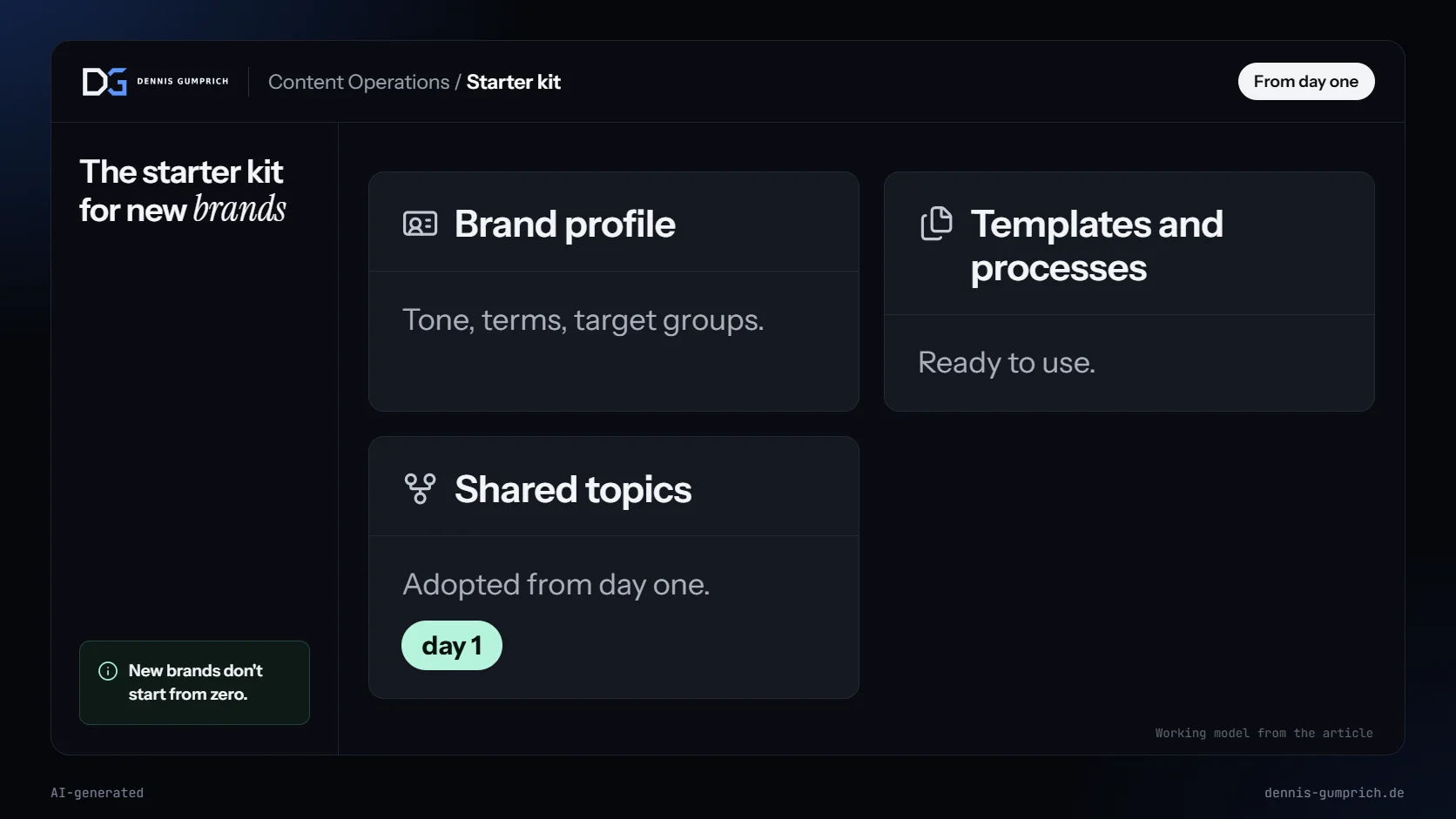
Companies that regularly build or acquire brands face the same task again and again: a new team needs structures without additional capacity being available. If templates, roles and processes are created anew for every brand, that ties up weeks. A starter kit significantly reduces this effort. It consists of three parts:
- Brand profile: positioning, target groups, tone, wording, banned terms. Once filled in, people and AI tools use it equally.
- Templates and processes: content types with structure, status and approval routes, taken over from an existing brand and adapted only where necessary.
- Adoption of shared topics: a list of umbrella brand and shared topics that the new brand can use from day one. That way, the channel isn't empty while its own topics are being developed.
The prerequisite is that the existing setup is documented somewhere. If processes only exist in individual people's heads, there is nothing to copy. How to prevent this is described in the article Content operations without a key person.
Who decides what between the umbrella brand and individual brands?
The umbrella brand decides on shared rules and overarching key statements. The individual brands decide on their topics, their tone and their channels. It gets unclear with shared topics. These need a fixed rule, otherwise ten people end up discussing every sentence.
| Decision | Umbrella brand | Individual brand |
|---|---|---|
| Overarching rules: quality, labeling, data protection | Decides | Applies |
| Umbrella brand topics | Develops and approves | Adopts, adapts slightly |
| Key statements of shared topics | Approves | Provides input before approval |
| Brand version of shared topics | Is informed | Decides |
| Brand-specific topics | No role | Decides |
| Brand profile and tone | Sets the framework | Fills in and maintains |
Such a division also reduces the problem of open coordination rounds. If every version is discussed in a general channel, many opinions arise instead of one responsible approval. Fixed approval routes with one responsible person per level make it clear who decides and who is only informed. The article Shortening approval processes offers guidance. For large communications departments with many brands, a corporate newsroom is often the right organizational model.
What role does AI play with several brands?
AI can greatly speed up adapting a topic to different brands, but only if each brand has a properly stored profile. Without profiles, AI produces texts that sound the same across all brands and reinforces exactly the problem it is supposed to solve.
The process of a central briefing and brand adaptation is a good case for AI. From an approved core text, drafts for several brands and channels are created in a short time. What matters is what the AI knows about each brand: target group, tone, typical phrasing, banned terms and example texts. If this knowledge is stored centrally and separately per brand, people and AI draw on the same basis. How to build such a basis is described in the article Building a knowledge base.
Two rules help. First: the key statements are approved before adaptation, not after. Otherwise the specialist department reviews four AI versions instead of one. Second: a person from the respective brand team always reviews the brand version. They recognize whether a text sounds like their own brand or just like a variant of the others.
How do you measure whether collaboration between brands is improving?
With a few simple values: how many topics are worked on multiple times, how long approval of shared topics takes and how quickly a new brand becomes operational. Collect them before the change as a baseline, otherwise no improvement can be proven.
| KPI | What it shows | How you collect it |
|---|---|---|
| Topics worked on multiple times per month | Extent of duplicate work | Comparison of all brands' topic plans |
| Approval time for shared topics | Coordination effort | Days from briefing to approval of key statements |
| Time until a new brand is operational | Effect of the starter kit | Days until the first published content |
| Contradictory statements | Consistency across all brands | Sample once per quarter |
For the conversation with management, saved hours and avoided risks can be derived from this. How such reporting is structured is described in the article Proving content impact.
What mistakes do companies with several brands make?
The most common mistakes don't arise in brand strategy, but in day-to-day collaboration between the brands. Five patterns come up particularly often.
- Confusing separate brands with separate processesIndependent brands need their own tone and their own topics, but not their own process, templates and tools. A shared process with brand-specific profiles saves a lot of effort.
- Assigning shared topics to no oneIf nobody is responsible for topics that concern several brands, each brand works on them separately. Name a fixed responsibility for this level.
- Centralizing everythingThe opposite is just as harmful. If each brand only adopts central content, it loses its voice and its closeness to the target group.
- No shared storage placeWithout a central overview of topics and content, things that already exist get rewritten. Searching is more expensive than rewriting as long as nobody knows where to look.
- Building new brands from scratchEvery brand that starts without a starter kit costs weeks and creates yet another variant of the processes. Document the setup once and reuse it.
Self-check: how well do your brands share content?
Tick everything that applies to you.
a short note on how our brands work together:
Topics that concern several brands are often worked on multiple times here: several teams research, ask the same experts and have things approved separately. That costs time and leads to different statements. New brands also build their processes from scratch every time.
I suggest separating topics into three levels: umbrella brand, shared topics and brand-specific topics. We develop shared topics once centrally, approve the key statements once and adapt them per brand. We also create a starter kit for new brands.
As a first step, I would record for one month which topics are worked on multiple times and how much time that costs.
Conclusion: independent brands need a shared content process
Brand architecture is usually treated as a question of brand strategy: how much umbrella brand should be visible, how independently do the brands appear? For communications, a second question is just as important: on which level is which content created, and who decides on it? If you separate topics into umbrella brand, shared and brand-specific topics, develop shared topics once centrally and give new brands a starter kit, you save duplicate work, avoid contradictory statements and gain time for the actual brand work.
Start with an inventory. Record for one month which topics several brands worked on at the same time. The list shows where the biggest lever lies. A content inventory helps make existing content visible before new content is created.
Frequently asked questions
What is meant by brand architecture?
Brand architecture is the strategic order of all of a company's brands. It defines which role each brand plays, how closely it is connected to the umbrella brand and how the brands differentiate themselves from each other. The four basic models are branded house, house of brands, endorsed brands and mixed forms.
What is the difference between an umbrella brand and an individual brand?
With an umbrella brand, all of a company's offerings appear under one shared name. With individual brands, each product or service has its own brand name, and the corporate brand stays in the background. Many companies combine both.
What is a multi-brand strategy?
With a multi-brand strategy, a company runs two or more brands in the same market segment to address different target groups or price segments. For communications, this means similar topics but clearly different tone and address.
Which brand architecture suits our company?
That depends on how similar your brands' target groups and offerings are and how much trust the corporate brand transfers. Similar target groups speak for a stronger umbrella brand, very different markets for independent brands. For communications, it is more important that you clearly regulate the consequences of the chosen model for your content.
Should several brands have a shared content team?
Not necessarily, but a shared process. Brand teams can remain separate as long as shared topics are coordinated centrally, templates and processes are shared and everyone can see in one place what is in progress.
Where does your content process lose time today?
In 30 minutes, we look together at where unnecessary coordination, manual tasks, tool switching or repetitive content work cost you time today.
If you manage several brands, we go through your topics and sketch which content is created centrally and which is adapted per brand.
Analyze your content process in 30 minutes Free of charge. You take away concrete starting points you can use internally right away.
Dennis Gumprich
Dennis helps marketing and communication teams fit generative AI into existing content processes without undermining quality, brand voice and approvals. Focus areas: content operations, AI governance and tool selection in mid-sized companies and corporations.
Transparency note: Dennis works for contentbird, a provider of AI-powered content software. Product mentions are marked in the article. More about Dennis (in German) · LinkedIn
Read more
Sources
- This article is based on established classifications in brand management and on consulting practice with marketing and communication teams. No external studies were used.
How this article was created
This article was created with the help of AI. Structure and draft wording were developed with AI support. Professional assessment, review of the statements and the final version are the responsibility of Dennis Gumprich. The English version was translated with AI and reviewed. Read the original German version.
How reliable are the statements?
The four models and brand strategies correspond to common classifications in brand management; the examples serve as illustrations. The level model, process, starter kit and decision grid are working models from consulting practice, not measured values. The observations on duplicate work between brands come from conversations with marketing and communication teams in 2026.


