
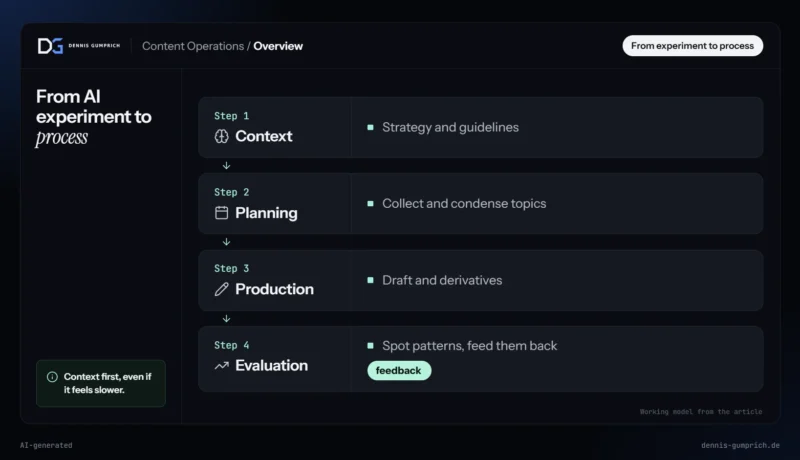

As long as AI is a project, it remains an experiment. Only as part of the workflow does it reliably save time.
AI content operations means running content production as an end-to-end process instead of a collection of individual tasks. AI is not a separate work step but a function within existing workflows. Four levels are decisive: strategy, planning, production and evaluation, connected by clear roles and a shared place for context. A compact introduction to the term is given in Content operations: definition, building blocks and getting started.
The following sections show how these four levels interact and where AI fits in. First, a term that comes up often in this context.
What is an AI content operations platform?
An AI content operations platform is software that maps a team's entire content process in one system: topic planning, AI-supported creation, approval, publication and evaluation. The difference from a writing assistant lies in context: brand voice, target groups and knowledge sources are stored centrally, so AI drafts are bound to the same guidelines for everyone on the team. The difference from a CMS lies in timing: the platform steers the work before publication, the CMS the delivery afterwards.
Whether you need such a platform is not decided by the term but by your maturity. The following sections show which order needs to be in place first so that a tool can map it. Which vendors exist in this category is described in Content marketing software for teams 2026.
Why AI experiments rarely become processes
In most teams, AI use starts individually. One person discovers that text drafts can be created faster, another uses a tool for subject lines, a third has social posts derived. Each of these applications works on its own. This applies to marketing just as much as to internal communications. How internal communications takes the step to a manageable process is described in Internal communications with AI.
What is missing is the connection. The results end up in personal folders, the instructions used exist only in the head of the person concerned, and nobody can say whether a text was created before or after the brand review. As soon as that person is on holiday, the advantage disappears. How to resolve this dependency is described in Content operations without a key person.
The leap from experiment to process does not happen through more tools. It happens when three things are settled: where the shared context lives, who decides at which point, and how you recognize that a result is good enough. What this means for planning in 2027 is described in The AI opportunity for marketing and communications teams in 2027.
How widespread this gap is, is shown by the 2026 marketing practice report by Bitkom (in German), Germany's digital industry association. In the non-representative survey of 180 companies from the digital sector, 54 percent each name cost pressure and the automation of marketing processes as an internal challenge, and 37 percent the coordination of marketing processes. 35 percent lack an AI strategy, and 34 percent complain about insufficient integration of AI. So even in the digital sector, around a third do not yet see AI properly integrated into their workflows. For you, this means: clarify context, ownership and quality standards before deciding on the next tool.
What does content operations include?
Content operations does not describe a tool but the order in which your work runs. Four levels build on each other.
Strategy and context
Target groups, positioning, brand voice, recurring messages. This level rarely changes but is needed constantly.
Clearly good when: A new person on the team finds the brand voice without asking.
Topics and planning
Which topics are covered when, through which channels, with what goal. This is where most coordination loops arise.
Clearly good when: The status of a topic can be read without asking.
Production and approval
Creation, editing, subject-matter and legal approval, publication. This is where most time is spent.
Clearly good when: Everyone knows who has the ball next.
Evaluation and feedback
What worked, what did not, and what follows from it for planning. This level is skipped most often.
Clearly weak when: Evaluation only takes place at the end of the year.
AI has an effect on all four levels, but to different degrees. In production, it visibly speeds things up. In planning, it helps with deriving and reshaping. In strategy, it replaces nothing; it needs strategy as its foundation. And in evaluation, it is only as good as the data you collect.
How the four levels interact
The four levels are not departments but dependencies. Each level supplies the material for the next, which is why a gap always has an effect further down.
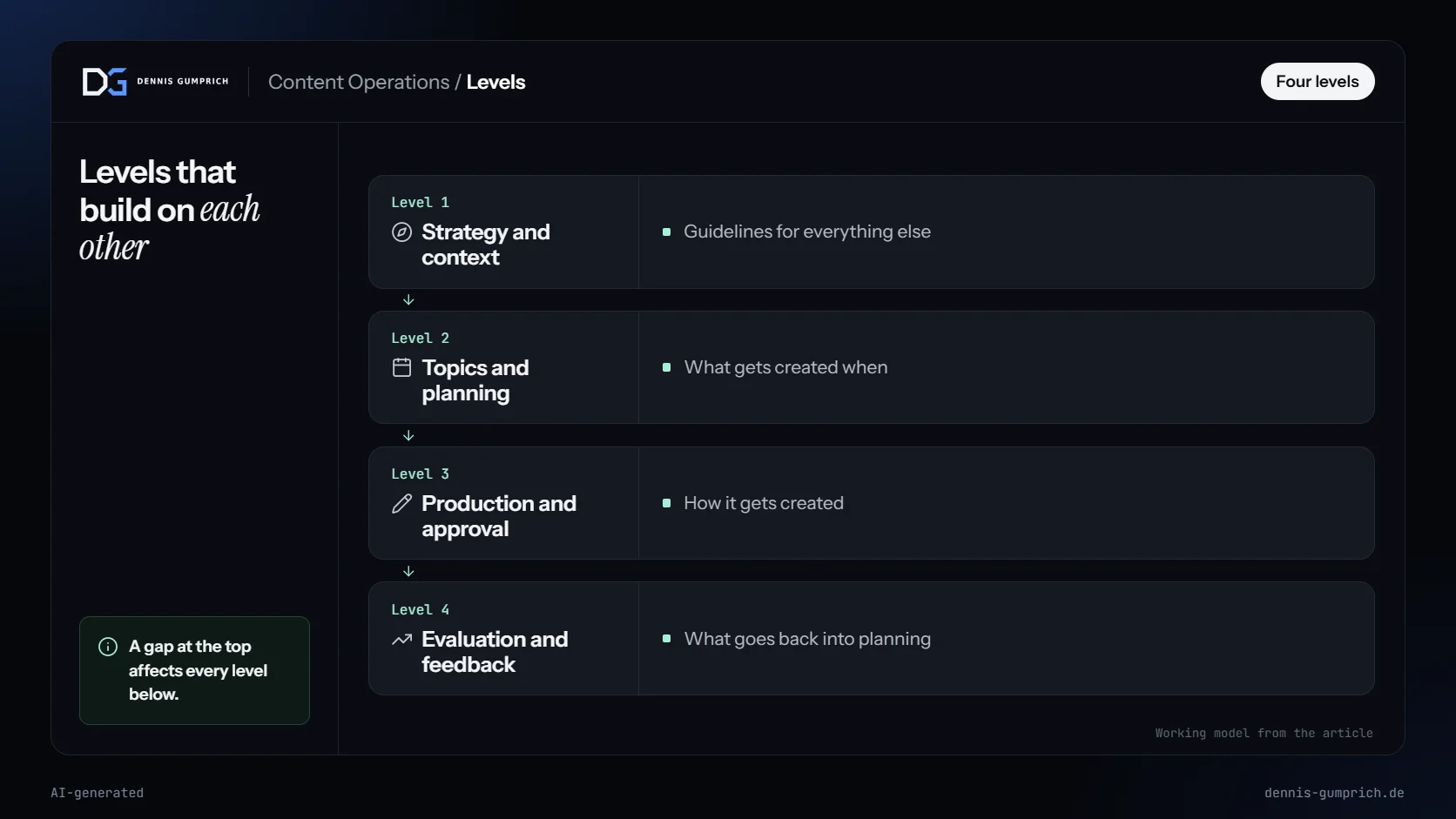
If strategy and context are missing, planning has to discuss what should long since have been decided: who a topic is for and how you sound. If planning is missing, production makes individual decisions under time pressure. If production is not a defined process, evaluation is worthless, because results cannot be attributed to any cause.
This chain explains a common observation: teams that work on evaluation even though planning does not hold up gain no insights from it. They measure the results of a process that does not exist in that form.
The practical consequence is a sequence. Only work from the bottom up if you really have a bottleneck in production. In all other cases, the order context, planning, production, evaluation is the faster one, even if it feels slower.
Where does AI have an effect at each level?
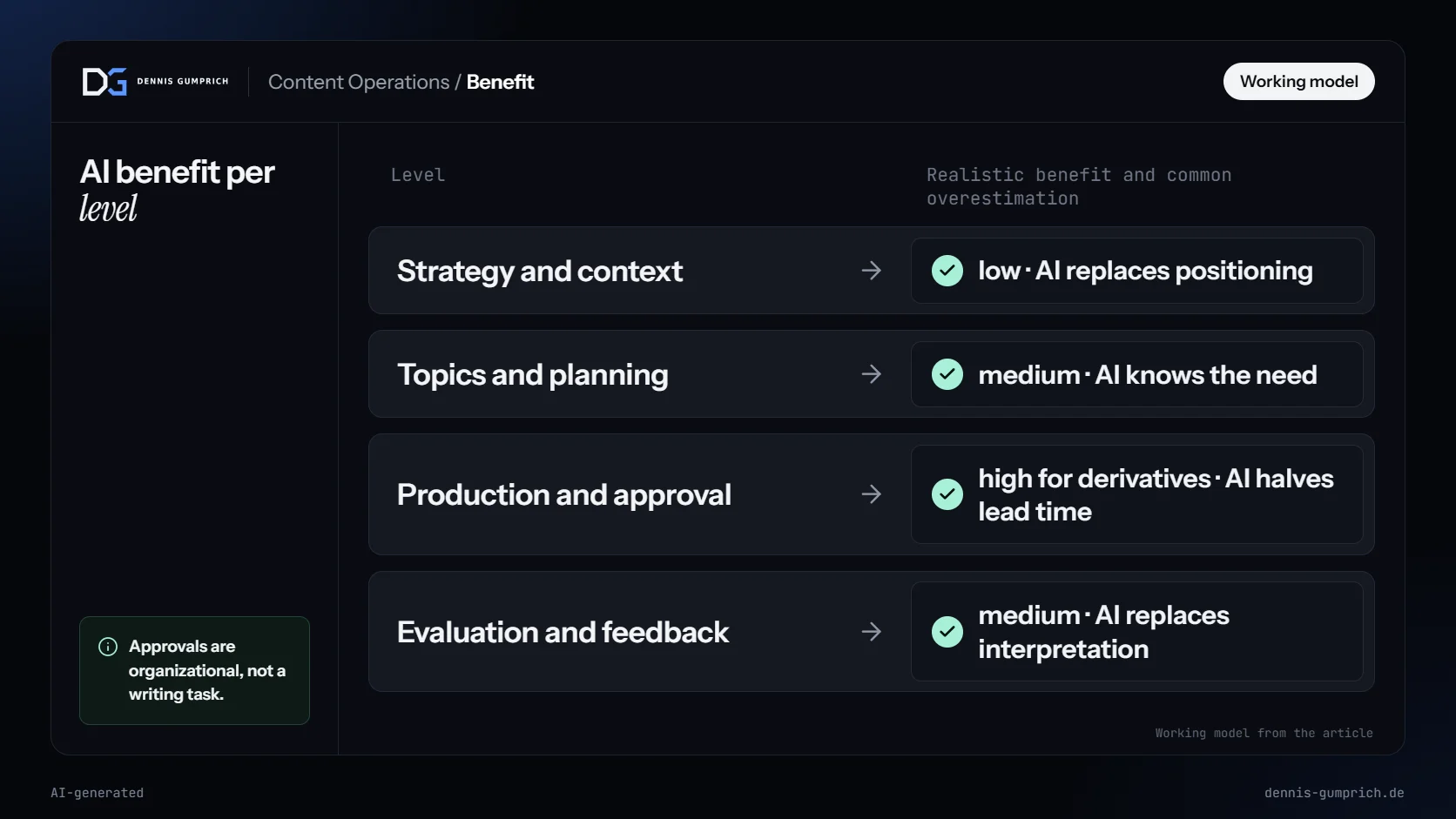
Very differently. Low at the strategy level, where AI only supports the wording of guidelines. Medium for topics and planning, for example in collecting topics and condensing research. High in production for derivatives, medium for first drafts and not at all for approvals. Medium for evaluation and feedback.
| Level | Realistic benefit | Common overestimation |
|---|---|---|
| Strategy and context | low, supportive in wording guidelines | AI replaces positioning work |
| Topics and planning | medium, in collecting topics and condensing research | AI recognizes what your target group needs |
| Production and approval | high for derivatives, medium for first drafts, none for approvals | AI halves the lead time |
| Evaluation and feedback | medium, in summarizing and identifying patterns | AI replaces interpretation |
The third row contains the most important pointer for managing expectations. Approvals are organizational processes, not writing tasks. If a piece sits with the specialist department for three weeks, no model shortens that time. That is exactly why rollouts justified by time savings disappoint when nothing has been changed in the approval route.
The second row deserves a caveat. A model can suggest topics, but it knows neither your sales conversations nor the questions your customers actually ask you. Useful as a complement to your own topic base, but not as a replacement for it.
Maturity: where do you stand today?
Most teams are between stage two and three: there is a shared plan, but it goes out of date faster than it is maintained. Maturity does not come from more AI use but from repeatable standards, clear roles and steering.
The following classification helps you find the next sensible step. Most teams are between stage two and three.
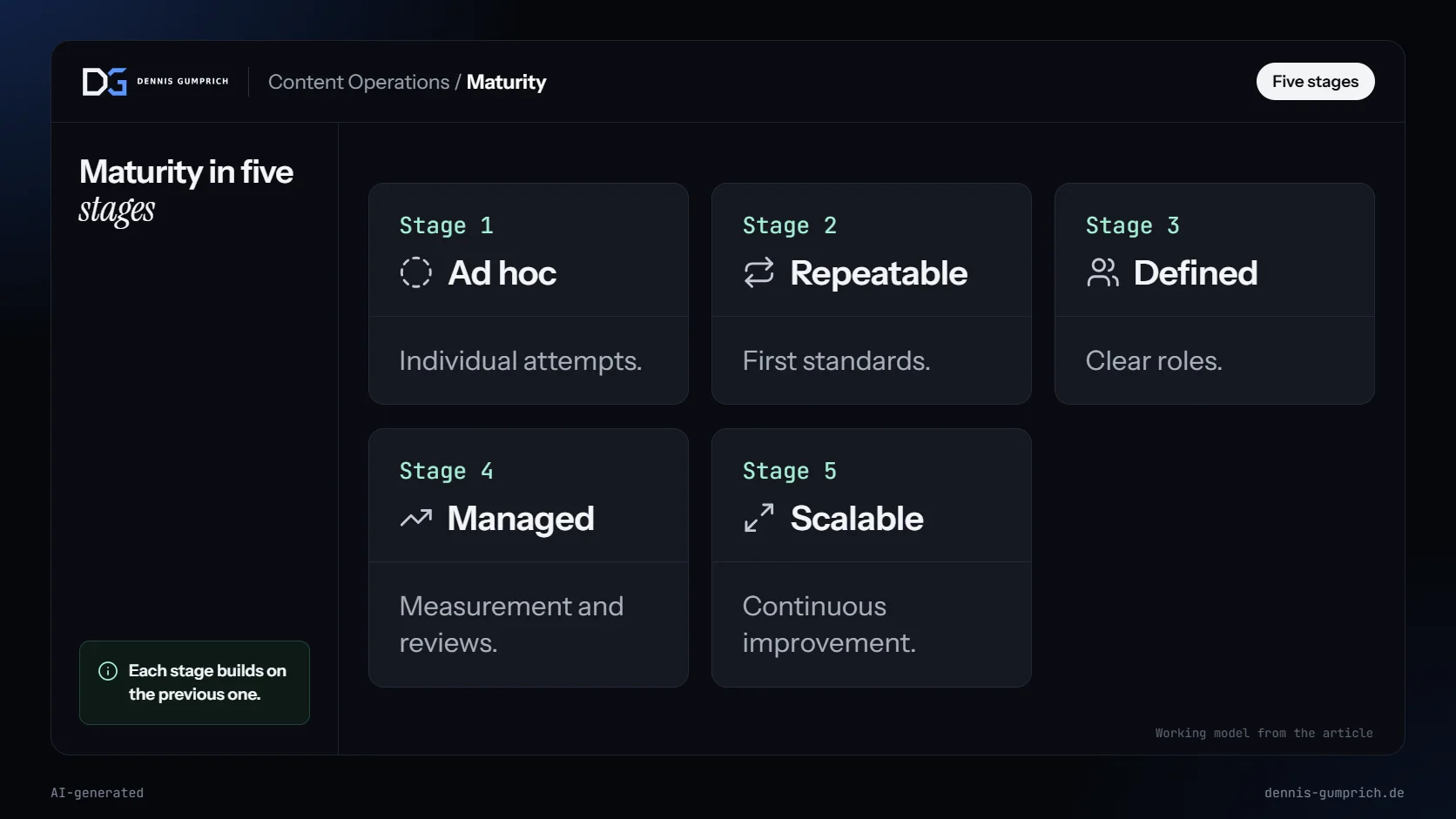
| Stage | Identifying feature | Typical bottleneck | Next step |
|---|---|---|---|
| 1 Individual actions | Everyone works alone, storage in personal folders | Knowledge depends on people | Define a shared storage location |
| 2 Shared planning | One central plan, usually a spreadsheet | Status goes out of date faster than it is maintained | Clarify status logic and ownership |
| 3 Defined process | Roles and approval routes are described | The process exists on paper, not in daily work | Map the process where the work happens |
| 4 Connected operation | Context, planning and production are linked | Evaluation does not flow back | Plan feedback in as a fixed element |
| 5 Learning operation | Insights regularly change planning | Rarely reached, high maintenance effort | Maintain rather than expand |
The most common mistake is jumping from stage two to stage four. If you introduce tools before roles and approval routes are clarified, you only map your existing disorder faster. Which skills need to be in place on the team for this is described in AI know-how in online marketing.
How do you get from stage two to stage three?
With three changes, all of which are decisions and not tools: instead of a status, a person is attached to each process. Each approval stage gets a deadline and a deputy. And the context, that is, brand voice and verified information, sits in one place everyone knows. The leap is possible without any purchase.
Most teams are at stage two: there is a shared plan, and it goes out of date faster than it is maintained. The leap to stage three is the most important in the entire model, because it is possible without any purchase.
Three changes are enough, and all three are decisions, not tools. First: instead of a status, a person is attached to each process. Second: each approval stage gets a deadline and a deputy. Third: the context, that is, brand voice and verified information, sits in one place everyone knows.
Together, these three points solve most of what teams experience as coordination effort. They cost a two-hour meeting and the willingness to stick to the decisions afterwards.
Content strategist Robert Weller sums up this idea in his article "The critical elements of a content strategy" (in German): what teams experience as a resource problem is usually a decision problem. Content governance therefore defines who decides, as a role and not a person, on what basis and by which process content is reviewed, updated or withdrawn. This is a consultant's assessment, not a survey. But it supports the sequence: first you make the three decisions, then you talk about capacity.
Do not expect an immediate effect on lead time. The first visible change is a different one: the number of follow-up questions drops, because answers are attached to the process. Only then does the time saving follow, because waiting times become plannable.
What distinguishes stage four from stage three?
At stage three, there is a process that is described. At stage four, there is a process that is lived in daily work without anyone having to remind people of it. The difference does not lie in the description but in the place. How this development plays out over five phases in a continuous example is shown in The 5 phases of AI transformation.
As long as guidelines sit in a document and the work happens elsewhere, every step requires a conscious decision to open the document. Under time pressure, that decision does not get made. That is exactly why teams with a good process manual often only reach stage three.
Stage four means that context and ownership are available where the work happens. Whether this is solved through a platform, templates in the existing system or a shared knowledge base does not matter for the classification. What matters is that nobody has to actively search. How to provide this context in a single prompt is described in ChatGPT for SEO and content marketing.
For most teams, stage four is the economically sensible target state. Stage five requires ongoing maintenance of feedback loops and only pays off at high production volumes or with several brands. From stage four onward, the first recurring workflows can also be handed over to AI agents. What they reliably take on today and where people remain is described in AI agents in the content team.
Where does AI actually take work off your hands?
In deriving and reshaping, not in writing. Creating five channel versions from an approved core piece is reliably faster and stable in quality, because the content review has already taken place. What is overestimated is finished text at the push of a button: the raw draft is created quickly, but the rework eats up the head start again.
The expectation that AI halves production time rarely holds up in practice. The robust benefit lies elsewhere.
Finished texts at the push of a button. The raw draft is created quickly, but the rework eats up the head start again when context and brand voice are missing.
Deriving and reshaping. Creating five channel versions from an approved core piece is reliably faster and stable in quality, because the content review has already taken place.
This results in a simple rule for process design: AI comes in after the content approval, not before. If you reverse the order, you end up reviewing five versions instead of one.
Five mistakes when building content operations
- Starting with the toolA tool maps what you have decided. Without decisions, it maps your lack of clarity.
- Tackling all four levels at onceThat overwhelms any team. Start where the pain is greatest, usually planning and approval.
- Describing the process without the people involvedA workflow designed at a desk is bypassed in daily work. Whoever carries it out must help shape it.
- Brand voice only as a documentA tone-of-voice description on the intranet does not get read. It needs to sit where the writing happens.
- No end date for old processesAs long as the old spreadsheet lives on, teams maintain both. Set a cut-off date.
Five steps to a robust process
- Weeks 1 to 2Record the current workflowTake three completed pieces and trace who did what and when. Not how it should be, but how it was.
- Week 3Name the bottleneckOne single bottleneck, not five. In most cases, it lies in subject-matter approval or in searching for templates.
- Week 4Clarify rolesWho creates, who edits, who approves the subject matter, who publishes. Four roles are enough to start.
- Weeks 5 to 8Store context centrallyBrand voice, target groups and recurring guidelines in one place that is accessed in the work step.
- From week 9Use AI in a targeted wayFirst for deriving from approved content. Only when that runs stably, add further use cases.
Self-check: how far along are you?
Tick everything that applies to you.
A short assessment of why our content production takes longer than planned:
The bottleneck is not the writing but coordination, approvals and searching for guidelines. These shares exist regardless of how fast an individual text is created.
I suggest we first trace our actual workflow using three completed pieces and identify one bottleneck from it. Only then do we decide on tools. Otherwise we will just map our current lack of clarity faster.
Effort: around four weeks alongside regular work, with no additional budget. The result is a basis for decision-making that holds even if we stay with our existing tools.
How you can tell it holds up
A process is not established because it has been decided. Four observations show whether it has arrived in daily work, and all four can be checked without a KPI system.
The first concerns follow-up questions. When nobody needs to ask where a topic stands anymore, the status has arrived where the work happens. This change occurs fastest, usually within a few weeks.
The second concerns absence. When a planned week of holiday no longer requires preparation and nothing gets left behind anyway, roles and cover are holding up. This is the most robust single indicator, because it cannot be faked.
The third concerns new people. When someone can accompany a complete piece in their first month without an experienced person sitting next to them, the context is sufficiently stored. As long as onboarding mainly consists of watching, the knowledge still sits in people's heads.
The fourth concerns exceptions. When the fast track is rarely used and exceptions remain exceptions, regular operations are holding up. If special cases pile up, your process describes not the actual work but a wishful state.
These four observations do not replace a maturity assessment, they complement it. Their advantage is that they stand out in daily work and do not need a meeting. If you keep an eye on them, you notice early when an established workflow starts to erode again.
Conclusion: the process decides, not the tool
AI content operations is not a product you introduce but an order you create. If you first clarify roles, context and approval routes, you can then use AI exactly where it holds up. If you reverse the order, you get faster drafts and the same waiting time as before.
Frequently asked questions
Do we need dedicated software for this?
Not necessarily. The first three steps work with your existing resources. Software becomes relevant when context, planning and production should come together in one place and the number of people involved makes coordination by message impractical.
How big does a team need to be for this to be worthwhile?
What matters is not team size but the number of people involved per piece. As soon as three or more people regularly contribute to a piece of content, coordination effort arises that can be structured.
What if our specialist departments do not cooperate?
Then the process starts with you and ends at the interface. Describe exactly what you deliver and what you need back, with a deadline. That is more effective than trying to standardize the entire workflow at once.
How do we prevent AI texts from sounding like nobody?
By making brand voice part of the work step and not a document alongside it. The second lever is the order: derivatives from an approved core piece take on its tone, free new generations do not.
How long does the setup realistically take?
Around four weeks alongside regular work for the first three steps. Experience shows it takes two to three months until context is centrally available and used in daily work. Anyone who wants to finish faster usually skips clarifying roles and falls back on it later.
Where do we start if several levels are weak?
At the lowest weak level, not the most important one. If context and planning are both at stage two, you start with context, because otherwise planning keeps making up for decisions missing there.
Do we need a dedicated role for content operations?
Rarely in teams of fewer than ten people. More important than a dedicated position is that the existing roles are clearly separated and someone is responsible for the workflow. A new position without clarified decisions changes little.
Where does your content process lose time today?
In 30 minutes, we look together at where unnecessary coordination, manual tasks, tool switching or repetitive content work cost you time today.
You get a concrete assessment of which tasks you can simplify, automate or organize better, and where AI and tools actually help instead of adding complexity.
Analyze your content process in 30 minutes Free of charge. You take away concrete starting points you can use internally right away.
Dennis Gumprich
Dennis helps marketing and communication teams fit generative AI into existing content processes without undermining quality, brand voice and approvals. Focus areas: content operations, AI governance and tool selection in mid-sized companies and corporations.
Transparency note: Dennis works for contentbird, a provider of AI-powered content software. Product mentions are marked in the article. More about Dennis (in German) · LinkedIn
Read more
Sources
- Content Marketing Institute, B2B research 2026, cited by MarketScale: 95% of B2B Marketers Use AI in 2026, But Fewer Than 4 in 10 Say It's Actually Working, July 20, 2026: 95 percent use AI, around 39 percent see an improvement in results. Accessed October 31, 2026.
- Gartner: 2026 CMO Spend Survey, press release from May 11, 2026, 401 respondents, survey January to March 2026: 70 percent of CMOs consider their internal marketing processes not yet mature enough to introduce and scale AI. Accessed October 31, 2026.
- McKinsey & Company: Past forward: The modern rethinking of marketing's core (State of Marketing Europe 2026), report from November 20, 2025, 500 marketing leaders in five European countries: 6 percent mature users of generative AI; bottlenecks mainly infrastructure, adoption, strategy and operating model. Accessed October 31, 2026.
- Bitkom: Marketing im digitalen Wandel: Lagebild der Marketingpraxis in deutschen Unternehmen 2026 (in German), study (DOI 10.64022/2026-marketing), online survey of 180 companies from the digital sector in the Bitkom network in calendar weeks 44 to 50 of 2025: internal challenges 54 percent each cost pressure and automation of marketing processes, 37 percent coordination of marketing processes, 35 percent missing AI strategy, 34 percent insufficient integration of AI. Not representative, sample from the Bitkom network in Germany. Accessed October 31, 2026.
- Robert Weller (toushenne.de): Die kritischen Elemente einer Content-Strategie (in German), article from March 30, 2026: a resource problem is usually a decision problem; five elements in three levels from analysis through synthesis to content operations; content governance defines who decides as a role, on what basis and by which process content is reviewed, updated or withdrawn. Opinion and professional article by an independent consultant who names contentbird as a project reference. Accessed October 31, 2026.
How this article was created
This article was created with the help of AI. Structure, research and draft wording were developed with AI support. Professional assessment, review of the statements and the final version are the responsibility of Dennis Gumprich. The English version was translated with AI and reviewed. Read the original German version.
How reliable are the statements?
Evidence exists for widespread AI use with rarely noticeable impact from the Content Marketing Institute figures, a lack of process maturity as an obstacle to scaled AI use from the Gartner survey, the small share of mature users and the organizational bottlenecks from the McKinsey study, as well as a missing AI strategy and insufficient AI integration as internal challenges from the Bitkom 2026 report (non-representative survey of 180 companies from the digital sector in Germany) and the idea that a resource problem is usually a decision problem from Robert Weller (article by a consultant, not a survey). The maturity model, the levels and the time periods given are explicitly marked as working models. They are based on observations from conversations with content teams and are neither an industry standard nor measured values. As of October 31, 2026.


