

AI training that only practices prompting makes teams faster, but not better.
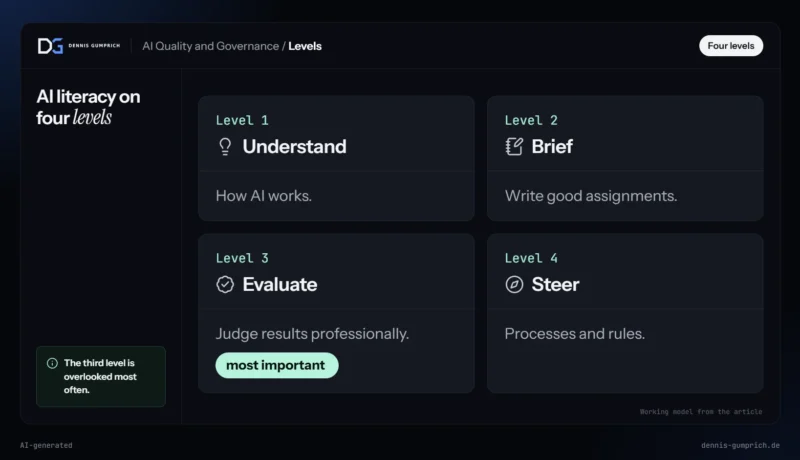
AI literacy in marketing consists of four levels: a basic understanding of how it works, briefing skills, evaluation skills and process knowledge. The third level is overlooked most often and is the most important: if you cannot judge whether a result is factually correct, you cannot use AI responsibly. Effective AI training for employees therefore combines a short foundation for everyone with practice on real tasks and fixed support in everyday work, such as prompt templates.
This article shows step by step how to build these four levels in your team, up to a 90-day plan. It starts with a question many teams underestimate: whether AI literacy is voluntary at all.
Is AI literacy legally required?
Before we get to the professional benefit, a point that has not yet reached many marketing teams. Article 4 of the EU AI Act (Regulation 2024/1689) has applied since February 2025. Originally, it obliged providers and deployers of AI systems to ensure that their staff have a sufficient level of AI literacy. Since the Digital Omnibus Regulation (EU) 2026/1744, which entered into force on July 27, 2026, the obligation is worded more weakly: providers and deployers must take measures to promote the AI literacy of their staff.
Which measures are appropriate depends on the purpose, the context and the people affected. For a marketing team that uses generative AI for text drafts, the requirements are different from those for a company operating a high-risk system.
Practical consequence: The relaxation is not a free pass. Document which measures you have taken, for example an internal training with an attendance list and content overview. That answers follow-up questions and is the basis for building competence anyway. Whether and to what extent the obligation applies to you specifically is for your legal department to clarify. This article does not replace legal advice.
Which rules, roles and training records you document internally is shown in the free template for an AI policy in marketing, including a training register.
How big is the competence gap in marketing?
Bigger than the usage figures suggest. Almost all teams use AI, but only some can evaluate the results and integrate them into processes in a way that makes them effective.
- Bitkom, February 2026: 84 percent of the companies surveyed count AI among the trends with the greatest influence on marketing through the end of 2027, putting AI at the top. At the same time, 52 percent say that marketing departments often lack the skills to use AI effectively (survey of 180 companies, not representative).
- Gartner, May 2026: Only 30 percent of marketing leaders consider their internal processes mature enough to scale AI (CMO Spend Survey 2026).
- Content Marketing Institute, 2026: 95 percent of B2B marketers use AI, but only around 39 percent see an improvement in their performance (summary at MarketScale).
The figures show the same pattern as the four levels in the next section: most people can operate the tools. What is missing is evaluation and process knowledge, meaning levels three and four.
The Trendbarometer Industriekommunikation 2026 by the German industry association bvik, an online survey of 282 participants in October and November 2025, points in the same direction. There, AI shapes all relevant B2B marketing trends. At the same time, many companies lack clear rules for using AI. The scientific supervisor, Prof. Dr. Seon-Su Kim, sees a remarkable gap between vision and implementation overall. That is exactly level four. According to the study, besides rules, it is above all skills that are missing, which is why written rules and training belong together. One limitation: it is an association survey whose results cannot simply be generalized.
Which AI skills does a marketing team need?
AI literacy is often confused with operating tools. In fact, it consists of four different skills that build on each other.
Basic understanding
Knowing that a language model calculates probabilities for word sequences and does not look things up in a database. It follows directly why it can produce convincing-sounding false statements.
Effort: a good hour. Effect: prevents most fundamental false expectations.
Briefing skills
Being able to describe a task so that it can be done without follow-up questions: role, situation, goal, assignment, example, format.
An interesting side effect: people who brief well also brief humans better. This skill pays off twice.
Evaluation skills
Being able to judge whether a result is factually correct, fits the brand and works for the target group. This is the decisive level and the one overlooked most often.
Important: this skill is subject-matter knowledge, not AI knowledge. If you don't understand your product, you can't check a product text either.
Process knowledge
Knowing where AI sits in the workflow, who approves, what must not be uploaded and how results are documented.
This level is not an individual skill, but a team agreement. It does not come from training, but from decisions.
The most common mistake in training is to train only at level 2. Prompt trainings are popular because they deliver quick wins. Without level 3, however, the result is a team that quickly produces content that nobody reliably checks anymore.
Why level three is gaining weight is suggested by the Anthropic Economic Index report: Economic primitives from January 2026. For it, Anthropic analyzed one million conversations each on Claude.ai and API transcripts from November 2025. On Claude.ai, 52 percent were augmentation, meaning work in interplay with the model, and 45 percent automation, where the task is handed off. In January 2025, the ratio was still 56 to 41 percent. Via the API, meaning in integrated applications, about three quarters were automation most recently. The more tasks are handed off instead of accompanied, the more quality depends on level three. So build evaluation exercises into every training. One limitation: it is a vendor source that only evaluates the use of Claude, and Claude itself classified the conversations. The values show a direction, not exact shares.
Who on the team needs to be able to do what?
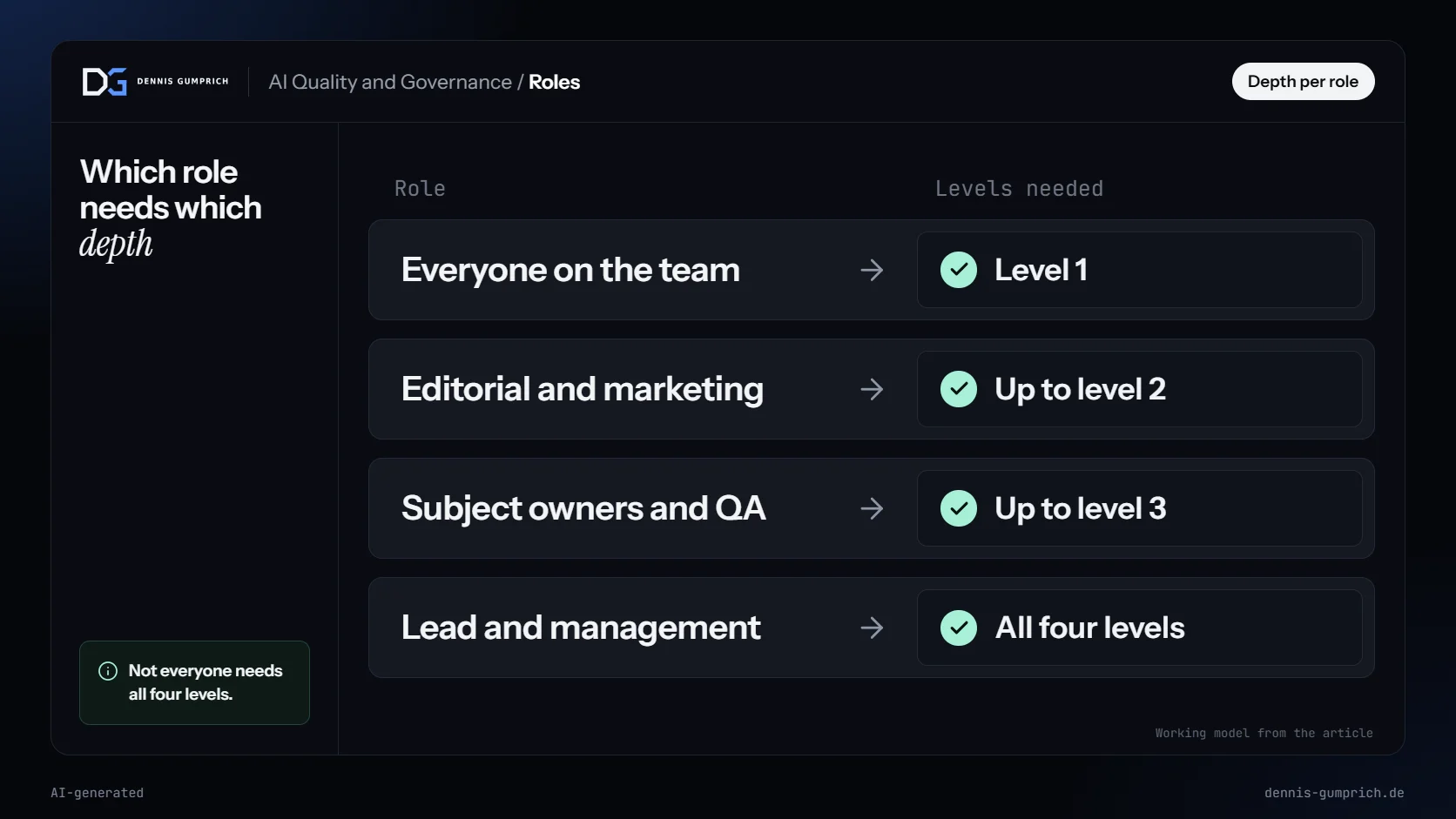
Not every role needs every level to the same depth. Content creation needs solid skills in basic understanding and briefing, while steering needs above all evaluation and process skills. Competence becomes effective when it is clear who needs to know and apply what, not when everyone learns everything.
The following matrix is a working model you can adapt to your structure.
| Role | Basic understanding | Briefing | Evaluation | Process |
|---|---|---|---|---|
| Content creation | solid | high | high | solid |
| SEO | solid | high | solid | solid |
| Specialist department as reviewer | basic | basic | high | solid |
| Head of marketing | solid | solid | solid | high |
| External partners and agencies | solid | high | solid | high |
The row on external partners is often forgotten. If your agency works with your content in its own systems, your rules only apply if you have agreed on them contractually.
Self-check: where is your biggest gap?
Tick everything that applies to your team.
How do you build AI literacy in 90 days?
With about half a day per person per month, without an external budget, tailored to a team of three to eight people. What matters is the rhythm: learning, applying and steering belong in fixed weeks, not in a one-off workshop.
The following plan is tailored to a marketing team of three to eight people and works without an external budget. It can be implemented with about half a day per person per month.
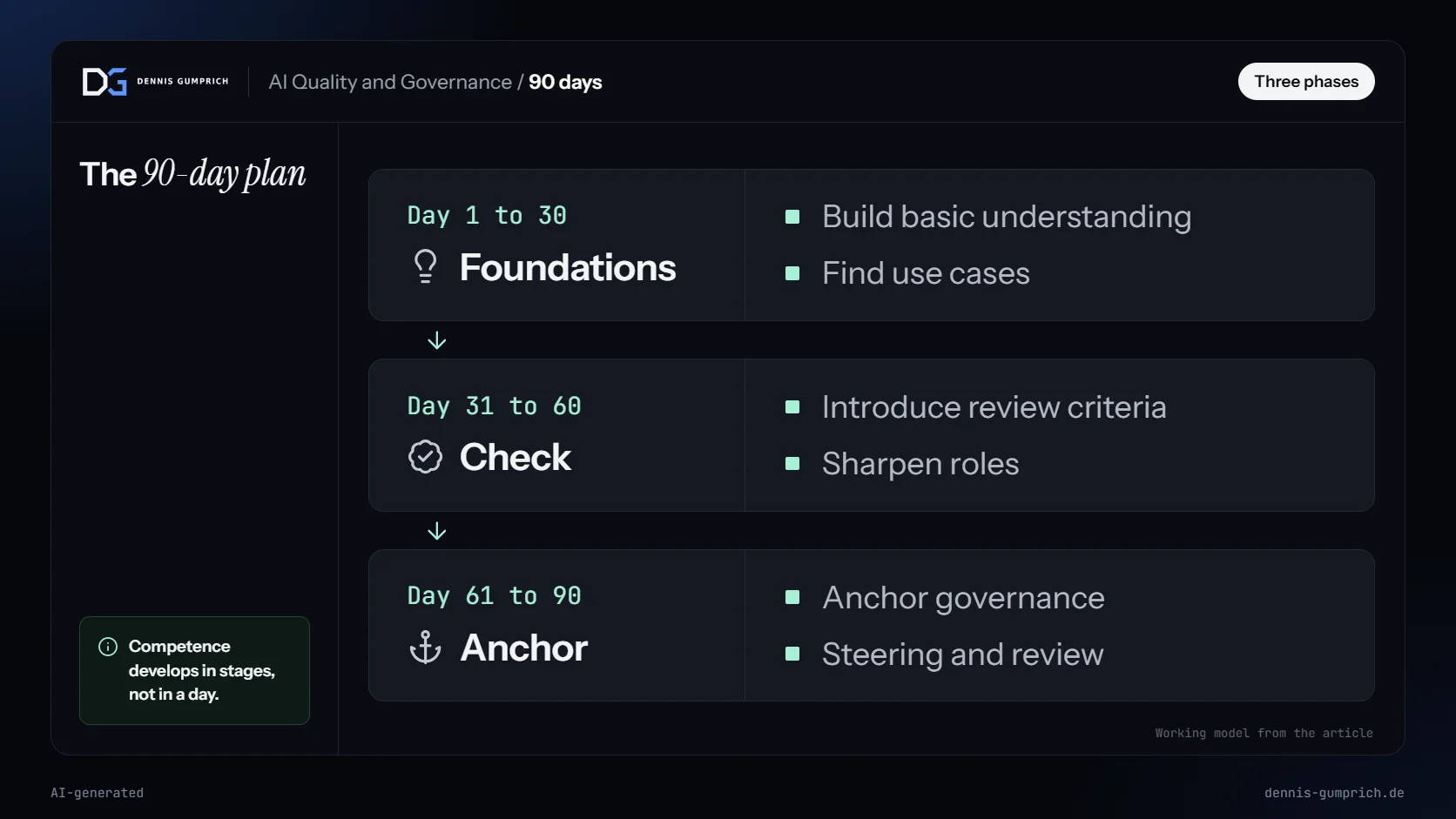
- Weeks 1 to 2Create a shared foundationA 90-minute session for everyone: how a language model works, why it invents things, what it does well and what it doesn't. Document the date, participants and content. That is also your training record.
- Weeks 3 to 4Set rules before practicingTwo pages: what AI is used for, who approves, what is never uploaded, how you handle factual statements. Without this foundation, habits form during the practice phase that you will have to correct laboriously later.
- Weeks 5 to 8Practice on a real use caseChoose a recurring task. Each person works on it once, then you compare briefings and results in the team. The comparison is the actual learning step, not the trying out.
- Weeks 9 to 10Write down evaluation criteriaHow do you recognize a usable draft? A suggestion to start: factually correct, in your language, without unsupported numbers, answers the reader's question. Four criteria are enough to begin with.
- Weeks 11 to 12Secure templates and clarify responsibilityThe best briefings go into a shared collection. For each content type, one person is named as the subject-matter reviewer. That anchors levels 3 and 4.
Subject: AI literacy in marketing, proposal for an internal approach
I suggest building AI literacy in the team in a structured way. Two reasons.
1. Legal framework. Article 4 of the EU AI Act requires deployers of AI systems to take measures to promote the AI literacy of their staff. The provision has applied since February 2025 and was amended in July 2026 by the Digital Omnibus Regulation. We should be able to document which measures we have taken. The specific interpretation for our case should be clarified with the legal department.
2. Professional reason. The level of knowledge in the team currently varies a lot. This leads to uneven quality and to results sometimes being reused unchecked.
Proposal: an internal build-up over 90 days, without an external budget.
- Weeks 1 to 2: a shared 90-minute foundation session, documented.
- Weeks 3 to 4: written definition of use cases, approval and data handling.
- Weeks 5 to 8: practice on a real use case followed by a comparison in the team.
- Weeks 9 to 12: record evaluation criteria, secure templates, name review responsibility per content type.
Effort: about half a day per person per month. Result: a documented training status, consistent templates and clear review responsibility.
What does effective AI training for employees look like?
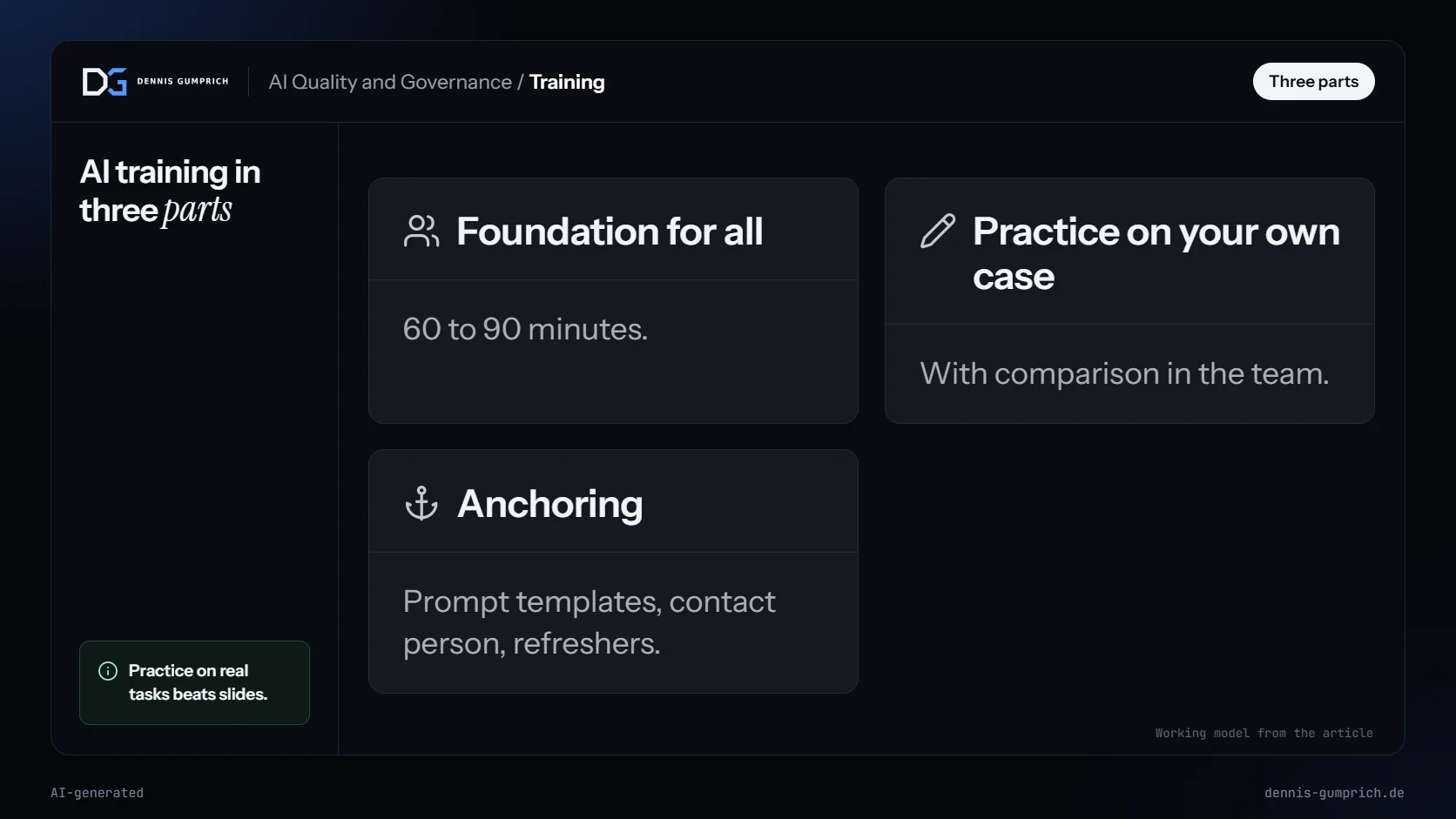
Effective AI training for employees combines three elements: a short shared foundation for everyone, practice on real tasks from their own work and fixed support afterwards, such as prompt templates and a contact person. A single workshop without this follow-up structure usually fizzles out within a few weeks.
Many companies start with a one-day workshop or an e-learning license. Both convey knowledge, but rarely change the way people work. In conversations with marketing and communication teams, the same picture emerges again and again: a few people are deep into the topic after the training and experiment a lot, others return to their old way of working after two disappointing attempts. Everyone prompts differently, and the results differ accordingly.
| Format | Suitable for | Limit |
|---|---|---|
| Foundation training for everyone, 60 to 90 minutes | Shared understanding and in-house rules, level 1 | Does not replace practice |
| Practice session on your own case | Briefing and evaluation, levels 2 and 3 | Needs prepared real tasks |
| External AI training with certificate | Entry and proof for individuals | Rarely tailored to your processes and brand |
| Office hours and exchange in the team | Clarifying everyday questions, sharing knowledge | Needs a person with fixed time allocated |
| Shared prompt templates | Consistent results regardless of skill level | Must be maintained |
Three points determine whether AI literacy training works. First, the target group: not everyone needs everything. The four levels above show who needs which depth and prevent subject-matter owners from being bored with basics and beginners from being overwhelmed with process questions. Second, the material: practice with your texts, your products and your brand voice, not textbook examples. Third, the time afterwards: providing tested templates for frequent tasks ensures that less experienced colleagues start at the same level as advanced ones. Such a collection, often called a prompt library, is the most effective follow-up to any training. How to build one is described in the article Prompt library.
Also record who took part in which measure and when, and what content was covered. That answers questions about AI literacy under Article 4 of the AI Act and shows internally where gaps remain.
The 100 AI prompts for marketing are suitable as practice material for the training: participants work with their own material and compare the results with the review criteria.
Five mistakes when building competence
- Offering only prompt trainingPrompt courses work quickly but cover only level 2. Without evaluation skills, you end up with a team that produces fast and checks slowly.
- Giving evaluation to the wrong roleFactual review needs subject-matter knowledge, not AI knowledge. If someone doesn't understand your product, they can't approve a product text, no matter how well they prompt.
- Leaving out external partnersAgencies and freelancers work with your content. If your rules are not agreed contractually, they don't apply there.
- Practicing first, setting rules laterHabits form during the practice phase. Correcting them later takes far more effort than setting them beforehand.
- Not documenting trainingA training that took place without a record won't help you in an audit. Date, participants, content, done.
Transparency note: I work as a Senior Consultant at contentbird, a provider of AI-powered content software. Platforms of this kind can map review steps and approvals and store brand voice centrally, which supports levels 3 and 4. For building competence itself, you don't need software, but time and decisions. When a system is worthwhile is covered in the article on content marketing software for teams.
When this effort is not appropriate
If your marketing consists of one person who occasionally uses AI for drafts, a 90-day program is oversized. Then two pages of usage rules and a documented onboarding are enough.
Likewise: if your team doesn't use AI at all at the moment and doesn't plan to, the competence question is not the first priority. Instead, check whether AI is being used unnoticed through private accounts, because that is exactly where the bigger risk arises.
Conclusion: evaluating matters more than operating
A team learns to operate tools in days. Reliably judging results takes longer, because it requires subject-matter knowledge and clear responsibility. That is exactly where the difference lies between a team that uses AI productively and one that creates risks with it. What briefing and evaluation look like in everyday work is shown in the article ChatGPT for SEO and content marketing. How this becomes a fixed process in the team is described in AI content operations.
Frequently asked questions
What is AI literacy?
AI literacy is the ability to use AI tools competently, evaluate their results and assess opportunities and risks. In marketing, it covers four levels: basic understanding, briefing skills, evaluation skills and process knowledge. Operating tools alone is not yet AI literacy.
Which AI training makes sense for marketing employees?
A combination of a short foundation training for everyone, practice on their own tasks and fixed support in everyday work such as prompt templates and a contact person. External trainings with a certificate are suitable as an entry point for individuals, but don't replace practice with your processes and your brand.
What does AI literacy under the EU regulation mean in concrete terms?
Since the Digital Omnibus Regulation of July 2026, the regulation requires measures to promote the AI literacy of staff, taking into account technical knowledge, experience, education and the specific context of use. There is no fixed number of hours or mandatory certificate. What is appropriate for you depends on what you use AI for and whom it affects. This assessment belongs with your legal department.
Do we need external training or is internal learning enough?
For levels 1 and 2, an internal session plus joint practice is enough in most marketing teams. External support is more worthwhile at level 4, that is, the question of how to set up usage rules, approvals and coordination with data protection and IT, because experience with comparable cases saves time there.
How do we deal with colleagues who reject AI?
First, take the rejection seriously and ask for the reason. Often there is a concrete experience behind it, such as a poor result or unclear responsibility for errors. Both are solvable problems. It also helps to deliberately put skeptical people in the evaluation role. Those who review instead of produce experience the technology as a tool, not as competition.
How often does knowledge need to be refreshed?
A fixed one-hour quarterly meeting is a practical rhythm: what has changed, which templates no longer work, which new cases have come up. More important than the frequency is that the meeting is fixed and doesn't get dropped when workloads are high.
Which AI skills does a marketing team really need?
At its core, it is about describing tasks so that an AI can do them, critically checking results, handling data and rights safely and integrating AI sensibly into your own process. Detailed technical knowledge about models is secondary for most roles. More important is recognizing where AI helps and where human judgment remains necessary.
What does tool literacy mean in AI-supported marketing?
Tool literacy describes the ability to operate AI tools safely and purposefully: knowing features and limits, choosing the right tool for a task and setting options correctly, for example regarding data protection and training. It is part of AI literacy, but it is not enough on its own, because being able to operate a tool doesn't automatically mean checking its results.
Where does your content process lose time today?
In 30 minutes, we look together at where unnecessary coordination, manual tasks, tool switching or repetitive content work cost you time today.
You get a concrete assessment of which tasks you can simplify, automate or organize better, and where AI and tools actually help instead of adding complexity.
Analyze your content process in 30 minutes Free of charge. You take away concrete starting points you can use internally right away.
Dennis Gumprich
Dennis helps marketing and communication teams fit generative AI into existing content processes without undermining quality, brand voice and approvals. Focus areas: content operations, AI governance and tool selection in mid-sized companies and corporations.
Transparency note: Dennis works for contentbird, a provider of AI-powered content software. The product mention is marked in the article. More about Dennis (in German) · LinkedIn
Read more
Sources
- European Parliament and Council: Regulation (EU) 2024/1689 on artificial intelligence (AI Act), Article 4 on AI literacy, applicable under Article 113 since February 2, 2025. Accessed October 31, 2026.
- European Parliament and Council: Regulation (EU) 2026/1744 (Digital Omnibus Regulation on AI), July 8, 2026, Official Journal of July 24, 2026, in force since July 27, 2026: Article 4 now requires measures to promote AI literacy, taking into account technical knowledge, experience, education and context of use. Accessed October 31, 2026.
- Bitkom: Marketingtrends: Unternehmen sehen KI an Spitze (in German), press release of February 12, 2026, 180 companies from the Bitkom network, survey at the end of 2025, not representative. Accessed October 31, 2026.
- Gartner: 2026 CMO Spend Survey, press release of May 11, 2026, 401 respondents, survey January to March 2026: 70 percent do not yet consider their internal marketing processes mature enough to introduce and scale AI effectively. Accessed October 31, 2026.
- Content Marketing Institute, B2B research 2026, cited by MarketScale: 95% of B2B Marketers Use AI in 2026, But Fewer Than 4 in 10 Say It's Actually Working, July 2026. Accessed October 31, 2026.
- OpenAI: Why language models hallucinate, research post of September 5, 2025 (Kalai, Nachum, Vempala, Zhang et al.): language models predict likely word sequences and therefore also produce convincing-sounding false statements. Accessed October 31, 2026.
- European Parliament and Council: Regulation (EU) 2016/679 (General Data Protection Regulation), Article 28: processing of personal data by external service providers only on the basis of a contract with defined obligations. Accessed October 31, 2026.
- bvik: Trendbarometer Industriekommunikation 2026: KI wird zum Standard, Chancen aber teilweise noch ungenutzt (in German), press release of January 13, 2026, online survey of 282 participants in October and November 2025, preceded by a workshop with 32 managers, scientifically supervised by Prof. Dr. Seon-Su Kim: AI shapes all relevant B2B marketing trends, many companies lack clear rules for AI use, according to Prof. Dr. Seon-Su Kim a remarkable gap between vision and implementation overall. Association survey, results not readily generalizable. Accessed October 31, 2026.
- Anthropic: Anthropic Economic Index report: Economic primitives, research report of January 15, 2026, sample of one million Claude.ai conversations and API transcripts each from November 13 to 20, 2025: on Claude.ai 52 percent augmentation and 45 percent automation (January 2025: 56 to 41 percent), in the API about three quarters automation. Vendor source, evaluates only Claude usage, classification by Claude, values indicative. Accessed October 31, 2026.
How this article was created
This article was created with the help of AI. Structure, research and draft wording were developed with AI support. Professional assessment, selection and review of sources and the final version are the responsibility of Dennis Gumprich. The competence matrix and the 90-day plan are marked as working models and are not an industry standard. The English version was translated with AI and reviewed. Read the original German version.
How reliable are the statements?
Documented are the start of application and the current version of Article 4 of the AI Act after the Digital Omnibus Regulation, the survey figures from Bitkom, Gartner and the Content Marketing Institute, how language models work as the basis of false statements (OpenAI) and the contractual obligation for external processing of personal data (Article 28 GDPR), as well as the lack of AI rules according to the Trendbarometer Industriekommunikation 2026 (bvik, association survey) and the shift from augmentation to automation in the Anthropic Economic Index (vendor source, Claude usage only, values indicative). The four-level model, the competence matrix, the 90-day plan and the effort figures are working models from consulting practice, not measured values. As of October 31, 2026. Legal note: this article does not replace legal advice. Whether and to what extent the obligations of the AI Act apply to you is for your legal department to clarify.


