

A sales engineer sends a LinkedIn post to the communications department for approval. It is about a trade fair day, a photo of the booth and two sentences on a new product. The draft has been sitting in the department's inbox since Monday, because the responsible person is on vacation and nobody else feels responsible.
On Friday the fair is over, the post never appears. In the next team meeting, the sales engineer says she will simply not post anything anymore. Two colleagues nod. The program that management announced in spring has thus lost three of its twelve participants.
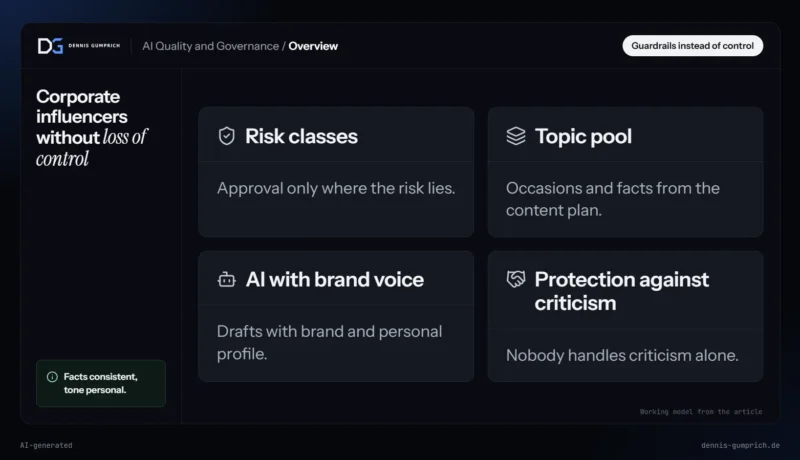
The brand voice stays consistent if you define facts and stance centrally and leave the tone to the person. Employees post voluntarily, from a maintained topic pool and with AI support that knows your brand voice. Only posts with figures, product claims, customers or company topics are approved in advance. Everything else runs on clear guardrails, spot checks and a fixed path for criticism.
What do corporate influencers bring, and what do marketing leaders fear?
Corporate influencers bring credibility that a company channel alone can hardly achieve. In a Marketagent survey of 230 marketing and communications leaders in Austria, 78.3 percent consider it more credible when employees talk about a company. The same respondents name the varying quality of posts as the biggest risk, followed by uncertainty in dealing with criticism.
The risk list from this study reads like a task list for any program. 59.1 percent cite varying quality, 46.5 percent uncertainty with criticism or shitstorms, 45.7 percent a lack of resources for support and 45.2 percent loss of control over content. 43.0 percent are unsure about legal questions. Around 40 percent of respondents say their company already uses corporate influencers, but only 10.4 percent with a structured program.
The basis for rules is thin too. Of the respondents whose company already uses corporate influencers, 39.1 percent report informal agreements, 23.9 percent clear guidelines and approval processes, 16.3 percent no clear framework. Anyone building a program or putting an existing one in order rarely starts from zero, but often from agreements that only exist in individual heads.
The trust advantage of one's own employer is also documented internationally. In the 2026 Edelman Trust Barometer with almost 34,000 respondents in 28 countries, "my employer" is the institution with the highest trust: 78 percent of employees trust their employer, while 64 percent of the population trust business in general. Employees therefore speak from a position a press release does not have. This position wears off when their posts sound like a press release.
How does the brand stay recognizable when employees post in their own voice?
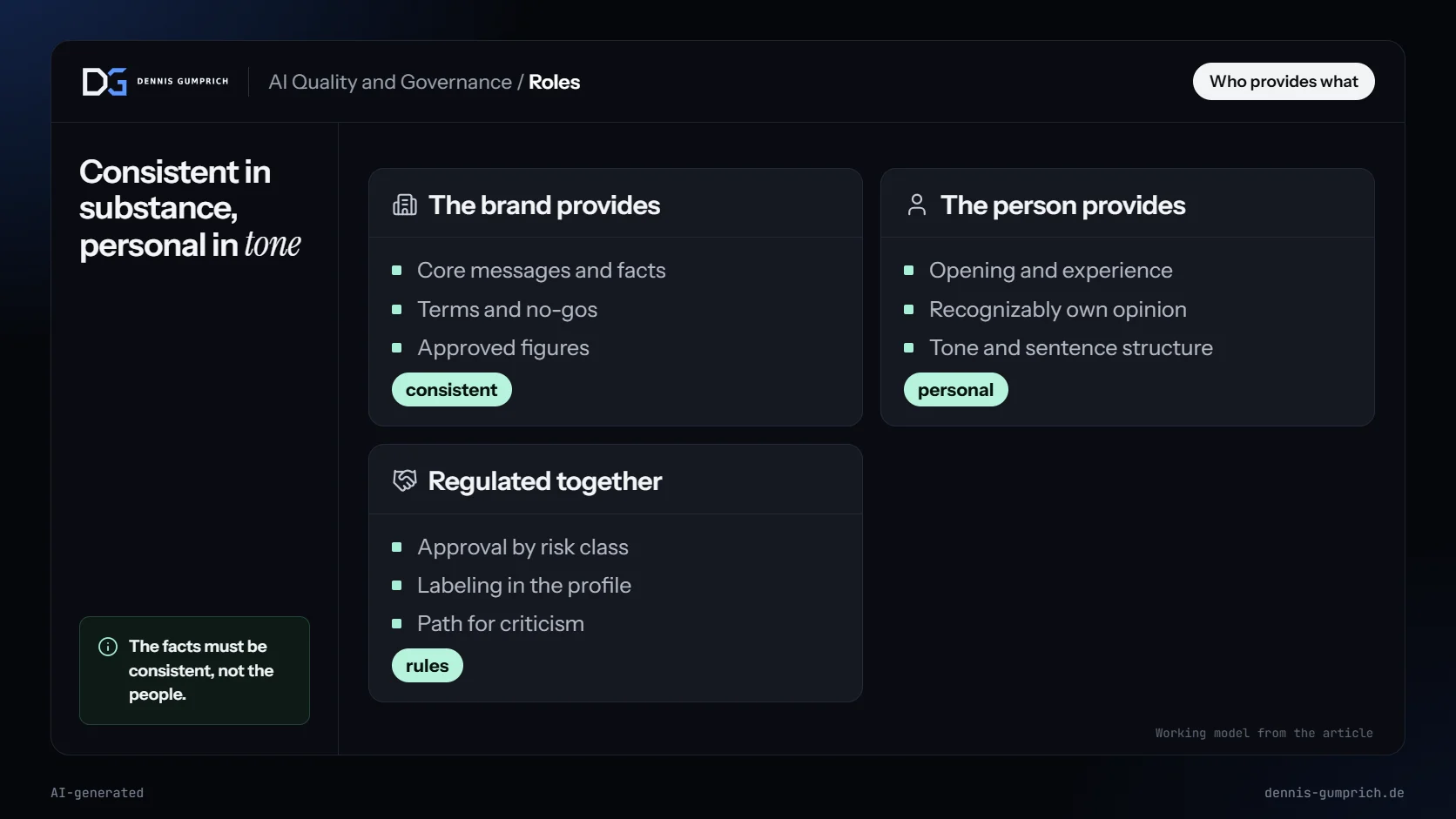
By defining what must be consistent and releasing everything else. Core messages, facts, technical terms, approved figures and the list of statements nobody makes must be consistent. The tone belongs to the person. A post by an engineer may sound different from one by HR, as long as both say the same about product, stance and company.
For the company channel you already distinguish between a constant voice and a tone per channel. How to build this framework is covered in On-brand AI content. With employees, a third level comes in: the personal voice. It is the reason people believe these posts more than the company profile, and it disappears as soon as you smooth out every sentence.
Consistency therefore does not come from identical wording but from identical content. If ten employees write about a new product, all should use the same product name, the same core message and the same figures. How they open, which experience they describe and what opinion they have remains up to them. An opinion must be recognizable as personal and must not appear as the company position.
Another argument for consistent facts comes from the discussion around AI search. Olaf Kopp, co-founder of the agency Aufgesang, describes in his guide to Brand Context Optimization from February 2026 the principle of co-occurrence: a brand should appear consistently in as many authoritative sources as possible together with the right attributes, topics and category terms, so that AI systems describe it correctly. This is a conceptual assessment from an agency perspective, hardly backed by data, and whether posts on personal profiles carry weight in this is open. For your topic pool this means: record product names, core benefit and technical terms in exactly the form in which they should appear everywhere.
Three employees write about the same product launch. Each begins with their own experience from development, sales or service. Product name, core benefit and availability are the same in all three posts.
Three employees share the same pre-written text with the same hashtags. Anyone who sees two of these posts in their feed recognizes a campaign and no longer reads the third.
How do you start a program without pressuring anyone?
With a small group of volunteers, a clear time budget and a pilot of about three months. Voluntariness is not a formality: people pushed to post write obligatory posts, and the audience notices. In Marketagent's survey of the general population, 38.2 percent fear that employees are under pressure to report positively, 29.8 percent doubt it is voluntary.
Choose the first participants by two criteria: they have something to tell that interests your audience, and they want to tell it. Experts from development, service and sales are often more suitable than executives, because they are closer to customers' concrete questions. In the Marketagent survey, 54.3 percent of marketing leaders want specialists with expert status, only 27.8 percent top executives.
Time is the second point. A program that treats posting as an extra task after hours loses its participants within a few weeks. Clarify with the respective managers how much working time is set aside for posts, comments and exchange, and put it in writing. Involve the works council early where one exists, because guidelines and measurement affect employee behavior.
- Weeks 1 to 2Clarify goal and frameworkWhat is the program's goal: visibility, employer branding or inquiries? Who supports it, and how much working time do participants have?
- Week 3Win volunteersOpen invitation instead of nomination. Six to twelve people from different areas are enough for a pilot.
- Week 4Guardrails and starter kitGuidelines, risk classes, topic pool and a short training on profile, labeling and dealing with criticism.
- Weeks 5 to 12Post and supportA fixed contact in communications, exchange every two weeks, spot checks instead of prior approval for everyday posts.
- Week 13Evaluate and decideAssess metrics, participant feedback and support effort together. Then expand, adjust or end.
Why does not every post need prior approval?
Because prior approval of all posts slows the program down and ties up the communications department without reducing the actual risk. Personal posts live on timeliness; a trade fair post three days later is worthless. The risks lie in a few topics, such as figures, customers, products and crises. These get an approval, everything else guardrails and spot checks.
Slow approvals hold communications teams back even without a corporate influencer program. In Cision's Inside PR 2026 report, 53 percent of almost 600 PR professionals surveyed in the US and the UK cite slow approval processes as an obstacle. Where your approvals lose time today and how to shorten them is described in Approval processes: why three weeks is normal. For personal profiles, there is the added fact that employees are not obliged to post at all. Every hurdle lowers participation.
| Model | Assumption | Review time per week |
|---|---|---|
| Prior approval of all posts | 20 posts with 15 minutes of review each | 300 minutes (5 hours) |
| Approval by risk class | 16 posts in class A without prior review, 3 posts in class B with 5 minutes each, 1 post in class C with 15 minutes, plus 2 spot checks with 5 minutes each | 40 minutes |
| Difference | per week | 260 minutes (4 hours 20 minutes) |
| Difference | at 45 working weeks | 195 hours per year |
The calculation example assumes 20 participants with one post per week each. The wait time for employees is not yet included, and in daily work it is often the bigger loss. What the saved time is worth in your case you can work through with your own hourly rates in the ROI calculator (in German).
Which approval rules apply to which risk class?
A working model with four classes covers most cases. Everyday posts and expert opinions run without prior approval. Company topics get a quick check by communications. Figures, product claims and customer names need approval by the responsible department. Crises, ongoing proceedings and insider knowledge do not belong on personal profiles.
| Class | Examples | Rule |
|---|---|---|
| A: everyday life and expert opinion | Impression from a conference, experience from a project without customer names, comment on an industry topic | No prior approval. Spot checks afterwards with feedback to the person |
| B: company topics | Sharing a job ad, trade fair presence, new location, award | Quick check by communications on facts and terms, answer on the same working day |
| C: figures, products, customers | Revenue or performance figures, product comparisons, customer names, reference projects | Approval by the responsible department, for customers their consent in advance |
| D: not via personal profiles | Crises, ongoing legal disputes, unpublished business figures, personnel decisions | Communication only via official channels. Employees may share official posts, but not comment on or add to them |
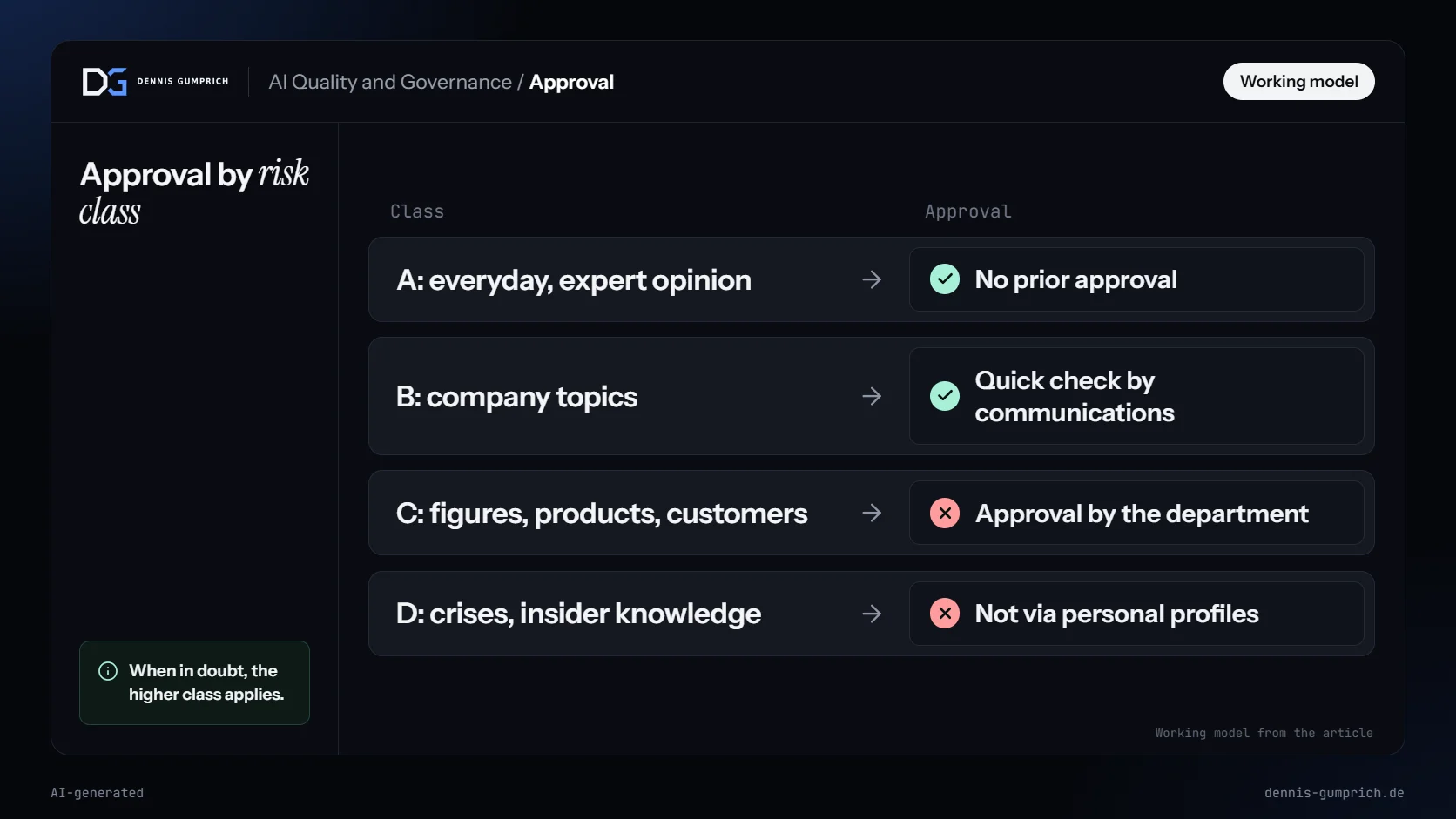
The classes only work if employees can assign them themselves. So write three to five examples from your daily work for each class, not abstract categories. And set a simple rule for doubtful cases: when unsure, take the higher class. In industries with special obligations, such as listed companies, pharma or financial services, the legal or compliance department belongs in the definition of classes C and D.
Classes B and C need a path that does not depend on a single person. Name at least two contacts in communications and a deputy in the department. The scene at the beginning of this article shows what happens when that is missing.
Where do topics and templates for employees come from?
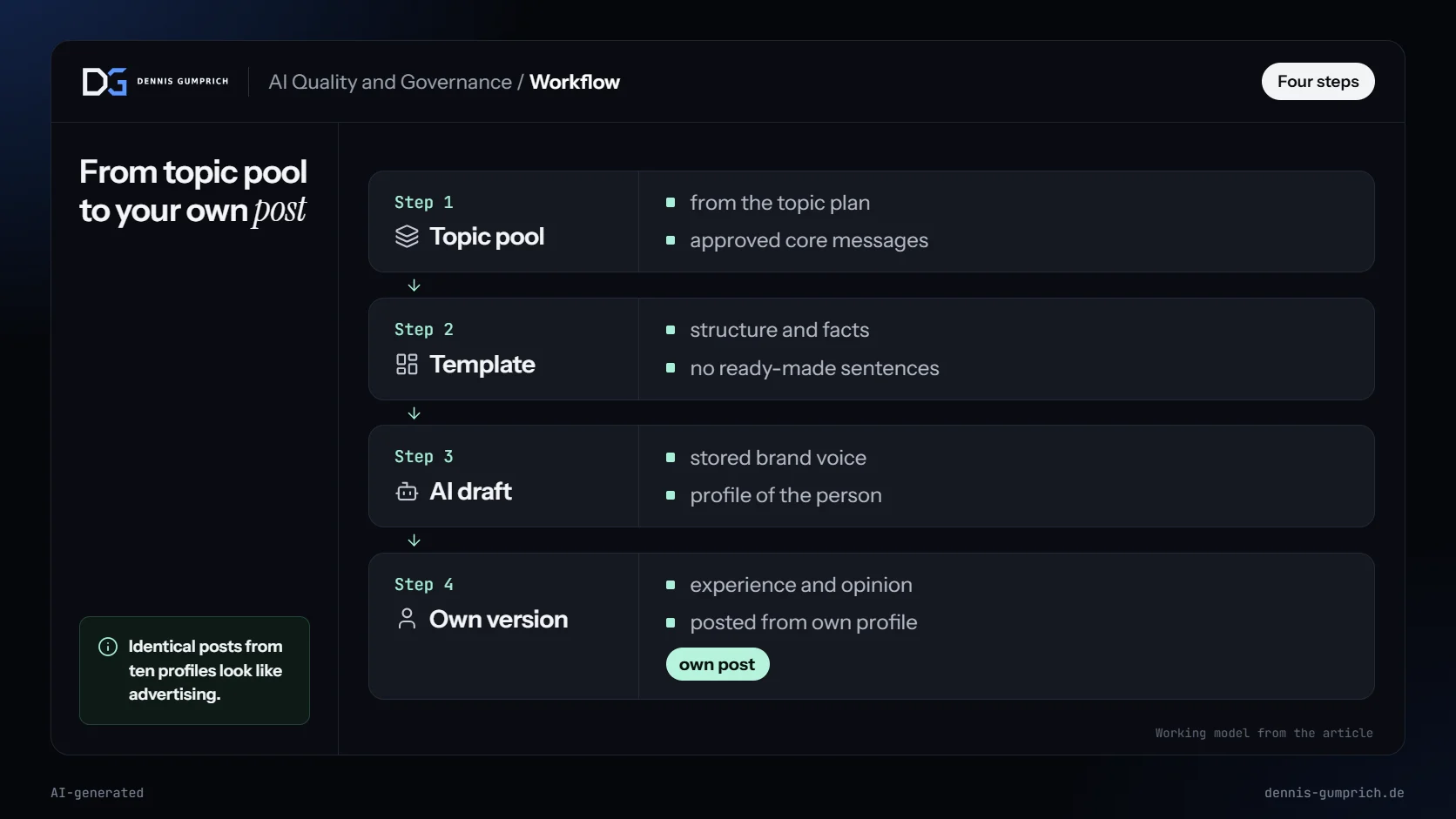
From your existing content process. What is in the topic plan for website, newsletter and company channel also provides occasions for personal posts. A topic pool collects these occasions with the approved core messages, figures and links. Employees choose what fits their role and add their own experience.
The topic pool is not a separate editorial plan but a view of the existing one. If you plan topics instead of individual dates, as described in From editorial plan to topic plan, this view comes almost as a by-product. Each entry contains the occasion, the core message, approved figures, the link to the main content and the risk class. That way employees know without asking whether they can post directly.
Templates help as long as they provide structure rather than ready-made sentences. A good template describes the structure, for example experience, insight, link to the topic, question to the network, and names the facts that must be right. A bad template is a pre-written post to copy. How to derive several formats from one core piece is covered in AI and multichannel strategy. The same logic applies to personal profiles, just with an additional voice per person.
How does AI help without everyone sounding the same?
With two levels of context. The first level is your stored brand voice: terms, core messages, exclusion list and facts from the topic pool. The second is a profile per person with role, subject areas and typical writing style, ideally derived from their own earlier posts. The AI then delivers a draft that the person completes with their own experience and opinion.
Without this second level, AI drafts quickly converge. If ten employees use the same tool with the same instruction, you get ten posts with similar openings, similar phrasing and similar length. That is exactly the "varying quality" in reverse: uniform, but arbitrary. How to store brand voice so that an AI can apply it is described in Storing brand voice.
Three rules have proven themselves. First: the AI may provide structure, facts and phrasing help, but not invent the experience. What someone experienced, the person writes themselves. Second: the draft is checked against the facts from the topic pool, not against gut feeling. You find review criteria for this in Review criteria for AI texts. Third: the tool must be approved for use with company content. Private AI accounts for work content create a data protection problem that no program justifies.
Whether and how AI support in personal posts has to be labeled is a separate question. For mostly self-written posts with AI phrasing help, the situation differs from fully generated content. How to arrive at a robust practice is covered in AI labeling: how to arrive at a robust practice.
What belongs in social media guidelines for corporate influencers?
Little text, many examples. Good guidelines fit on two pages and answer seven questions: what may I write about, what is off-limits, when do I need approval, how do I make my employment visible, how do I deal with criticism, who helps me, and what applies to photos and data of other people. Everything else belongs in a training.
| Building block | What it contains |
|---|---|
| Goal and voluntariness | Why the program exists, that participation is voluntary and can be ended at any time |
| Topics and taboos | Examples of welcome topics, the risk classes and the list of what does not belong on personal profiles |
| Approval path | Who reviews classes B and C, how fast, and who deputizes |
| Visibility of the employer | Employer in the profile, note on posts about products and offers, handling of incentives |
| Confidentiality and data | No internal figures, photos of colleagues and customers only with their consent, no screens in the background |
| Criticism and escalation | When to answer, when not, when to hand over to the social media team, whom to call in an emergency |
| AI use | Which tools are approved and what the AI should not write |
The guidelines protect both sides. They show the company where the limits are and give employees certainty that they are free within those limits. Keep them short and revise them after the pilot with the participants' experience. Questions asked several times belong in them as examples.
When do employees have to make clear that they are communicating commercially?
When the commercial purpose of a post is not already apparent from the context. In the EU, the Unfair Commercial Practices Directive treats failing to identify the commercial intent of a commercial practice as a misleading omission, unless it is already apparent from the context. Germany, for example, implements this in § 5a(4) of its Act against Unfair Competition (UWG), with the added condition that the omission is likely to cause a business decision that would otherwise not have been taken. Whether that applies to a specific post is a question of the individual case and of national law in your markets.
For practice, a cautious rule can be derived that your legal department should confirm. The employer is shown in the profile, so the employment relationship is recognizable to every reader. For posts promoting products, offers or campaigns of one's own company, the connection is also made clear in the post itself, for example with a phrase like "at our company" or an explicit reference to the employer. Expert opinions without product reference are usually less critical.
Incentives are particularly sensitive. If employees receive additional bonuses, benefits in kind or competition prizes for posts, the risk rises that a post counts as hidden advertising. The audience expects openness here anyway: in the Marketagent survey, 83.0 percent of the population consider it important to disclose whether employees are additionally paid or incentivized for advertising. Those who use incentives should therefore disclose them or do without them.
How do you protect employees when criticism or a shitstorm comes?
With a clear commitment: nobody has to answer criticism of the company alone on their own profile. Factual questions about their own expertise the person answers if they want to. Criticism of the company, complaints and hostility they pass on to the social media team, which answers via the company channel or advises the person. In the case of personal attacks, the manager stands behind the person.
This commitment needs a concrete path, otherwise it remains a sentence in the guidelines. Define through which channel employees report a critical comment, who reviews it within what time and who decides whether and how to answer. For comments on your company channels, Social inbox: answering comments and messages centrally describes how responsibility and response times are organized. Personal profiles usually do not run through such an inbox, so they need the reporting path.
| Situation | What the person does | What the company does |
|---|---|---|
| Factual question on the expert topic | Answers personally if they want to | Contact in communications helps when unsure |
| Criticism of the company or a product | Does not debate the substance, briefly refers to the official contact and reports the comment | Social media team reviews on the same working day and answers via the company channel |
| Personal attack or harassment | Does not answer, saves a screenshot and reports | Supports with blocking, reporting to the platform and further steps |
| Situation that looks like a crisis | Pauses all posts on the topic | Company channel takes over, participants briefly learn what they may share |
Also plan for the case that a person leaves the company. The profile belongs to them, and so do the contacts. Make clear at the start that the program relies on personal reach and creates no claim to profiles, contacts or posts. That saves awkward conversations later.
How do you know whether the program pays off?
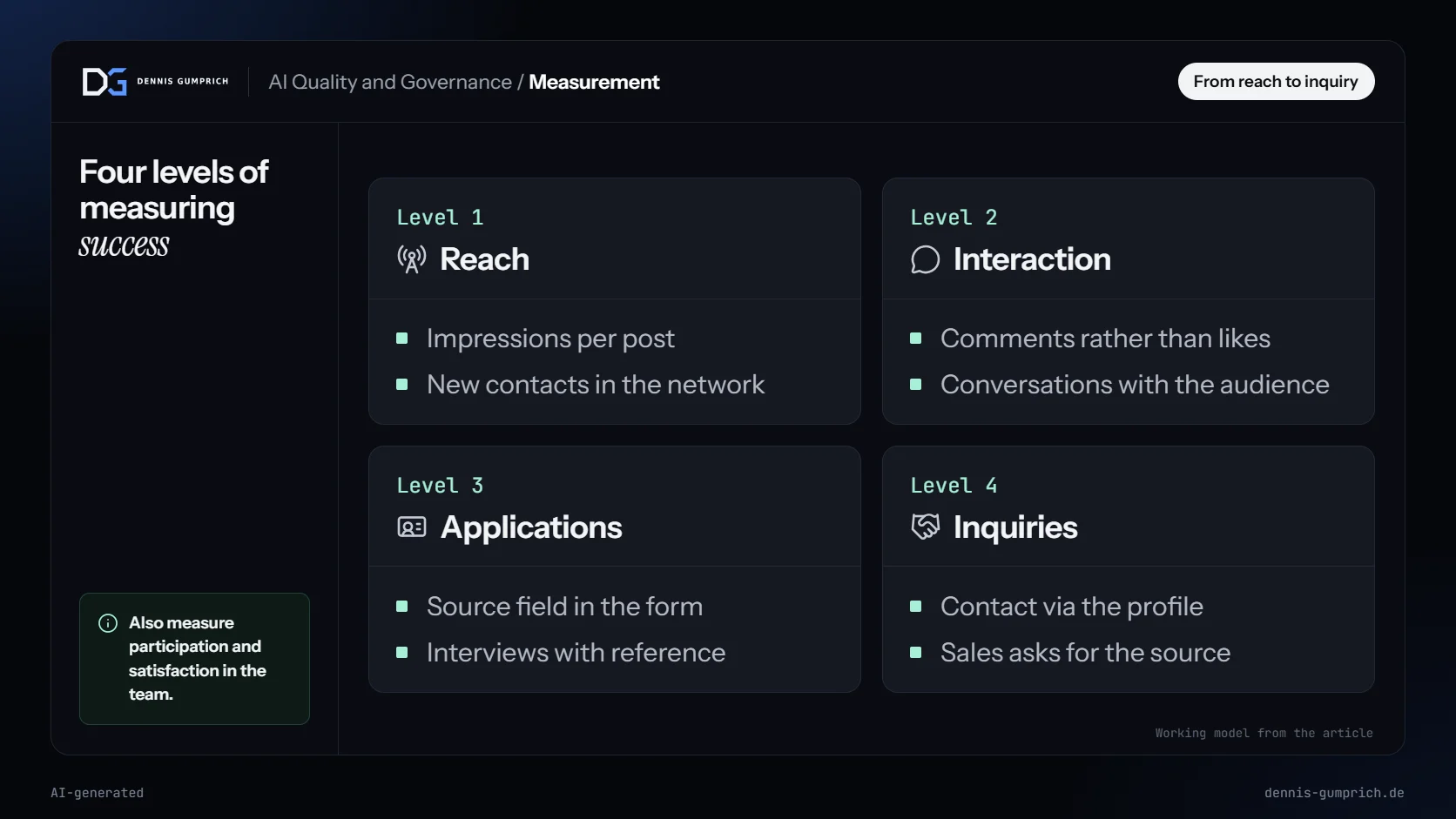
By four levels leading from the visible to the commercial: reach, interaction, applications and inquiries. The first two show whether posts are seen and discussed. The last two show whether something comes of it that counts for HR and sales. According to Marketagent, around a third of companies with corporate influencers do not yet measure systematically.
In the study, of the respondents whose company uses corporate influencers, 52.2 percent say they measure reach, 48.9 percent engagement. 33.7 percent cite no systematic success measurement. A small set is enough for a pilot if you collect it from day one. For applications and inquiries you need a source, for example a field in the application form or a question in sales' first conversation.
| Level | Metric | Where the data comes from |
|---|---|---|
| Reach | Impressions per post, network growth of participants | Platform statistics, reported monthly by participants |
| Interaction | Comments per post, share of comments from the audience | Platform statistics, sample of commenters |
| Applications | Applications referring to a person or a post | Source field in the application form, question in the interview |
| Inquiries | Contact requests and conversations referring to a person or a post | Question in the first conversation, note in the CRM |
| Program | Active participants, support effort, satisfaction | Short survey after the pilot, time recording in communications |
Do not measure participants against each other. Rankings by reach create exactly the pressure the audience fears, and reward volume instead of substance. Evaluate the program as a whole and talk to individuals about their experiences, not their numbers. How to prepare results so that management can make a decision with them is described in Proving content impact.
Five mistakes in corporate influencer programs
- Ordering participationPeople who have to post write obligatory posts. Voluntariness is a prerequisite for credibility and protects the program from the accusation of pushing employees forward.
- Approving every post in advanceThat costs time on both sides and robs posts of their timeliness. Approvals belong to classes B and C, not to everyday posts.
- Handing out ready-made texts to copyIdentical posts from many profiles look like advertising. Provide facts and structure, not finished sentences.
- Leaving employees alone with criticismWithout a reporting path and backing, one bad comment is enough for someone to stop for good.
- Starting without a goal and measurementWithout a baseline and a source for applications and inquiries, all that remains after three months is a feeling. That cannot defend a budget.
Disclosure
I work for contentbird. There, AI personalities with role, writing style, subject areas and tone can be set up for the AI assistant to use when writing, as well as workflows with tasks per status, for example for approving class C posts. Whether that fits your program depends on how you organize topic pool, approval and posting. The principle in this article also works with other tools.
Self-check: how robust is your corporate influencer program?
Tick everything that applies to you.
A short assessment of our corporate influencer program:
Posts by employees are considered more credible than corporate communications. The biggest risks are uneven quality, uncertainty with criticism and loss of control. Approving every post in advance does not solve this, it only slows participation.
Proposal: a three-month pilot with six to twelve volunteers. Approval only for posts with figures, products, customers or company topics. A topic pool from our content plan provides the facts, employees write themselves. The social media team takes over when criticism comes.
We measure reach, interaction, applications and inquiries with a source and decide after the pilot on expansion or ending.
Conclusion: guardrails instead of control
A corporate influencer program does not lose control because employees post in their own voice. It loses control when nobody has defined which facts apply, which topics need approval and what happens with criticism. Clarifying these three points lets you do without prior approval of every post and gain speed, participation and credibility in return. How approval and brand voice are regulated in the rest of content operations is shown in What is content operations?
The brand voice stays consistent because the content comes from the same topic pool and the same stored brand voice goes into the AI drafts. The tone stays personal because the final version lies with the person. Start small, with volunteers and a clear pilot, and measure from day one what counts for HR and sales.
Frequently asked questions
How many corporate influencers does a company need?
Six to twelve people from different areas are enough for a pilot. More important than the number is that participants are there voluntarily, have something to tell and get time for it. A small, active group achieves more than a large one that only shares company posts.
May we give employees ready-made texts to post?
You may, but it hurts the effect. Identical posts from many profiles look like a campaign. A topic pool and template with structure and facts work better, from which each person writes their own text, ideally supported by an AI that knows your brand voice.
What happens if a person posts a mistake?
For class A posts, the contact in communications clarifies the mistake directly with the person; usually a correction or an additional comment is enough. What matters is that mistakes do not end participation. Collect recurring mistakes and add them to the guidelines as examples.
Should executives be part of the program?
Yes, if they want to, but not as an obligation and not in the lead role. Executives help mainly by enabling working time for the program, supporting their team's posts and standing behind their employees when criticism comes. For many audiences, specialists are the more credible senders.
Do employee posts belong in the editorial plan?
The occasions yes, the individual posts no. The topic pool is a view of your topic plan; employees decide themselves when and whether to post. Only class B and C posts that need approval run through a fixed workflow with responsibility and deadline.
Where does your content process lose time today?
In 30 minutes, we look together at where unnecessary coordination, manual tasks, tool switching or repetitive content work cost you time today.
You get a concrete assessment of which tasks you can simplify, automate or organize better, and where AI and tools actually help instead of adding complexity.
Analyze your content process in 30 minutes Free of charge. You take away concrete starting points you can use internally right away.
Dennis Gumprich
Dennis helps marketing and communication teams fit generative AI into existing content processes without undermining quality, brand voice and approvals. Focus areas: content operations, AI governance and tool selection in mid-sized companies and corporations.
Transparency note: Dennis works for contentbird, a provider of AI-powered content software. Product mentions are marked in the article. More about Dennis (in German) · LinkedIn
Read more
Sources
- Marketagent in cooperation with the Austrian Marketing Society: Corporate Influencer*innen. Vom Flurfunk zur digitalen Markenstimme (in German), press charts, February 2026. Part 1: 230 marketing decision-makers and communications professionals in Austria, online survey from September 30 to November 28, 2025. Part 2: 1,000 people from the Austrian population aged 14 to 75, representative, online survey from December 17 to 22, 2025. Accessed October 31, 2026.
- Edelman: 2026 Edelman Trust Barometer: Society Slides into Insularity, press release from January 18, 2026, almost 34,000 respondents in 28 countries, online survey from October 23 to November 18, 2025. Accessed October 31, 2026.
- Cision: Inside PR 2026 (press release in German), press release from January 6, 2026, almost 600 PR professionals in the US and the UK. Accessed October 31, 2026.
- Official Journal of the EU: Directive 2005/29/EC (Unfair Commercial Practices Directive), Article 7(2): failing to identify the commercial intent of a commercial practice, if not already apparent from the context, as a misleading omission. Accessed November 26, 2026.
- German Federal Ministry of Justice, Federal Office of Justice: § 5a Act against Unfair Competition (UWG), misleading by omission (in German), in particular paragraph 4, statutory text, as an example of national implementation. Accessed October 31, 2026.
- Olaf Kopp, Kopp Online Marketing: Brand Context Optimization: A Practical Step-by-Step Guide, guide from February 26, 2026: principle of co-occurrence, placing the brand consistently in as many authoritative sources as possible together with the right attributes, topics and category terms, so that AI systems describe it correctly. Conceptual assessment from the perspective of the agency Aufgesang, hardly backed by data. Accessed October 31, 2026.
How this article was created
This article was created with the help of AI. Structure, research and draft wording were developed with AI support. Professional assessment, review of the statements and the final version are the responsibility of Dennis Gumprich. The English version was translated with AI and reviewed. Read the original German version.
How reliable are the statements?
Backed by sources are the figures on credibility, risks, prevalence, rules, measurement, preferred profiles and public expectations from the Marketagent study, which refers to Austria and can only serve as an indication for other markets. Also backed are trust in one's own employer by the 2026 Edelman Trust Barometer, slow approvals as an obstacle by the Cision report, which comes from a PR software vendor, the requirement to identify commercial intent under the EU Unfair Commercial Practices Directive and the wording of § 5a(4) UWG as a German example of implementation, and the principle of naming a brand consistently with the right attributes in authoritative sources so that AI systems describe it correctly by Olaf Kopp's guide (conceptual assessment from an agency perspective, hardly backed by data). The risk classes, pilot workflow, guideline contents, reporting path for criticism and metrics are working models from consulting practice, not collected measurements. The values on posts, review minutes and time saved are a calculation example. The remarks on labeling reflect the legal texts and a cautious practical rule and are not legal advice. Legal status and status as of October 31, 2026.


