
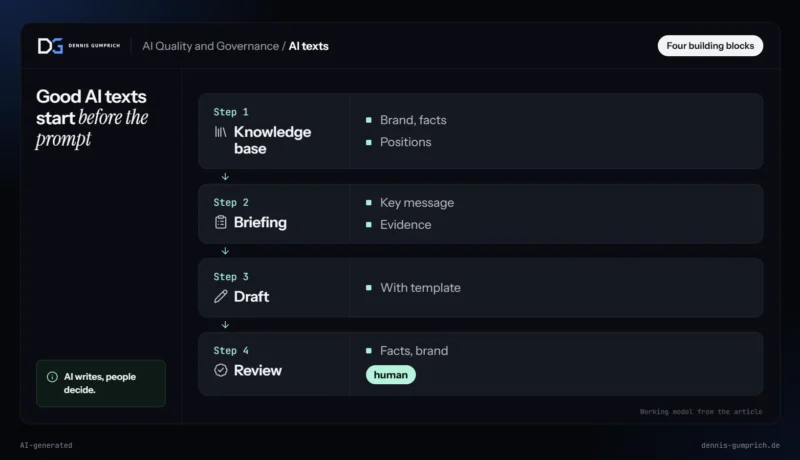

The working student has written ten blog posts in one day with a free AI tool. The head of marketing reads the first one and nods. With the third, she notices they all start the same way. In the fifth, she finds a figure that exists nowhere.
In the end, none of the texts is wrong enough to throw away, and none is good enough to publish as it is. The revision takes longer than the writing.
You can have AI write your texts in three ways: yourself with a chat tool, as a team with an enterprise assistant or a content platform, or externally through an agency or copywriters who work with AI. Which way fits depends less on price than on three questions: how many texts you need, how much expertise they contain and who reviews them before publication. Google explicitly allows AI content if it is helpful and recommends reviewing it before publication. On every route, that review stays with you.
Can you have AI write your texts?
Yes. AI tools deliver usable drafts for blog posts, product texts, social media posts or newsletters in minutes. They are rarely ready for publication without revision, because they lack your knowledge and because they can make mistakes.
In its guidance for site owners, Google describes generative AI as useful for research and structure. It becomes a problem when many pages are created without added value. That can violate the spam policies. Google also reminds readers that language models do not retrieve facts but predict a likely sequence of words. That is why all AI content should be reviewed before publication, including titles, meta descriptions and alt texts.
Why AI texts sound interchangeable without context and what a good prompt framework looks like is shown in Writing SEO texts with ChatGPT. This article is about the question before that: which route do you use to have AI write your texts in the first place?
Which ways are there to have AI write your texts?
Three: yourself with a chat tool, as a team with an enterprise assistant or a content platform, or externally through an agency or copywriters using AI. They differ above all in where your knowledge sits and who reviews.
| Route | Fits when | Limit |
|---|---|---|
| Yourself with a chat tool | Individuals, few texts, little subject depth | No shared brand knowledge, data protection often unclear with free versions |
| As a team with an enterprise assistant or content platform | Several people involved, recurring text types, approvals in house | Needs a maintained knowledge base and an introduction |
| Externally through an agency or copywriters with AI | Absorbing peaks, formats you rarely need, missing capacity in the team | Expertise and brand voice have to be handed over, the review stays with you |
Many teams end up with a mix: recurring text types are created in house, peaks and special formats go outside. What matters is that both routes write from the same knowledge base. Otherwise the agency text sounds different from your own, and the alignment eats up the time saved. Whether an approved enterprise assistant is enough for marketing is discussed in Copilot is approved. Is that enough for marketing? How to check tools for data protection is covered in GDPR-compliant content marketing software.
- The mixed model is the most common. The team writes with AI itself, the agency takes over special cases. A health insurer with four content people uses a paid ChatGPT account with a stored brand voice, while social media and medical specialist texts go to agencies.
- Often the tools grow, not the process. The head of content at an online retailer works with ChatGPT, Gemini, Neuroflash and a company AI in parallel. The internal AI is hardly used.
- "Everyone for themselves within the team" fails most often. Quality depends on who prompts how. Teams themselves name exactly this inconsistency as a risk, even when the brand voice is stored in ChatGPT.
- The agency also fails if it only delivers volume. An online marketing team of seven finds that agency content repeats itself and the internal effort to steer it grows. Because of fluctuating quality, the company is now building its own AI with a glossary.
How do you know which route fits you?
By three questions: volume, subject depth and review capacity. The more texts, the more expertise and the more people involved, the more the team route pays off.
- Volume. If you need a handful of texts a month, an approved chat tool is enough. If you regularly need many texts of the same type, you benefit from templates and a shared knowledge base.
- Subject depth. The more product knowledge, figures and positions a text needs, the more expensive every handover to outsiders becomes. Specialist texts are therefore usually better created where the knowledge sits.
- Review capacity. AI and agencies shift work from writing to reviewing. If nobody checks facts and brand before approval, you save time on none of the three routes.
- Use an agency if it brings expertise you lack internally. A pharma supplier works with a specialized healthcare agency that interviews experts. Internally, subject matter experts and legal review. The agency delivers expertise, not just text.
- Use an agency for volume work nobody wants to do internally. The same online marketing team deliberately keeps community management outsourced: high volume, around 90 percent recurring answers.
- Use an agency for special cases of execution, for example at a university that cannot book paid campaigns itself without its own credit cards.
- Avoid it when several agencies work side by side. Separate agencies for social media and ads lead to duplicate work, content that cannibalizes itself and slow approvals.
- Avoid it when the agency only writes standard texts. A team with AI and a shared knowledge base now handles this work itself.
What do you need to clarify beforehand on every route?
Four building blocks, no matter who writes: a knowledge base, a briefing per text, tested templates and a checklist for the review. With an agency, this means you hand over knowledge base and briefing instead of just naming a topic.
| Building block | Content | Maintained by |
|---|---|---|
| Knowledge base | Brand voice with examples, product facts, target groups, positions, banned terms | Head of content |
| Briefing | Key message, target group, evidence, format, length | Editorial team per text |
| Prompt templates | Tested instructions per text type | Editorial team, centrally |
| Review checklist | Facts, sources, brand voice, legal | Editorial team before approval |
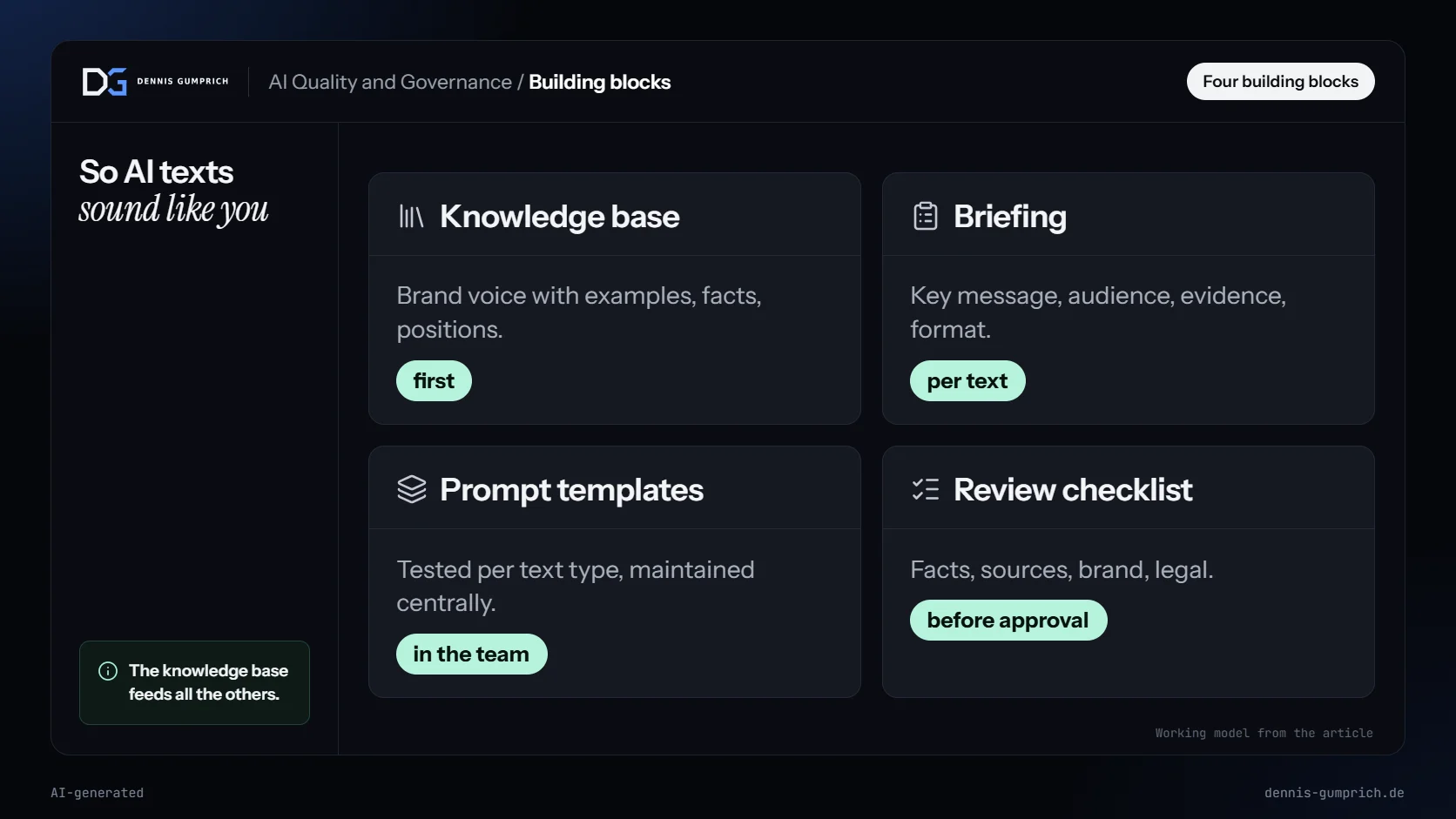
How to build these building blocks in detail is described in On-brand AI content, Building a knowledge base and Storing brand voice. For prompt templates there is the prompt library.
How does writing with AI work in a team?
In six steps in which human and machine take turns: briefing, loading context, draft, fact check, style and brand, approval. AI writes, people decide and review.
- HumanWrite the briefingKey message in one sentence, target group, two to three pieces of evidence, format. Without a key message, AI writes about the topic instead of answering the question.
- SystemLoad contextKnowledge base and the matching prompt template are passed along, not typed in again each time.
- AICreate the draftOutline first, then text. You check the outline before the text is written.
- HumanCheck factsEvery figure, every name, every claim needs a source. Anything without one is removed.
- Human and AIStyle and brandRemove typical AI patterns, add your own examples, check brand voice.
- HumanApproveSubject matter approval of the key statements, then publication with your labeling rule.
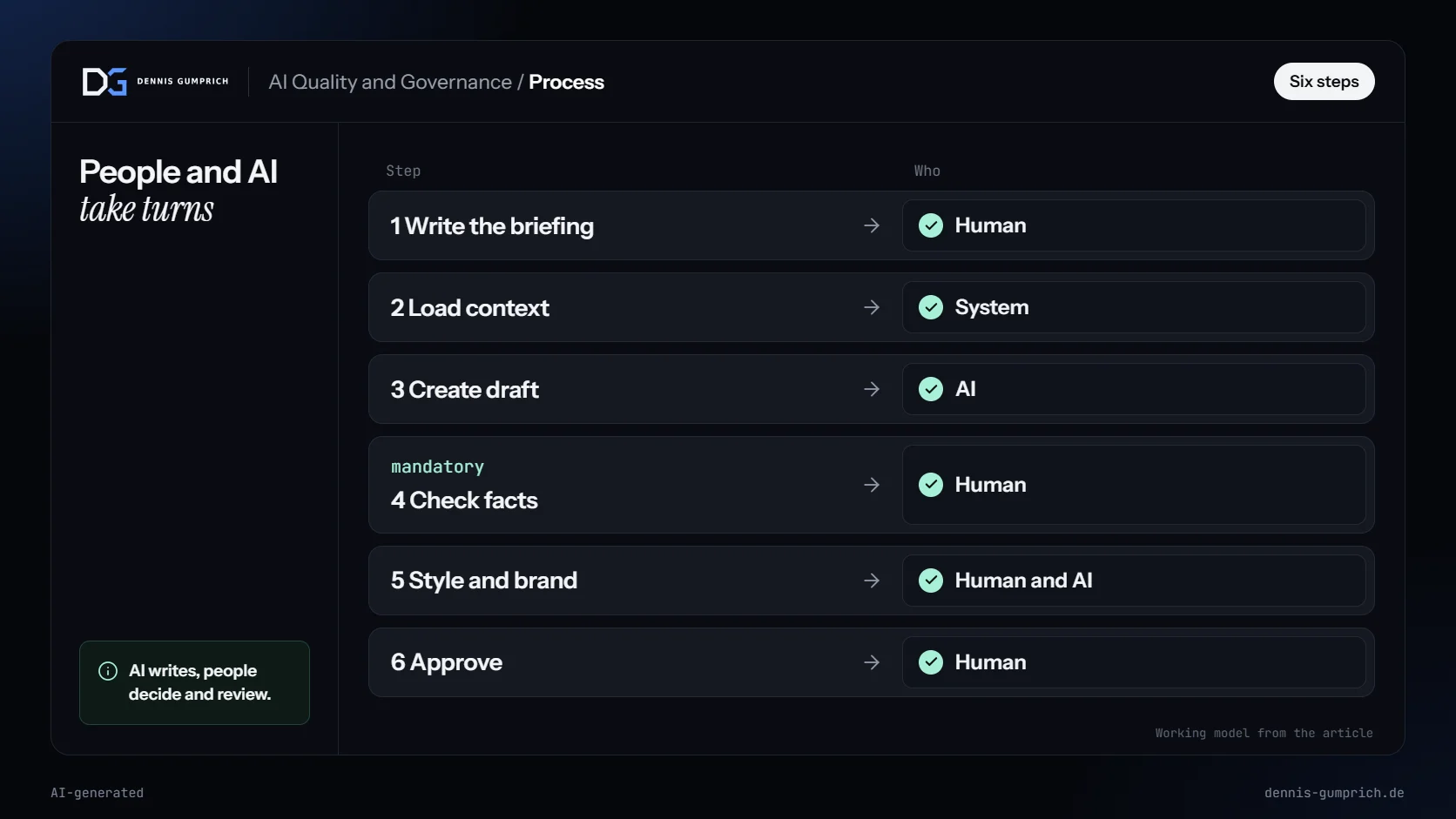
If an agency writes, it usually takes over steps two to five. Briefing and approval stay with you, and you should not hand over the fact check completely: errors in figures and product details ultimately fall back on you. The review criteria for steps four and five are covered in detail in Review criteria for AI texts.
Without brand voice, reference texts and review rules, effort shifts from writing to reviewing: every draft ends up in a loop with the department or legal. In regulated industries, this effort is so high that AI does not write at all. The international product marketing of a pharma supplier uses AI only for summaries, because of prohibited wording, claims that require evidence and several review rounds. A manufacturer of food supplements knows the same loops for health claims.
With a knowledge base, review becomes plannable: prohibited wording and evidence requirements can be stored as automatic checks before a text goes to approval.
Do AI texts have to be labeled?
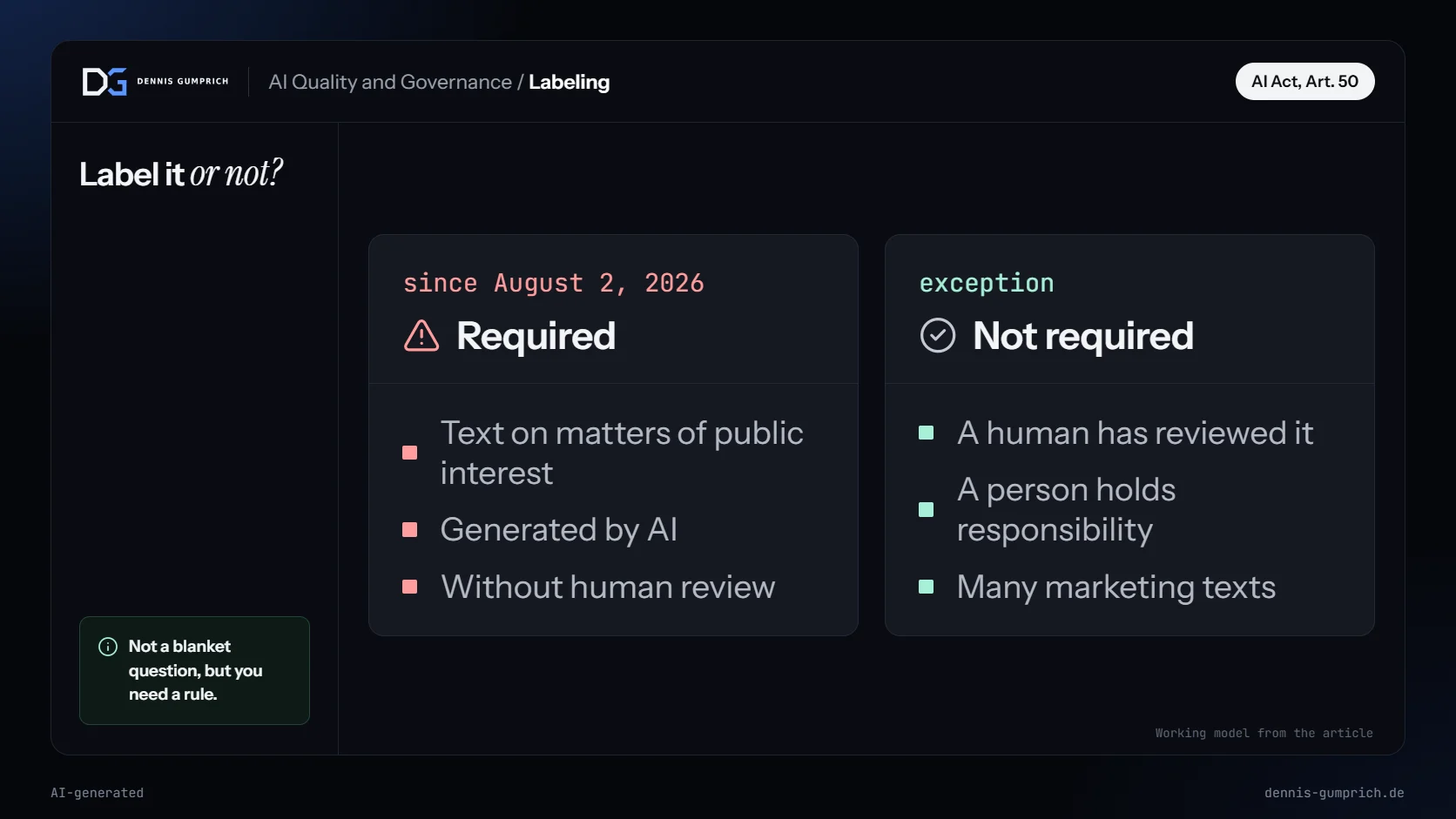
Not across the board. Since August 2, 2026, the EU AI Act requires labeling for AI-generated texts that are published to inform the public on matters of public interest. The obligation does not apply if a human reviews the text and a person holds editorial responsibility.
According to data protection specialists, many marketing texts are unlikely to fall under this rule. This also applies when an agency writes: what matters is who reviews and takes responsibility. In addition, the rules against misleading advertising apply, and Google recommends informing readers about the use of automation. A documented rule of your own therefore makes sense. How to arrive at a robust practice is described in AI labeling: how to arrive at a robust practice. This section is not legal advice.
Five mistakes when having AI write
- Choosing the route by priceThe cheapest text becomes expensive if revising it takes longer than writing it.
- Handing over only a topicWhether chat tool or agency: without a knowledge base and briefing, you get the average of all texts on the topic.
- Adopting figures without checking themLanguage models predict words, not facts. Every figure needs a source, including in agency texts.
- Volume instead of valueMany pages without added value can violate Google's spam policies and damage the brand.
- No rule for review and labelingIf you do not define who reviews and who is responsible, you discuss it anew with every text.
Self-check: are you ready to have AI write your texts?
Tick everything that applies to you.
A short assessment of how we have AI write our texts:
There are three routes: ourselves with a chat tool, as a team with an assistant or a content platform, or externally through an agency using AI. Which fits depends on our text volume, the subject depth and our review capacity, less on price.
I suggest we define four things regardless of the route: a knowledge base with brand voice and product facts, a briefing per text, shared templates and a rule for review and labeling. Then we decide which text types we write in house and which we hand over.
Conclusion: the route is secondary, the preparation is not
Whether you have AI write your texts yourself, as a team or through an agency is a question of volume, subject depth and review capacity. Whether they sound like your brand and are correct is decided the same way on all three routes: in the knowledge base, in the briefing and in the review before approval. Once that is clarified, you can choose the route per text type and switch later without starting from scratch.
Frequently asked questions
Can I have AI write texts for free?
For private or one-off purposes, yes. For companies, free tools are often problematic because data protection and the use of entered data are unclear and brand knowledge is missing.
Is it worth having an agency write AI texts?
For peaks, special formats and missing capacity, often yes. For specialist texts with a lot of product knowledge, the handover usually costs more time than the agency saves. In both cases the agency needs your knowledge base and a briefing, and the review stays with you.
Does Google detect AI texts and penalize them?
According to Google, it evaluates quality, not how content was created. Many pages without added value are problematic, as they can violate the spam policies.
Do AI texts have to be labeled?
Under the EU AI Act, only texts that inform the public on matters of public interest and are not reviewed by a human and editorially controlled. Many marketing texts are unlikely to fall under this. A transparency rule of your own still makes sense. This is not legal advice.
How much time does writing with AI save?
A lot in the draft, less across the whole process, because alignment and approval often take longer than writing. Where the time really goes is shown in Nine hours per article.
Where does your content process lose time today?
In 30 minutes, we look together at where unnecessary coordination, manual tasks, tool switching or repetitive content work cost you time today.
You get a concrete assessment of which tasks you can simplify, automate or organize better, and where AI and tools actually help instead of adding complexity.
Analyze your content process in 30 minutes Free of charge. You take away concrete starting points you can use internally right away.
Dennis Gumprich
Dennis helps marketing and communication teams fit generative AI into existing content processes without undermining quality, brand voice and approvals. Focus areas: content operations, AI governance and tool selection in mid-sized companies and corporations.
Transparency note: Dennis works for contentbird, a provider of AI-powered content software. Product mentions are marked in the article. More about Dennis (in German) · LinkedIn
Read more
Sources
- Google Search Central: Google Search's guidance on using generative AI content on your website, documentation as of October 1, 2026: generative AI useful for research and structure, mass production without added value can violate spam policies, models predict word sequences instead of retrieving facts, review of all AI content including titles, meta descriptions and alt texts, transparency about automation. Accessed November 7, 2026.
- Dr. Datenschutz, intersoft consulting services: KI-Texte: Was gekennzeichnet werden muss und was nicht (in German), article by a German data protection consultancy from February 26, 2026: labeling obligation under Article 50(4) AI Act from August 2, 2026 for texts on matters of public interest, exception for human review and editorial responsibility, classification of marketing texts, reference to unfair competition law. Accessed November 7, 2026.
- European Commission, AI Act Service Desk: Article 50: Transparency obligations for providers and deployers of certain AI systems, wording of Regulation (EU) 2024/1689, in particular paragraph 4 on AI-generated text published to inform the public. Accessed November 26, 2026.
How this article was created
This article was created with the help of AI. Structure, research and draft wording were developed with AI support. Professional assessment, review of the statements and the final version are the responsibility of Dennis Gumprich. The English version was translated with AI and reviewed. Read the original German version.
How reliable are the statements?
The statements on Google come from the official documentation, the legal classification from an article by data protection consultants and the wording of Article 50 of the EU AI Act; they are not legal advice. Building blocks, process, tool types and the list of mistakes are working models from consulting practice with marketing and communications teams in 2026, not collected measurements.


