

of citations in AI answers come from unpaid sources, a large share of them from journalism and editorial media.Source: Muck Rack
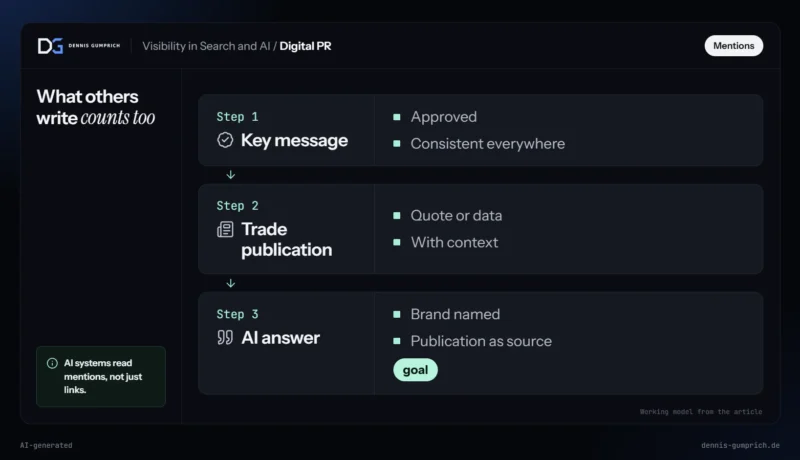
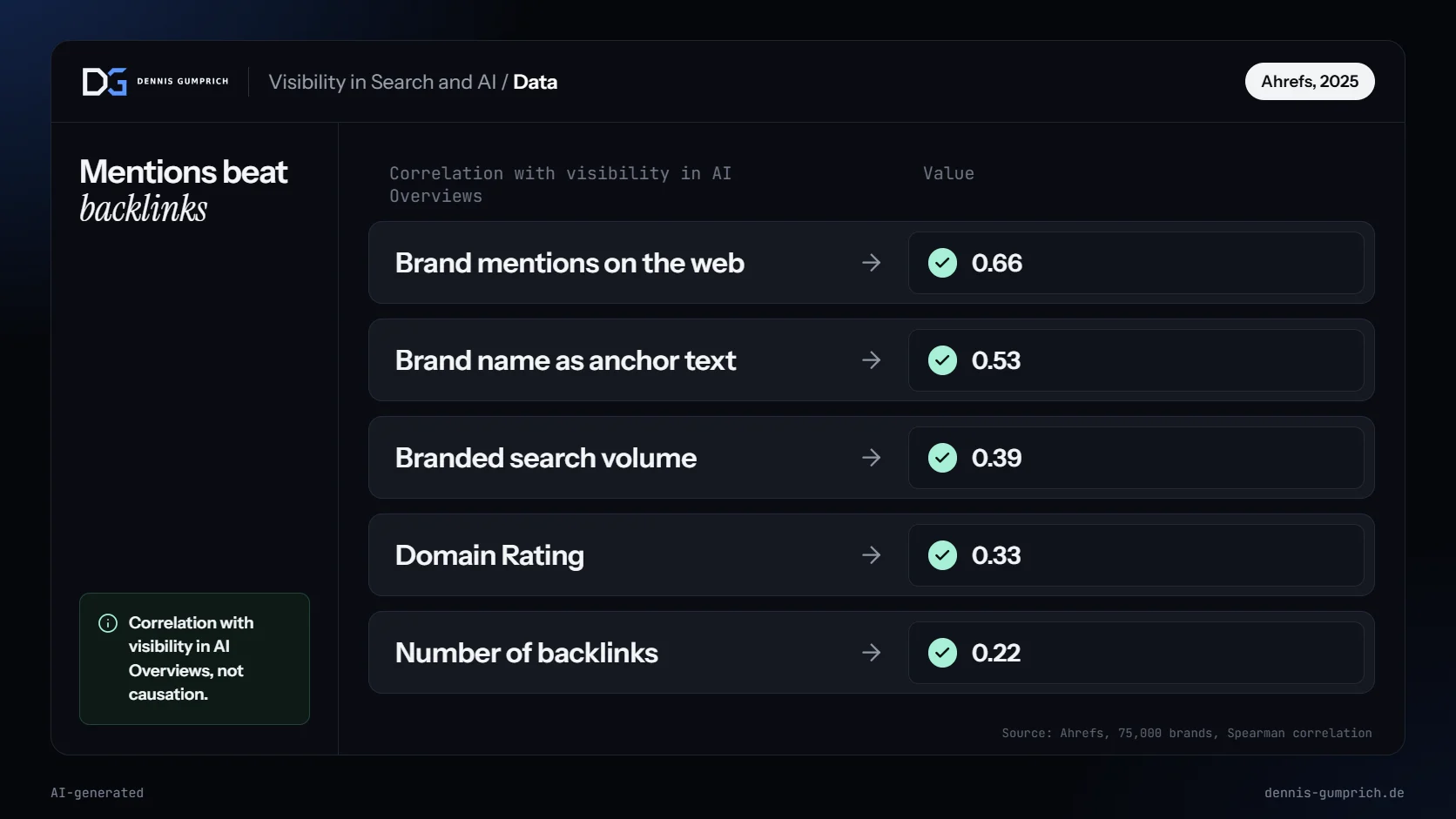
Digital PR is media relations aimed at being mentioned in online media. For visibility in AI answers, these mentions count more than many teams assume. In an Ahrefs analysis of 75,000 brands, brand mentions on the web were much more strongly associated with visibility in AI Overviews than backlinks. If you connect PR and your content process, you win twice: better media relations and more mentions in AI answers.
What is digital PR?
Digital PR is media relations that deliberately works toward mentions in online media: trade portals, news sites, industry magazines, association websites and podcasts. For a long time, the backlink was considered the most important result. With AI search systems, the mention itself moves to the center, with or without a link.
The reason is simple: AI systems read texts, not just links. If a trade portal writes that your company solves a certain problem well, an assistant can adopt that statement and name the portal as the source. Your brand then appears in the answer, even if not a single line links to your website.
Why do mentions count for AI visibility?
Because AI answers rely mainly on independent sources, and because brands that are written about a lot are named more often. Two analyses show this clearly, both with limitations.
In 2025, Ahrefs compared the visibility of around 75,000 brands in AI Overviews with various metrics. The strongest association was with brand mentions on the web, with a correlation value of 0.664. Backlinks came in at 0.218. The author herself stresses that correlation does not prove causation and that the study only covers AI Overviews.
In July 2025, Muck Rack analyzed millions of links from answers by ChatGPT, Gemini and Claude. More than 95 percent of citations came from unpaid sources, 85 percent of them from editorial, or "earned", mentions. Journalistic sources accounted for 27 percent, and half of all answers contained at least one such source. Muck Rack itself sells PR software, and the methodology is only roughly described. Still, the direction is clear: what others write about you ends up in the answers.
Which mentions work?
Mentions in sources that AI systems already draw on for your topic, with a clear statement about you. A quote with context in a trade magazine has more effect than ten entries on random press release portals.
| Type | Example | Effect on AI visibility |
|---|---|---|
| Trade article with a quote | Expert quote in an industry magazine | High, if the publication is cited on the topic |
| Study or data analysis | Your own survey, picked up by media | High, because figures are readily adopted |
| Comparison or overview | Vendor list on a trade portal | High for category questions |
| Associations and committees | Membership, working group, guideline | Medium, strengthens your standing as an expert |
| Podcast or webinar | Conversation with transcript | Medium, depends on the transcript |
| Press release portal | Press release in a distribution list | Low, no independent statement |
You don't have to guess which media matter for your topic. If you measure your AI visibility with a prompt set, you can see which third-party sources are cited most often in the answers. That list is your target media list. How to collect it is described in Measuring AI visibility.
Bought or artificially generated mentions are no substitute. Google writes in its guide to generative search that deliberately seeking artificial mentions helps less than it seems, because the systems rely on high-quality content and filter out spam.
How do you connect PR and the content process?
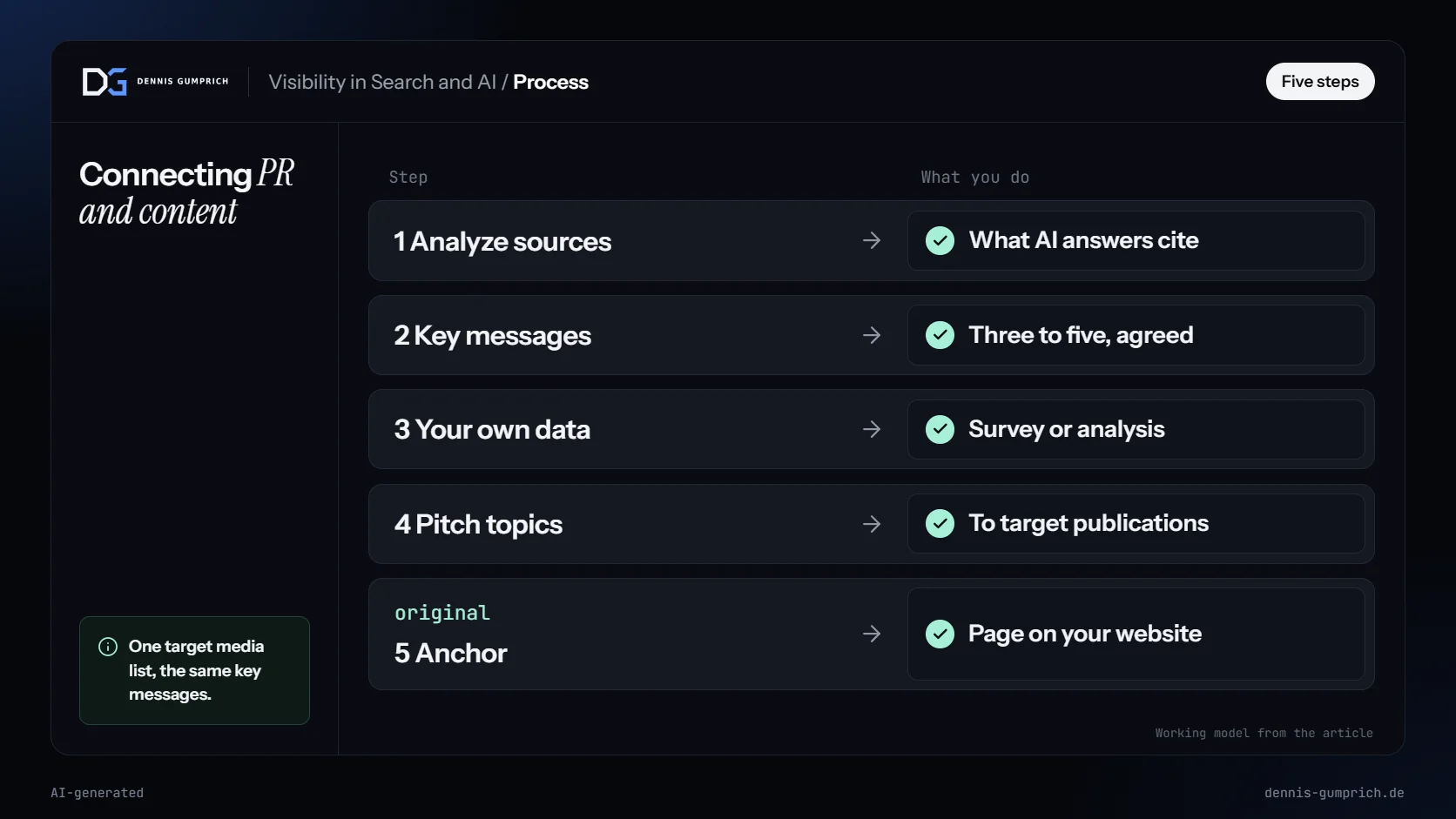
Through shared key messages, a shared target media list and your own data. The content team delivers substance, PR brings it into the media that AI systems cite. Both use the same approved statements.
- Step 1Analyze cited sourcesThe prompt set shows which media and portals are drawn on for your questions.
- Step 2Agree on key messagesThree to five statements you phrase the same way in every interview, every press release and every article.
- Step 3Create your own dataA small survey, an analysis from projects or a benchmark gives media a reason to write about you.
- Step 4Pitch topicsPR offers the target media guest articles, quotes and data that match the questions in the prompt set.
- Step 5Anchor it on your own websiteEvery study and every key message also has a page on your site, so media and AI systems find the original source.
How to speed up media relations with AI without publishing errors is described in Media relations with AI. How a newsroom brings PR and content together organizationally is covered in Corporate newsroom.
In the companies I work with, PR and content tend to operate separately. At a retail group with more than 100 locations, PR and marketing have their own strategies, personas and goals. What they want there is separate workspaces with a shared overview.
What do press releases do for AI visibility?
Quite a lot as a source on your own website, little as a mass entry on press release portals. What matters is whether media pick up the release and write about it with their own assessment.
A press release is a self-description. AI systems can use it as a source for facts, such as data, names and dates, if it is easy to find on your website. It only works as a recommendation once an independent publication picks it up. So write press releases with a clear key message in the first sentence and at least one figure or assessment that is new to editors.
How do you measure PR's contribution to AI visibility?
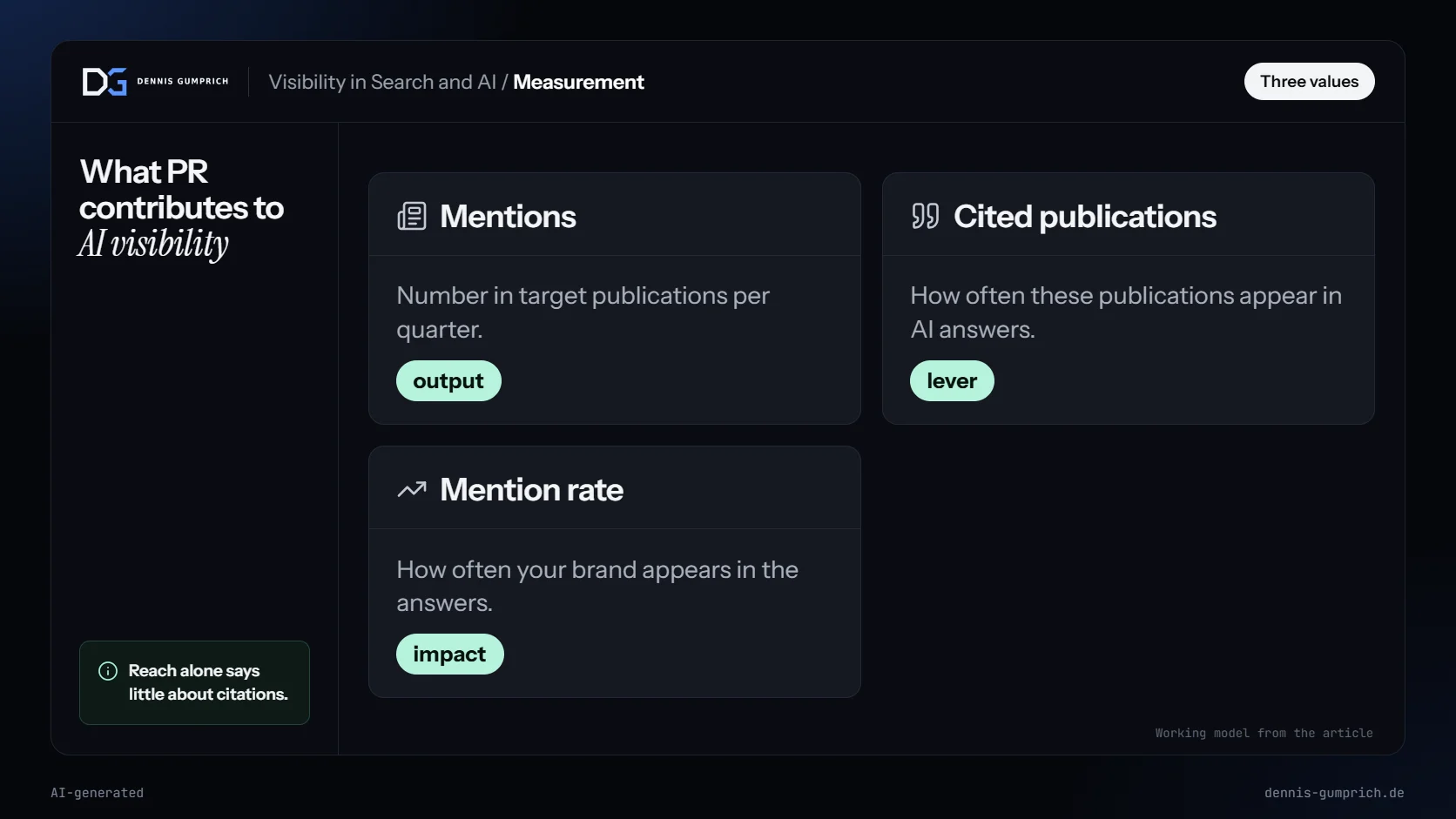
With three values: how many mentions you achieve in target media, how often these media are cited in AI answers to your prompt set and how your mention rate in these answers develops.
Classic PR metrics such as reach or advertising value equivalency say little about this. An article on a small trade portal that appears in every second AI answer on your topic can be worth more than a high-reach story that is never cited. This view also helps in budget discussions, because it connects PR work with measurable impact. More on reporting in Visibility without clicks.
Five mistakes in digital PR for AI visibility
- Counting only backlinksMentions without a link still work for AI systems. If you only measure links, you underestimate PR.
- Buying mentionsAccording to Google, bought articles and artificial mentions bring little and put your credibility at risk.
- Saying something different every timeIf interviews, press releases and website make different statements, no AI will adopt a clear positioning.
- Pitching without your own dataEditors and AI systems like to pick up figures. Without your own data, you remain interchangeable.
- Planning PR and content separatelyTwo teams with their own topic lists waste impact. A shared target media list connects both.
Self-check: Does your PR contribute to AI visibility?
Tick everything that applies to you.
a brief note on the value of our media relations for AI search:
AI assistants base their answers mainly on independent sources, including many trade and news media. In an analysis of 75,000 brands, mentions there were much more strongly associated with visibility in Google's AI Overviews than backlinks.
I suggest we plan PR and content together from now on, using a shared list of the media cited in AI answers on our topic, and report our mention rate in AI answers alongside reach.
Conclusion: PR becomes a source for AI answers
For a long time, digital PR was a supplier of backlinks. For AI search, it becomes a source of visibility in its own right. AI systems rely mainly on independent, editorial sources, and brands that are written about there appear more often in answers. If you connect PR and content through shared key messages, your own data and a shared target media list, you turn two departments into one lever.
Frequently asked questions
What is digital PR?
Digital PR is media relations aimed at being mentioned in online media, such as trade portals, news sites, industry magazines or podcasts. It combines classic media work with goals for search and AI visibility.
What is the difference between backlinks and mentions?
A backlink is a link to your website. A mention is the naming of your brand in the text, with or without a link. For classic SEO, links matter most; for AI answers, the statements in mentions increasingly matter.
Do press releases help with visibility in ChatGPT?
As a source of facts on your own website, they can help. More impact comes when independent media pick up and contextualize the release. Entries on press release portals alone bring little.
Which media are important for AI visibility?
The media that AI systems cite on your topics. You find them by regularly analyzing a prompt set of customer questions and counting which third-party sources are named most often.
Should PR or marketing be responsible for AI visibility?
Both, with shared steering. Content and SEO take care of your own website, PR of mentions in other media. One person should bring both together and report on a shared metric.
Where does your content process lose time today?
In 30 minutes, we look together at where unnecessary coordination, manual tasks, tool switching or repetitive content work cost you time today.
If you want to bring PR and content together for AI search, we clarify key messages, target media and responsibilities together.
Analyze your content process in 30 minutes Free of charge. You take away concrete starting points you can use internally right away.
Dennis Gumprich
Dennis helps marketing and communication teams fit generative AI into existing content processes without undermining quality, brand voice and approvals. Focus areas: content operations, AI governance and tool selection in mid-sized companies and corporations.
Transparency note: Dennis works for contentbird, a provider of AI-powered content software. Product mentions are marked in the article. More about Dennis (in German) · LinkedIn
Read more
Sources
- Louise Linehan, Xibeijia Guan, Ahrefs: An Analysis of AI Overview Brand Visibility Factors (75K Brands Studied), analysis of May 26, 2025, updated 2026: Spearman correlation with visibility in AI Overviews, brand mentions on the web 0.664, backlinks 0.218, note on lack of causation and limitation to AI Overviews. Vendor analysis by an SEO tool provider. Accessed November 7, 2026.
- Muck Rack: Muck Rack Study: Generative AI Relies Heavily on Earned Media and Journalism, press release of July 23, 2025 on the study "What is AI Reading?": analysis of answers from ChatGPT, Gemini and Claude in July 2025, over 95 percent of citations from unpaid sources, 85 percent of them editorial, 27 percent journalistic sources, half of the answers with at least one such source. Study by a PR software vendor. Accessed November 7, 2026.
- Google Search Central: Optimizing your website for generative AI features on Google Search, guide, as of July 10, 2026: deliberately seeking artificial mentions helps less than expected, systems rely on high-quality content and filter spam. Accessed November 7, 2026.
How this article was created
This article was created with the help of AI. Structure, research and draft wording were developed with AI support. Professional assessment, review of the statements and the final version are the responsibility of Dennis Gumprich. The English version was translated with AI and reviewed. Read the original German version.
How reliable are the statements?
The figures come from analyses by two vendors, an SEO tool provider and a PR software provider, and describe correlations, not causes. The statement on artificial mentions comes from Google's documentation. The classification of mention types, the process and the list of mistakes are working models from consulting practice with communication teams in 2026.


