
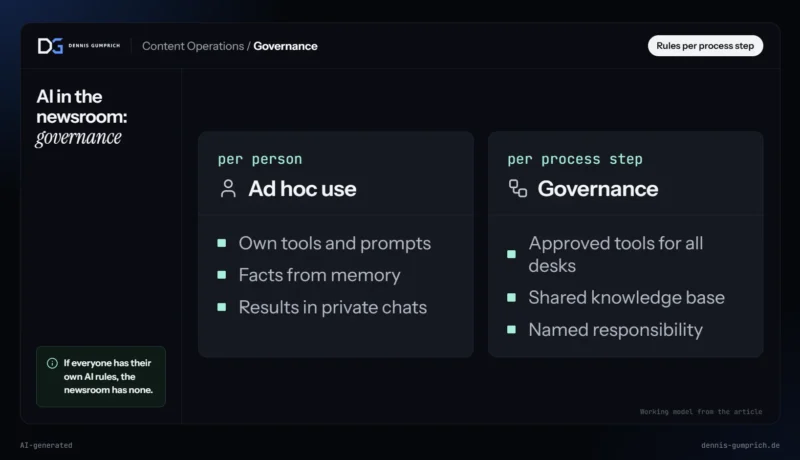

If everyone in the newsroom has their own AI rules, the newsroom has none.
In the newsroom, AI belongs to the process steps, not to individual people. Define what AI is used for, which tools are approved and which shared knowledge base all desks draw on. Add review criteria, a labeling rule and named responsibility for rules and knowledge base. Decisions on topics, approvals and crises stay with people. Introduce this in stages and measure whether cycle time and returns go down.
How to set up these rules and who owns them is shown in the following sections. First, the problem that arises without shared rules.
Why does ad hoc AI reinforce silos in the newsroom?
Because every desk works with its own tools, its own prompts and its own context knowledge. The topic list is shared, the knowledge the AI writes from is not. This creates parallel versions with diverging facts and terms, and the reconciliation lands with the managing editor or in approval.
The Corporate Newsroom Study 2026 describes this tension for Switzerland. Researchers from the University of Fribourg, Lucerne University of Applied Sciences and the University of Bern surveyed a total of 216 communications leaders and professionals in German- and French-speaking Switzerland in November and December 2025. Around 70 percent work in organizations with newsroom structures or comparable variants. Respondents with and without a newsroom reported silo thinking about equally often.
On AI, the study shows a clear gap. Openness towards AI reaches an agreement score of 4.32 out of 5, the provision of specific resources only 3.21 out of 5. According to the study, chat-based tools such as ChatGPT, Perplexity or Copilot are now part of the standard toolkit. But AI is introduced exploratively rather than strategically. Among the implications the researchers derive is explicitly: many organizations lack AI governance structures. Two further findings make this concrete. As the biggest risks, respondents name lack of transparency and lack of quality control, meaning questions of internal workflows, not reputational damage first. And they agree with the statement that they feel less responsible for errors in AI-generated content because they are not solely responsible at an average of 3.57 out of 5. The researchers see this as a possible shift of responsibility that directly affects governance and quality assurance. The data is self-reported and applies to Switzerland. But the pattern matches findings from other markets.
In Cision's Inside PR 2026 report with almost 600 PR professionals from the US and the UK, 91 percent use AI in their workflow. At the same time, 53 percent cite slow approval processes as a factor holding them back. Gartner arrives at a similar picture in its 2026 CMO Spend Survey of 401 marketing leaders: on average, 15.3 percent of the marketing budget goes into AI initiatives, and 70 percent of respondents say their internal marketing processes are not yet mature enough to use and scale AI effectively.
The Trendbarometer Industriekommunikation 2026 (in German) by bvik, the German association for B2B marketing, shows this pattern too, collected via an online survey of 282 participants in October and November 2025. AI shapes all relevant B2B marketing trends there, while many companies lack clear rules for using AI. The academic advisor Prof. Dr. Seon-Su Kim sees a remarkable gap between vision and implementation overall. For you this means: more licenses alone do not close this gap; it takes rules anchored in the workflow. One caveat: it is an association survey whose results cannot simply be generalized.
The mechanism behind it is simple. AI accelerates every desk individually. If the shared workflow does not grow with it, more versions are created in less time, and the work shifts into reconciliation. The long-term study by Mediamoss and the International School of Management led by Christoph Moss found, even without an AI focus, that 51.5 percent of respondents say the process in their department is not right. The study is a self-publication of a consultancy that offers newsroom introductions. For the question here, the finding is enough as a warning: accelerating an unclear process with AI gets you a faster unclear process.
How do you anchor AI in the corporate newsroom without reinforcing silos?
By attaching AI to the steering core of the newsroom and not to individual people. All desks work with the same approved tools and the same knowledge base, the rules apply per process step, and a named role owns rules and knowledge base. Decisions on topics, approvals and crises stay with people.
A newsroom only steers when three conditions are met at the same time: a binding shared topic list, an authority with real decision-making rights and feedback from data into the next planning. Why that is and which dysfunctional forms arise when one condition is missing is covered in Corporate newsroom: the steering model. There you also find the dividing line between which steps AI can take over and which contain a decision of responsibility. This article is about the next question: how to regulate this dividing line bindingly.
Each of the three conditions has an AI equivalent. AI works on the topic list, not beside it: proposals, duplicate checks and briefings are created on the topic in the list, not in private chat histories. AI recommends, the managing editor decides: a pre-sorting by a model is a draft, not a prioritization. And AI condenses evaluations, but the conclusion for the next planning is drawn by the group responsible for it.
Approved tools for all desks, a shared knowledge base with status and source, rules per process step, named responsibility for maintenance and samples, results stored directly on the topic.
Everyone with their own tool and prompts, facts from memory or old documents, results in private histories, review depending on time pressure, nobody responsible for the overall picture.
The most important single building block against new silos is the shared knowledge base. As long as every desk gives the AI its own context, the AI writes its own truth for every desk. A knowledge base with fact sheets, current figures, terms and language rules ensures that topic desk, media desk and internal communications start from the same basis. How to build it is covered in Building a knowledge base.
Where in the newsroom workflow does AI come in?
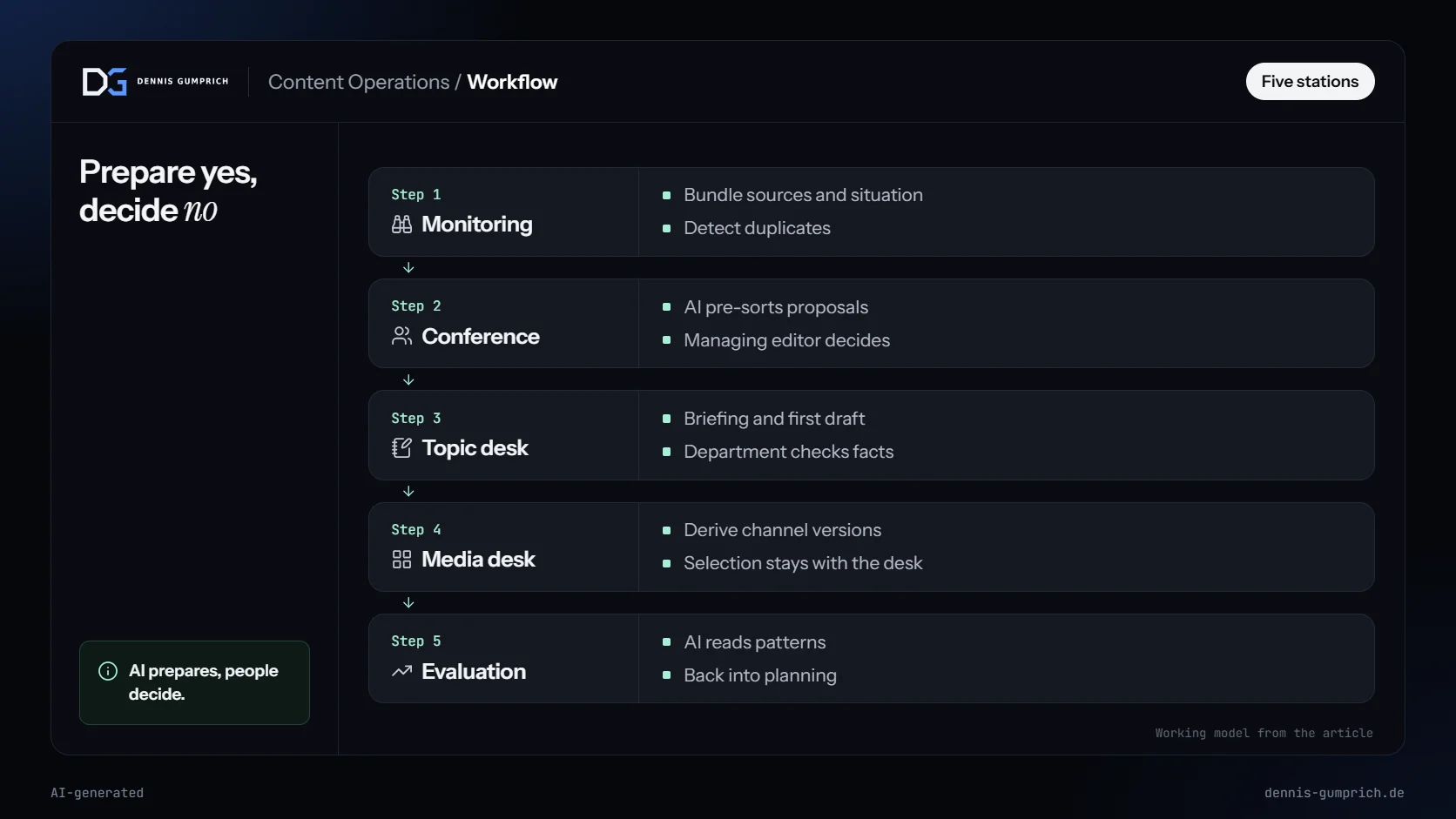
At six points: monitoring, topic conference, topic desk, media desk, the managing editor's daily business and derivations into further formats and languages. The same principle applies everywhere: AI prepares a decision, it does not make it. For each point you need a rule on what the AI delivers, who checks the result and where it is stored.
| Point | What AI delivers | Who decides | Rule you define |
|---|---|---|---|
| Monitoring | Condensed situation from defined sources, notes on duplicates with the topic list | Topic desk, the managing editor on inclusion | Which sources, how often, where results go |
| Topic conference | Pre-sorted topic submissions with reasons according to your criteria | Managing editor | AI assessment is a draft, a human justifies a rejection |
| Topic desk | Briefing, outline and first draft from the knowledge base | Topic desk, the department on subject matter | No figure without a source, subject matter approval remains |
| Media desk | Channel versions from the approved core | Media desk | Derivation only from approved content, selection stays with the desk |
| Managing editor's daily business | Overview of status, bottlenecks and open approvals | Managing editor | No automatic reprioritization |
| Derivations and languages | Variants for further formats, translations, versions for internal communications | Media desk, for languages a review by a proficient speaker | Glossary, knowledge base and labeling apply too |
The Bern interview study by Tobias Rohrbach and Mykola Makhortykh with 13 communications leaders of large Swiss companies shows that newsrooms use AI not only for routine tasks. New applications such as living data archives and transferring content between channels are also mentioned. At the same time, respondents stress an urgent need for rules on AI in corporate communications. This matches the table: the closer an application is to publishing, the more important the rule on which source it draws from.
Two points deserve special attention. In the topic conference, the temptation is great to adopt an AI assessment as a ranking. That quietly shifts the decision right from the managing editor to a model whose criteria nobody decided on. So store your own criteria, as described in Topic scoring, and let the AI pre-sort only against these criteria. For derivations into other languages, the same rules apply as for any translation: glossary, review and clear responsibility, more on this in Translating and localizing marketing content.
Which building blocks belong in AI governance for the newsroom?
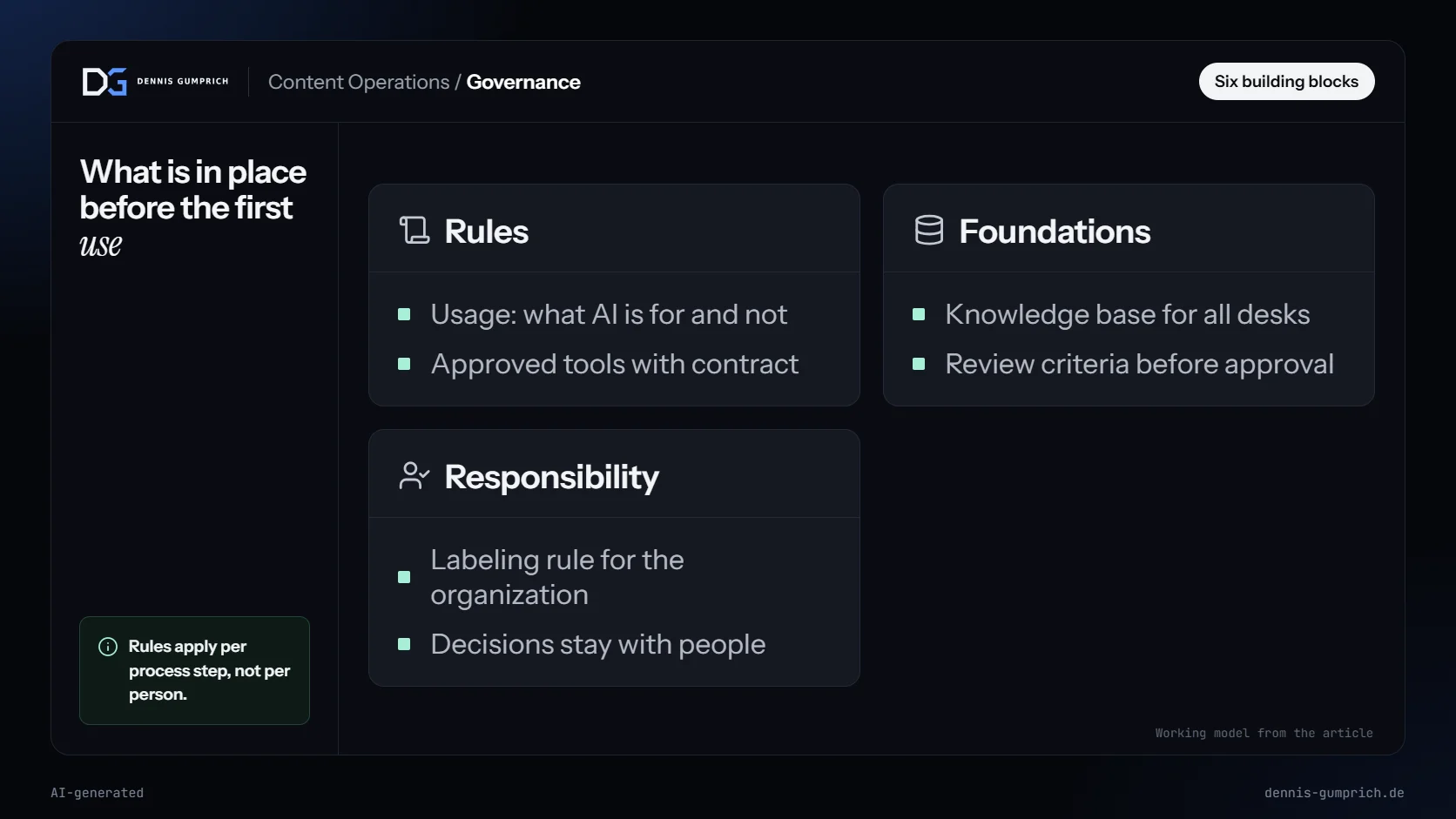
Six: usage rules, approved tools, a shared knowledge base, review criteria, a labeling rule and the clear stipulation that responsibility stays with people. Together they fit on a few pages. What matters is not the length but that every building block is assigned to a process step and a role.
1. Usage rules. They define what AI is used for, what only with additional review and what not at all. A simple traffic light is enough to start and can be looked up in any conference.
| Level | Examples | What applies |
|---|---|---|
| Free | Outlines, summaries of public sources, channel versions from an approved core, headline variants | Review by the responsible desk before publishing |
| With review | Expert texts, figures, quotes, statements about products and services, translations | Review against knowledge base and review criteria, subject matter approval |
| Not | Confidential and unpublished company information, personnel data, crisis communication | No use of AI tools, exceptions only with approval |
2. Approved tools. A short list of tools that may be used with a contract and clarified data protection, and for what purpose. A ban without an approved alternative shifts use into private accounts; what that costs is covered in Shadow IT in marketing. What to look for in the review is summarized in GDPR-compliant content marketing software.
3. Shared knowledge base. Fact sheets, current figures with status and source, approved quotes, terms and language rules, and the brand voice. It is the building block against new silos, because all desks start from the same basis. Every entry needs a date and a responsible person, otherwise the base becomes outdated faster than it is used. How to describe tone so that AI can apply it is covered in Storing brand voice.
4. Review criteria. A fixed list against which every AI-assisted piece is checked before approval, with criteria on facts, sources, tone and audience. The complete checklist and its introduction are described in Review criteria for AI texts, how to deal with invented facts in Catching hallucinations in marketing texts.
5. Labeling rule. One rule for the whole organization on when and how you disclose AI involvement, instead of every desk handling it differently. Which obligations Article 50 of the EU AI Act triggers and how to arrive at a robust practice is covered in Defining AI labeling.
6. Responsibility stays with people. Every piece has a named person who is responsible for it before publication, regardless of how much AI was involved. Enablement is part of this: Article 4 of the EU AI Act obliges companies that deploy AI systems to take measures that promote the AI literacy of their staff. In the version amended by the Digital Omnibus, the provision explicitly does not require a specific level of competence of individual people. For the newsroom, this practically means: anyone working with AI knows the usage rules, the review criteria and the limits of the tools.
Do not start with a comprehensive policy. One page with traffic light, tool list and responsibilities, presented in the next topic conference, works faster than a document that sits in alignment for three months. What you need to add after the pilot, operations will show you.
How does AI change the work of managing editor, topic desk and media desk?
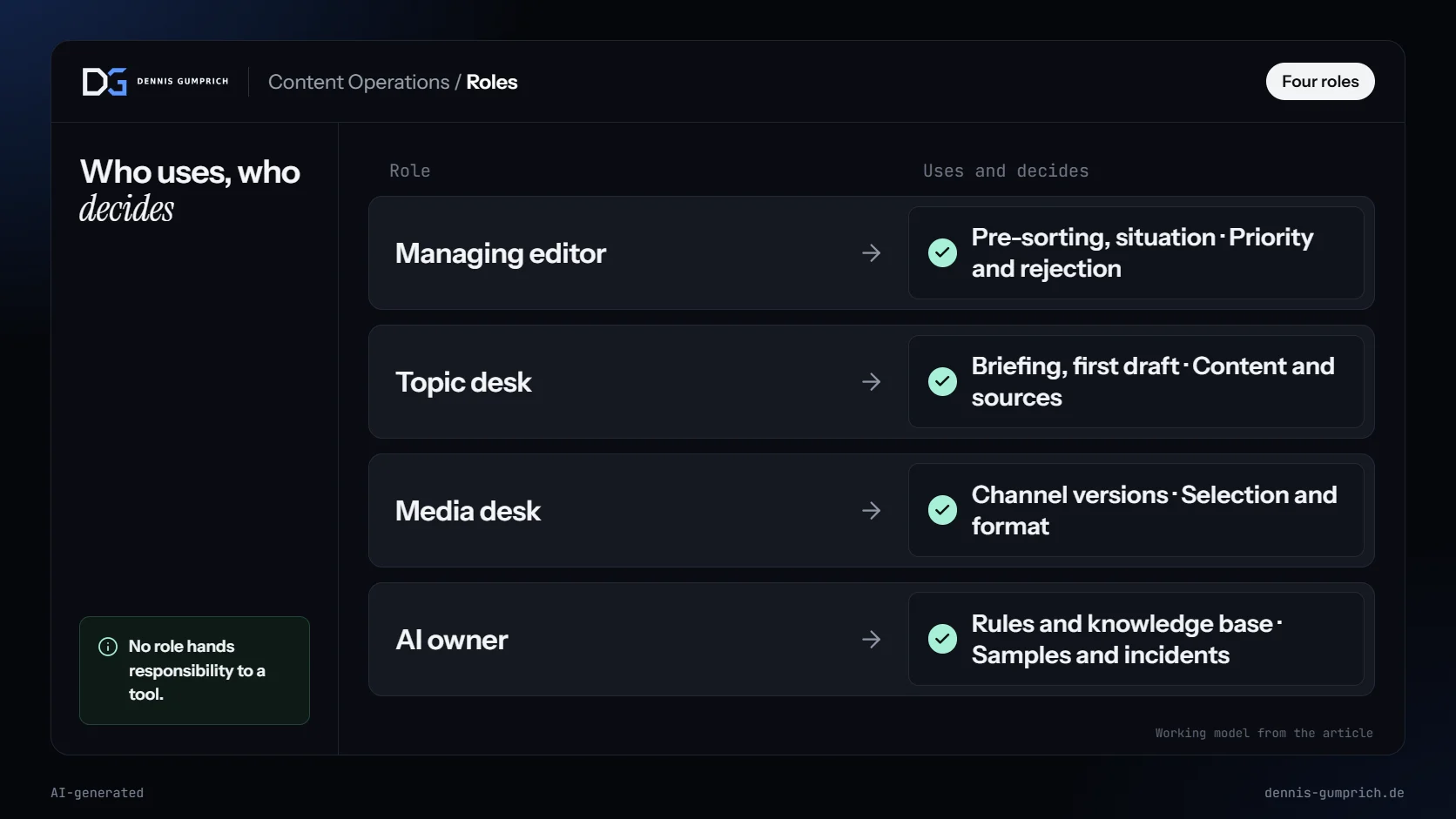
Decision rights stay as they are. What shifts is the share of preparation: fewer first drafts, more review and selection. What is new is responsibility for rules and knowledge base, which nobody carries yet in most newsrooms.
The role model with strategy team, managing editor, topic desk and media desk and the question of what each role decides on its own is described in Newsroom roles: what managing editor, topic desk and media desk actually do. With AI, a column is added: what the role hands over to AI and which new risk arises.
| Role | AI supports with | Remains a human decision | New risk |
|---|---|---|---|
| Strategy team | Evaluation, patterns across topic areas | Priorities, resources, adopting the AI rules | Rules are adopted but not given time |
| Managing editor | Situation overview, pre-sorting, overview of open approvals | Inclusion, priority, rejection | An AI ranking quietly replaces the weighing |
| Topic desk | Briefing, outline, first draft | Content, sources, subject matter alignment | First drafts are passed on unreviewed |
| Media desk | Channel versions, variants, translations | Selection, format, timing | Every version goes out because it already exists |
| AI owner, new | Maintaining the knowledge base, evaluating samples | Proposals for rule changes, handling incidents | The task is assigned on the side and is the first to drop |
The new responsibility is not a new position. It can sit with someone from the topic desk or close to the managing editor, but needs a quantified share of time and a named deputy. The split that has proven itself in consulting practice: the strategy team adopts the rules, the AI owner maintains knowledge base and samples, the managing editor enforces the rules in daily business. If everything sits with one person, exactly the dependency arises that is described in When one person drops out.
A framework for this assignment is provided by the Generative AI Profile (NIST AI 600-1) of the US National Institute of Standards and Technology. It recommends recording roles and responsibilities for human oversight in an AI inventory, together with provenance information on the data such as source, versioning and watermarks, and on the models and versions used (action GV-1.6-003). It also recommends defining responsibilities for regularly reviewing content provenance (GV-1.5-001). So add the responsible role and the model version used to your list of approved tools, and it doubles as your AI inventory. One caveat: it is a voluntary US framework, not a requirement of the EU AI Act.
For the media desk the shift is biggest. When channel versions are created in minutes, the right to select becomes more important, not less. A media desk that publishes every available version because it already exists becomes a production station with a faster pace. For tasks that go beyond individual steps and form chains, additional rules on permissions and logging apply; they are covered in AI agents in the content team.
How much capacity does AI governance in the newsroom need?
Less than the introduction suggests, but not zero. In the calculation example below, it is 24 hours a month for maintaining the knowledge base, samples and a rules meeting. This time has to be planned, otherwise governance is the first thing to go as soon as things get tight.
This is exactly the gap the Swiss study describes with 4.32 versus 3.21: high openness, few allocated resources. Tool licenses are paid for, the work that makes the tools reliable is not planned. The following calculation example shows an order of magnitude for a newsroom with around ten pieces per week.
| Task | Assumption | Hours per month |
|---|---|---|
| Maintaining the knowledge base | 2 hours per week | 8 |
| Sample review | 10 pieces at 15 minutes per week | 10 |
| Rules meeting | 90 minutes with 4 people, once a month | 6 |
| Total | 24 |
With 160 working hours a month, 24 hours equal 15 percent of a full-time position. At an internal hourly rate of 80 euros, that is 1,920 euros a month or 23,040 euros a year. If AI saves 20 minutes per channel version, this effort is covered after 72 versions a month, or 18 per week. Whether 20 minutes is realistic for you, you measure in the pilot, not beforehand.
Do not calculate governance against zero, but against the costs without it: versions created twice, correction loops in approval and rework after errors that have already been published. You can work through this with your own numbers in the ROI calculator (in German). How to turn it into a proposal for management is covered in Calculating the business case for content software.
In which stages do you introduce AI in the newsroom?
In four stages: inventory, rules, pilot and expansion. Each stage ends with a decision on whether to continue. That keeps effort manageable, and after the pilot you can prove what AI has actually changed in the workflow.
- Stage 1 · weeks 1 to 2InventoryFind out who uses which tool for what, including private accounts. Ask without assigning blame, otherwise you will not get complete answers. At the same time, measure baseline values: cycle time, returns in approval, channel versions per topic.
- Stage 2 · weeks 3 to 4RulesUsage traffic light, tool list, first version of the knowledge base, review criteria and labeling rule. The strategy team decides, the AI owner is named, with a share of time and a deputy.
- Stage 3 · weeks 5 to 10PilotOne process step, for example channel versions at the media desk, for one topic area and two channels. Six weeks with the same metrics as in the inventory.
- Stage 4 · from week 11ExpansionOnly if the metrics are right: next process step, monthly rules meeting, quarterly review of the rules.
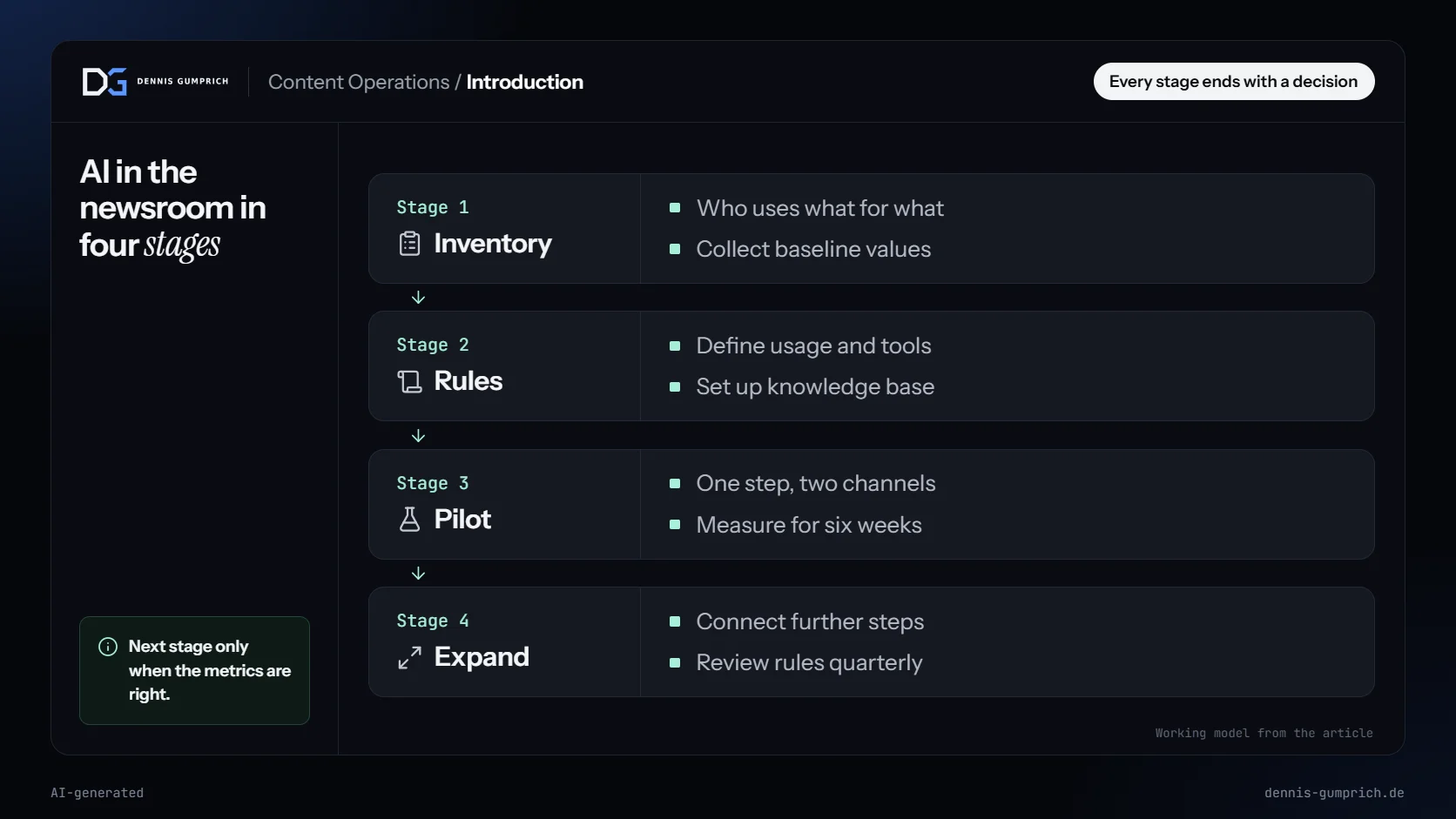
Why the pilot starts with a single process step: only then can you attribute a change in the metrics to AI. Switching monitoring, briefings and channel versions at the same time shows a change at the end, but you cannot say where it comes from. What a pilot can and cannot prove is covered in Pilot and rollout, how individual experiments become a process in AI content operations: from experiments to a process.
How to plan the introduction of the newsroom model itself as a change process, with timeline, roles and stakeholder arguments, is covered in the free white paper Introducing a corporate newsroom.
Which metrics show whether the AI rules work?
Metrics that measure the workflow, not the amount of AI text. Meaningful ones are returns in approval, cycle time, factual discrepancies between channel versions, use of the shared knowledge base and the number of non-approved tools in use. Collect the baseline values before the pilot.
| Metric | What it shows | Warning sign |
|---|---|---|
| Returns per piece in approval | Whether AI-assisted versions arrive better prepared | Rises after the introduction |
| Cycle time from topic inclusion to publication, median | Whether the whole workflow gets faster | Only drafts get faster, publication does not |
| Factual discrepancies between channel versions | Whether the shared knowledge base works | The same type of error appears in several channels |
| Desks working with the shared knowledge base | Whether the silo risk decreases | Individual desks keep maintaining their own files |
| Non-approved tools in use | Whether the approved solution meets the need | Number stays the same after three months |
| AI-related incidents after publication | Whether the review criteria take effect | The same incident occurs twice |
These metrics complement the process metrics you should collect for the newsroom anyway. How to define cycle time, returns and effort cleanly is covered in Making content production measurable. What matters is that these metrics remain steering values for the team and do not become performance targets for individuals. Otherwise the number of reported incidents goes down, not the number of incidents.
Five mistakes with AI in the newsroom
- Banning instead of approvingA blanket ban without an approved alternative does not end use, it makes it invisible. The inventory in stage 1 shows you which need the approved solution has to meet.
- Every desk with its own knowledge baseThree repositories of facts and terms create three truths, just faster than before. One base, one responsible person, every entry with a date.
- Adopting an AI ranking as prioritizationA pre-sorting by a model is a draft. If it becomes the ranking unreviewed, the managing editor loses the decision right without anyone deciding that.
- Governance as a document instead of a process stepA policy on the intranet has no effect if it does not appear in the workflow. Review criteria belong in approval, the traffic light in the conference, the knowledge base in every briefing.
- Not planning maintenanceKnowledge base and samples need fixed time. Without a share of time, the knowledge base is outdated after a few months and the desks fall back on their own documents.
Self-check: is AI in your newsroom regulated or tolerated?
Tick everything that applies to you.
A short assessment of the use of AI in our newsroom:
Most of us already use AI, but every desk with its own tools and its own knowledge. This creates parallel versions with diverging facts, and reconciliation lands in the conference or in approval. That is not a problem of individuals but of missing shared rules.
Proposal: within two weeks we find out who uses which tool for what, then define usage rules, approved tools and a shared knowledge base and test this for six weeks on one process step with two channels.
We estimate the ongoing effort in a calculation example at around 24 hours a month. Whether it pays off we decide based on the metrics from the pilot.
Disclosure
I work for contentbird, a content platform with AI features. There, among other things, roles with graded permissions, workflows with tasks per status and AI personalities for writing style and tone can be set up. For the governance in this article that is one possible tool, not a prerequisite. You have to define usage rules, knowledge base and responsibility yourself in any system, and the same questions apply to every vendor.
Conclusion: AI in the newsroom needs the same steering as the topics
A newsroom separates topics and channels and brings them back together through clear decision rights. Ad hoc AI undermines this principle, because every desk gets faster with its own tool and knowledge, but not together. The research shows the pattern: great openness, widespread use, few allocated resources and missing governance structures. How these rules fit into the overall content operation is described in Content operations: what it is and how to build it.
The answer is not a comprehensive policy but a small number of binding building blocks in the right place in the workflow: usage rules, approved tools, a shared knowledge base, review criteria, labeling and named responsibility. Introducing this in stages and measuring with the same metrics turns many individual uses of AI into part of the newsroom. Which requirements a tool should meet for this is summarized in the requirements catalog for newsroom software.
Frequently asked questions
Do we need a separate AI policy for the newsroom?
Not necessarily as a separate document. Many companies have an overarching policy that regulates tools and data protection. The newsroom adds what is missing there: rules per process step, the shared knowledge base and the assignment to roles. One page is enough to start.
Who should be responsible for AI in the newsroom?
A named person with quantified time and a deputy, often from the topic desk or close to the managing editor. They maintain the knowledge base and samples and propose rule changes. The rules are adopted in the strategy team and enforced in daily business by the managing editor.
May AI prioritize topics in the topic conference?
It may pre-sort, not decide. Pre-sorting against your own criteria saves time in the conference. Inclusion, priority and rejection stay with the managing editor, and a human justifies a rejection to the department.
Do AI-assisted press texts have to be labeled?
That depends on the individual case. Article 50(4) of the EU AI Act obliges deployers to disclose AI-generated text that is published with the purpose of informing the public on matters of public interest. The obligation does not apply if the text has undergone human review or editorial control and a person holds editorial responsibility. How to turn this into an internal rule is covered in Defining AI labeling.
How do we prevent employees from using private AI accounts?
With an approved alternative that meets the actual need, and clear usage rules. A ban alone only moves use out of sight. The inventory shows which tasks the approved solution has to cover, the metric on non-approved tools shows whether that has worked.
Where does your content process lose time today?
In 30 minutes, we look together at where unnecessary coordination, manual tasks, tool switching or repetitive content work cost you time today.
You get a concrete assessment of which tasks you can simplify, automate or organize better, and where AI and tools actually help instead of adding complexity.
Analyze your content process in 30 minutes Free of charge. You take away concrete starting points you can use internally right away.
Dennis Gumprich
Dennis helps marketing and communication teams fit generative AI into existing content processes without undermining quality, brand voice and approvals. Focus areas: content operations, AI governance and tool selection in mid-sized companies and corporations.
Transparency note: Dennis works for contentbird, a provider of AI-powered content software. Product mentions are marked in the article. More about Dennis (in German) · LinkedIn
Read more
Sources
- Tobias Rohrbach, Diana Ingenhoff (Université de Fribourg), Mykola Makhortykh (University of Bern), Philipp Bachmann (Lucerne University of Applied Sciences): Ein Modell, viele Wege. Corporate Newsrooms in der Schweiz 2026, study report, supported by Newsroom Communication, Axpo, SBB and Innosuisse. Online survey of 216 communications leaders in German- and French-speaking Switzerland, November and December 2025, self-assessments; values on AI openness, resources, risks and responsibility on pp. 26 to 28, silo thinking on pp. 22 to 23. Available via newsroominsights.ch/studie. Report on it: m&k, Corporate Newsroom Studie 2026: Standard mit Grenzen (in German), August 19, 2026. Accessed October 31, 2026.
- Cision: Inside PR 2026 (press release in German), press release from January 6, 2026, almost 600 PR professionals in the US and the UK. Accessed October 31, 2026.
- Gartner: 2026 CMO Spend Survey, press release from May 11, 2026, 401 respondents in North America, the UK and Europe, survey January to March 2026. Accessed October 31, 2026.
- Mediamoss: Langzeitstudie Status quo Corporate Newsroom (in German), study report from September 15, 2025, led by Prof. Dr. Christoph Moss, 209 communications departments, 743 interviews, January 2018 to June 2025, self-publication of a consultancy. Accessed October 31, 2026.
- Tobias Rohrbach, Mykola Makhortykh: A Matter of Mindset? Features and Processes of Newsroom-based Corporate Communication in Times of Artificial Intelligence, preprint on arXiv, July 9, 2024, 13 interviews with communications leaders of large Swiss companies. Accessed October 31, 2026.
- European Commission, AI Act Service Desk: Article 4: AI literacy, Regulation (EU) 2024/1689, consolidated version according to EUR-Lex with amendments by the Digital Omnibus, as of July 27, 2026. Accessed October 31, 2026.
- European Commission, AI Act Service Desk: Article 50: Transparency obligations, Regulation (EU) 2024/1689, in particular paragraph 4, consolidated version according to EUR-Lex. Accessed October 31, 2026.
- bvik: Trendbarometer Industriekommunikation 2026: KI wird zum Standard, Chancen aber teilweise noch ungenutzt (in German), press release from January 13, 2026 on the online survey of 282 participants in October and November 2025 by the German B2B marketing association, with a preceding workshop with 32 leaders and academic support by Prof. Dr. Seon-Su Kim: AI shapes all relevant B2B marketing trends, many companies lack clear rules for AI use. Association survey, results cannot simply be generalized. Accessed October 31, 2026.
- National Institute of Standards and Technology (NIST): Artificial Intelligence Risk Management Framework: Generative Artificial Intelligence Profile (NIST AI 600-1), July 26, 2024, Chloe Autio, Reva Schwartz, Jesse Dunietz et al., companion profile to the voluntary AI RMF 1.0: actions GV-1.6-003 (record roles and responsibilities for human oversight in the AI inventory, including provenance information and models and versions used) and GV-1.5-001 (define responsibilities for regularly reviewing content provenance). Voluntary US framework. Accessed October 31, 2026.
How this article was created
This article was created with the help of AI. Structure, research and draft wording were developed with AI support. Professional assessment, review of the statements and the final version are the responsibility of Dennis Gumprich. The English version was translated with AI and reviewed. Read the original German version.
How reliable are the statements?
Backed by sources are the results of the Corporate Newsroom Study 2026 according to the study report, the figures from Cision's Inside PR 2026 and Gartner's 2026 CMO Spend Survey, the finding of the Mediamoss long-term study, which is marked as a consultancy's self-publication, the results of the Bern interview study and the wording of Article 4 and Article 50(4) of the EU AI Act, as well as the finding of missing AI rules from the Trendbarometer Industriekommunikation 2026 (bvik, association survey) and the recommendations on roles, AI inventory and provenance review from NIST AI 600-1 (voluntary US framework). The Swiss study is based on self-assessments and is not representative for other countries. The mapping of AI to the stations of the newsroom workflow, the six governance building blocks, the usage traffic light, the roles table, the introduction stages and the metrics are working models from consulting practice, not collected measurements. Hours, hourly rate and minutes saved are a calculation example. The notes on the AI Act are not legal advice. As of October 31, 2026.


