
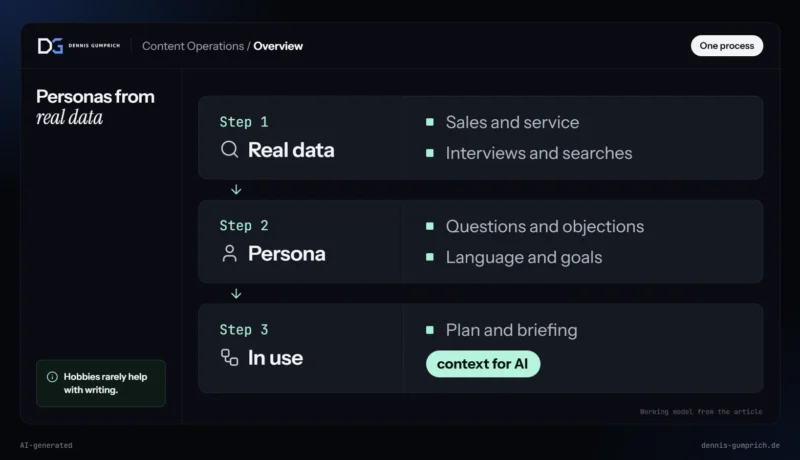

A persona describes a typical member of a target group so concretely that a team can plan, write and review content for this person. You create it in six steps: collect data, recognize patterns, formulate the persona, validate it with real customers, build it into your processes and maintain it regularly. A good persona template contains role, context, goals, questions, objections, information sources and language, but no invented hobbies. It only becomes effective when it is stored in the content process and in the AI, and every piece of content is assigned to a persona.
What is a persona, and how does it differ from a target group?
A target group describes a group by characteristics such as industry, function or age. A persona turns this into a concrete person with goals, questions, objections and a language. A buyer persona is a persona with a focus on the buying decision.
| Term | Describes | Example |
|---|---|---|
| Target group | A group by characteristics | Heads of marketing in industrial companies with 200 to 2,000 employees |
| Persona | A typical person in this group with goals, questions and language | Head of marketing, responsible for five channels with three people, wants to prove impact |
| Buyer persona | A persona viewed in terms of the buying decision and buying center | The same head of marketing as initiator, management as decision-maker, IT as reviewer |
For content teams, the persona is the more important tool, because it describes what someone wants to know and how they talk. For sales and campaigns, the buyer persona perspective adds: who is involved in the purchase, who decides, who can block.
Which fields belong in a persona template?
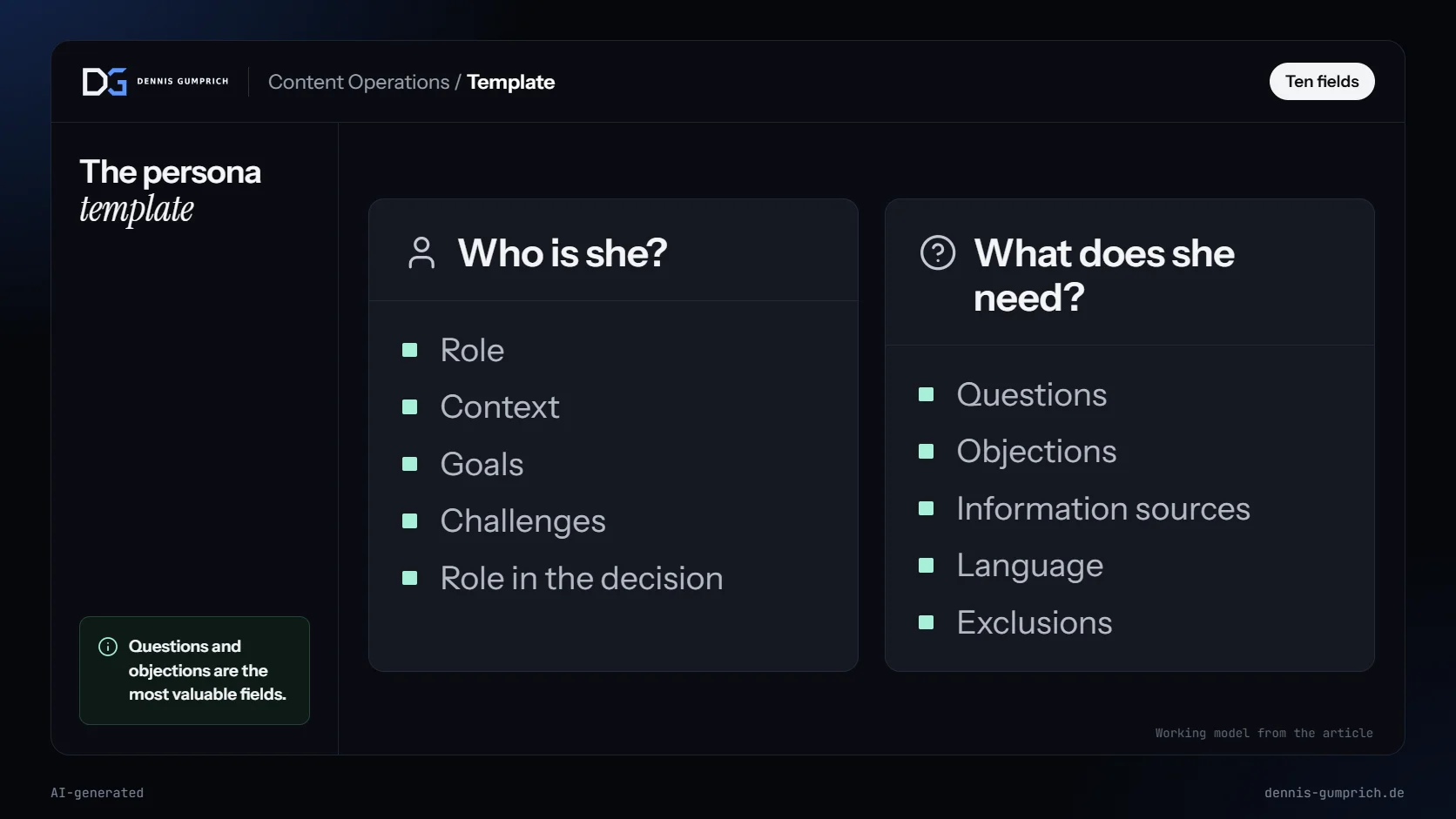
A usable persona template has ten fields, all relevant for content: role, context, goals, challenges, questions, objections, information sources, language, role in decisions and exclusions. Name, photo and hobbies are optional and help less than you might think.
| Field | Guiding question | Use in content |
|---|---|---|
| Role | Which function, which responsibility? | Determines level and technical depth |
| Context | Industry, team size, work environment | Provides fitting examples |
| Goals | What is this person measured by? | Defines the benefit of a piece of content |
| Challenges | What holds them back today? | Provides topics and openings |
| Questions | What exactly do they ask, including in search engines and AI assistants? | Basis for headings and answers |
| Objections | What makes them hesitate? | Content that addresses concerns |
| Information sources | Where do they get information? | Channel choice |
| Language | Which terms do they use, which not? | Wording and tone |
| Role in the decision | Do they initiate, decide, review or use? | Arguments per decision phase |
| Exclusions | What are they explicitly not interested in? | Prevents the wrong focus |
The questions field is the most valuable. It connects the persona with search: many of these questions are asked word for word in search engines and AI assistants. If you know them, you can align headings and answers accordingly. The language field, in turn, is the bridge to your brand voice: an HR director speaks differently from a maintenance manager, even if both read the same brand.
How do you create a persona?
In six steps: collect data from sales, service, analytics and interviews, recognize patterns, formulate the persona, validate it with real customers, build it into planning and creation, and review it at least once a year.
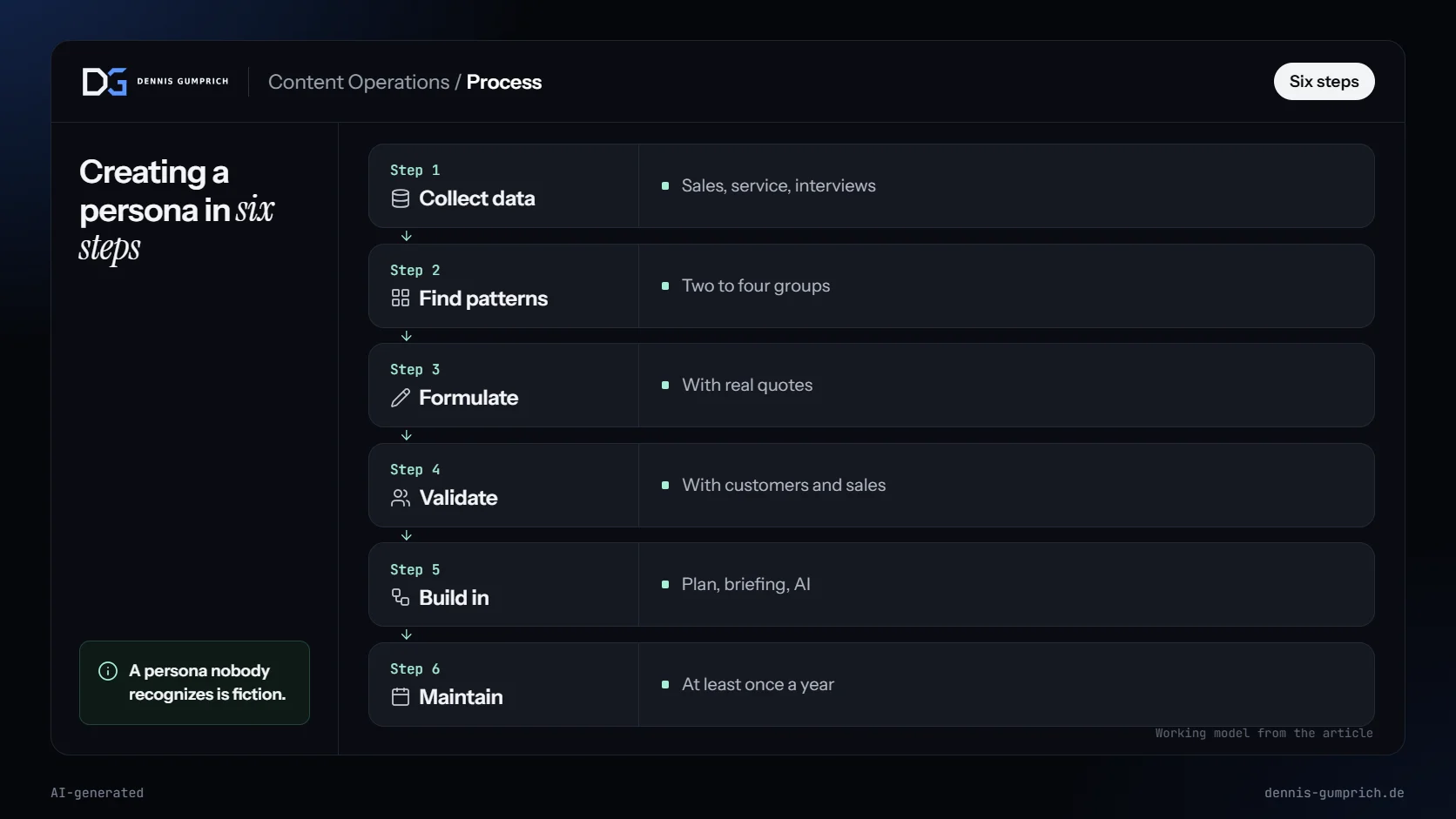
- Step 1Collect dataAsk sales and customer service about typical questions and objections. Evaluate search queries from Search Console, inquiries from forms and comments in social channels. Conduct five to eight short interviews with customers.
- Step 2Recognize patternsSort the findings by role, goal and challenge. Usually two to four clearly different groups emerge. More than five personas are rarely used in everyday work.
- Step 3Formulate the personaFill in the template for each group. Use verbatim quotes from interviews and inquiries. A sentence like "I have to show management what this delivers" says more than any description.
- Step 4Validate with real customersShow the persona to sales and two or three customers. Do they recognize themselves? Is something important missing? A persona nobody recognizes is fiction.
- Step 5Build into processesEvery piece of content in the editorial plan gets a persona. Every briefing names it. The AI gets it as context. Only then does the persona work in everyday life.
- Step 6MaintainReview the personas at least once a year and after major changes in the market. New questions and objections from sales flow in continuously.
The fifth step determines the value. Personas that only exist in a workshop result don't change any content. How to anchor personas as a fixed field in the editorial plan is described in the article on the topic plan.
Buyer persona in B2B: who has a say?
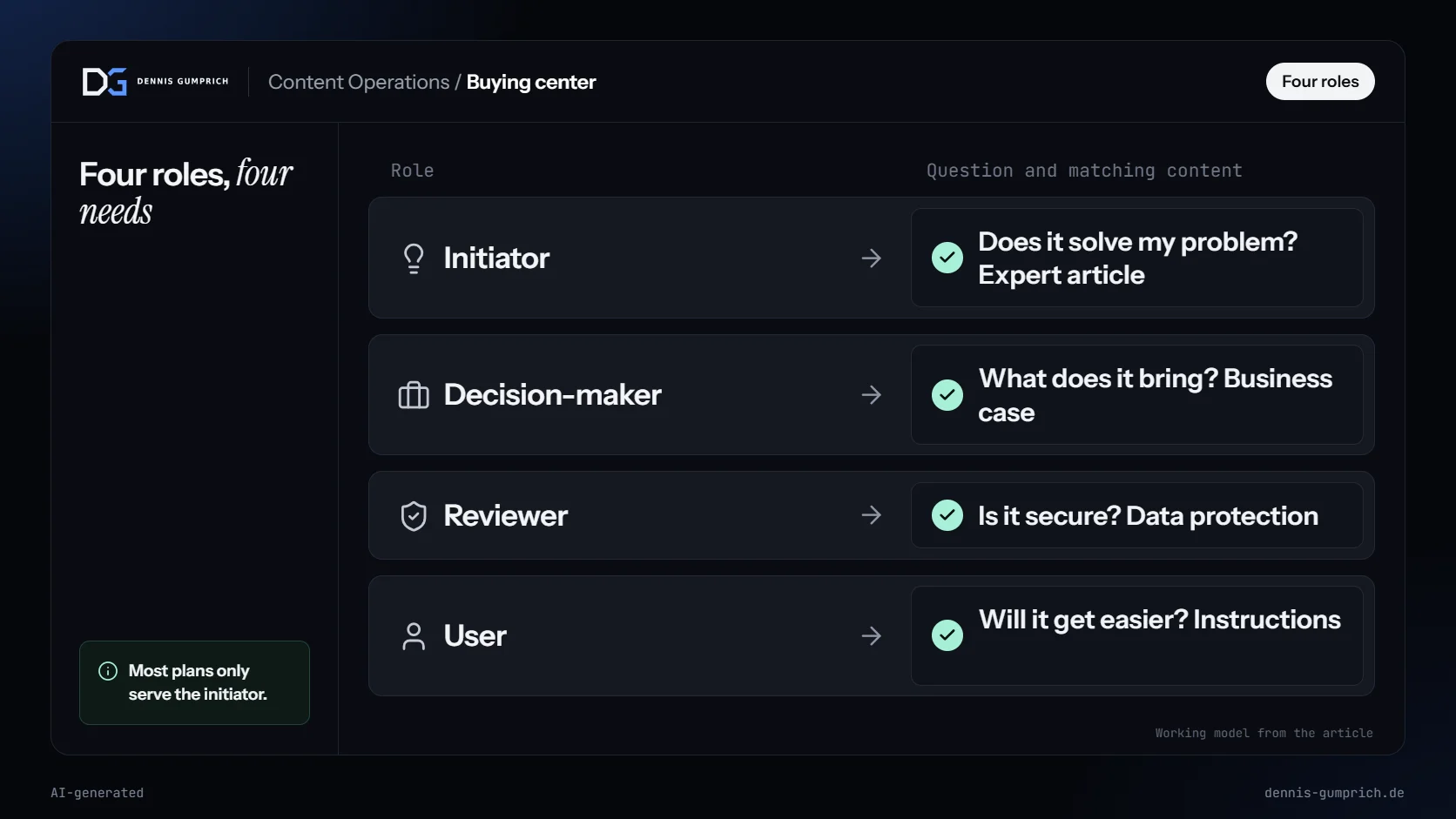
In B2B, a single person rarely decides. Usually four roles are involved in a purchase: initiators, decision-makers, reviewers and users. Each role has different questions and needs different content.
| Role | Typical question | Matching content |
|---|---|---|
| Initiator | Does this solve my problem? | Expert article, self-check, practical example |
| Decision-maker | What does it deliver, and what does it cost? | Business case, summary for management |
| Reviewer | Is it secure and does it fit our systems? | Data protection, interfaces, requirements catalog |
| User | Will it make my work easier? | Instructions, video, before-and-after comparison |
Many content plans only serve the initiator. She reads the expert article, is convinced and then fails internally because of questions for which there is no content. If you create buyer personas for all four roles, you see these gaps. A good addition is the text to forward that you'll find in many articles on this website: it gives the initiator arguments for the conversation with decision-makers.
How do you make personas usable for AI?
By storing them as context that the AI uses for every piece of content, and by assigning every piece of content to a persona. Then the AI doesn't write for an average reader, but for a concrete role with its questions, objections and language. In addition, AI can check whether a draft fits the persona.
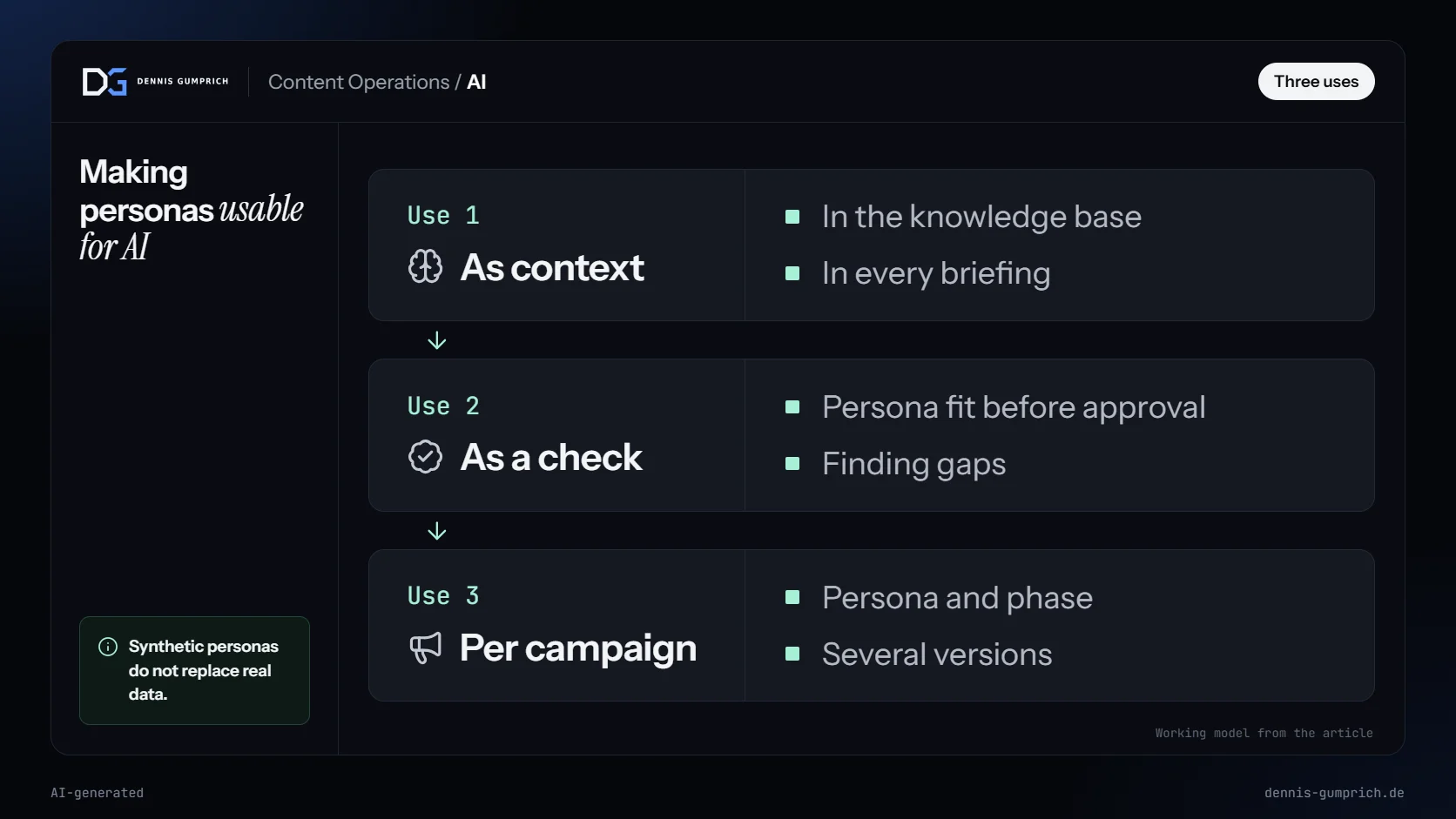
Three uses have proven themselves in practice:
- Persona as context: the persona sits in the knowledge base and is passed along with every briefing. This produces drafts that address the persona's questions and objections. How to build this foundation is described in the article Building a knowledge base.
- Persona check: before approval, the AI assesses whether a draft answers the persona's questions, hits their language and takes their objections into account. This doesn't replace a subject-matter review, but it finds gaps.
- Persona per campaign: when a topic is rolled out across several channels, you choose one persona and one customer journey phase per piece of content. That way, one briefing produces different versions for different readers.
A warning about so-called synthetic personas: AI can generate personas at the push of a button that sound plausible. Without real data from sales, service and interviews, however, these are assumptions in a nice form. Use AI to structure and maintain real insights, not to replace them.
With AI agents, personas take on another role. Agents that suggest or derive content need a clear description of whom they are working for. What agents can reliably take over today is covered in the article AI agents in the content team.
How do you connect personas with the customer journey?
With a simple matrix: personas in the rows, customer journey phases in the columns. Each cell holds the persona's most important question in that phase. Empty cells show missing content.
For most teams, four phases are enough: recognizing the problem, comparing solutions, convincing internally, using and staying. A head of marketing may ask in the first phase "Why do our approvals take so long?", and in the third "How do I explain the benefit to management?". Both questions need different content. The matrix thus becomes the basis for the topic plan and shows where content is missing. How to plan concrete content from it is described in the article on topic scoring.
Persona example: the head of marketing in a mid-sized company
A filled-in example shows how concrete a persona should be. It is fictional, but based on typical statements from conversations with marketing teams.
| Field | Content |
|---|---|
| Role | Head of marketing, leads a team of four, reports to management |
| Context | Industrial company with 600 employees, five channels, content often comes from product management |
| Goals | More qualified inquiries, proving the impact of marketing, relieving the team |
| Challenges | Long approvals, knowledge depends on individuals, AI is used very differently across the team |
| Questions | "How do I explain to management what content delivers?" "How do I get specialist departments to approve faster?" |
| Objections | No time for a big project, concern about IT and data protection review |
| Information sources | LinkedIn, trade newsletters, webinars, exchange with other heads of marketing |
| Language | Pragmatic, results-oriented, few buzzwords, skeptical of hype |
| Role in the decision | Initiates and prepares, management decides |
| Exclusions | Technical programming details, theoretical models without practical relevance |
Content follows directly from this persona: an article on the business case for management, a guide to shortening approvals, a text to forward to management. And it also follows how this content should sound: factual, concrete, with figures and without hype. This derivation is exactly what makes a persona valuable.
Where do you get your personas' real questions?
From four sources that almost every company already has: sales conversations, service inquiries, search queries in Search Console and questions in webinars or events. One month of systematic collection usually yields more than a workshop.
Recordings and notes from sales conversations are particularly productive. That's where questions and objections come up verbatim, in the customers' language. Search Console shows which phrases people type into search, increasingly as complete questions. Questions from webinars show what a target group is currently concerned with. Collect these questions in one place, assign them to the personas and mark which ones are already answered by content. The open questions are your next topics.
What mistakes do teams make when creating personas?
The most common mistakes concern the data basis and usage. Personas are made up instead of researched and are no longer used after the workshop.
- Made up instead of researchedPersonas from the conference room reflect the team's assumptions. Without conversations with customers, sales and service, the real questions are missing.
- Too many personasNobody uses eight personas. Two to four, clearly distinguishable, are enough for most teams.
- Hobbies instead of questionsWhether the persona likes cycling rarely helps with writing. Their questions, objections and terms always help.
- Only in a PDFPersonas that aren't stored in the editorial plan, briefings and AI don't influence any content.
- Never updatedMarkets, roles and questions change. A persona from four years ago describes a person who no longer exists in that form.
Self-check: how effective are your personas?
Tick everything that applies to you.
a short proposal on our target groups:
Our personas are several years old and hardly used in everyday work. As a result, everyone writes for their own image of the target group, and AI drafts are aimed at an average reader.
I suggest researching two to four personas anew over the next six weeks: with conversations from sales and service, five to eight customer interviews and an analysis of our search queries. After that, we assign every piece of content to a persona and store the personas as context for our AI tools.
That makes our content more targeted, and we see for which roles in the decision process we are missing content.
Conclusion: a persona is a working tool, not a poster
Good personas come from real data and are used in everyday work. They describe roles, goals, questions, objections and language, not hobbies. They only deliver their value when every piece of content is assigned to a persona and the AI knows them as context. Then the team no longer writes for an average, but for people with concrete concerns.
Start with your most important target group. Collect its ten most frequent questions from sales and service, conduct five interviews and fill in the template. After a month, you'll see whether briefings and drafts become more targeted.
Frequently asked questions
How many personas does a company need?
Two to four for most teams. What matters is that they differ clearly in goals, questions and objections. Additional personas are only worthwhile if you also create dedicated content for them.
What is the difference between a persona and a buyer persona?
A persona describes a typical person in a target group. A buyer persona looks at them in terms of the buying decision: which role they have in the buying center, which criteria they apply and which objections they have.
What data do I need to create a persona?
Frequent questions and objections from sales and service, search queries from Search Console, inquiries from forms, comments in social channels and five to eight short customer interviews. Demographic data is less important for B2B content.
Can AI create personas?
AI can structure and summarize real insights and put them into a template. Without real data, it only produces plausible-sounding assumptions. Use it as a tool for analysis and maintenance, not as a substitute for conversations.
How often should personas be updated?
At least once a year and after major changes, such as a new product, a new market or changed roles at customers. New questions from sales should flow in continuously.
Where does your content process lose time today?
In 30 minutes, we look together at where unnecessary coordination, manual tasks, tool switching or repetitive content work cost you time today.
If you want to set up personas anew or make them usable for AI, we go through your target groups and data sources and sketch a first persona.
Analyze your content process in 30 minutes Free of charge. You take away concrete starting points you can use internally right away.
Dennis Gumprich
Dennis helps marketing and communication teams fit generative AI into existing content processes without undermining quality, brand voice and approvals. Focus areas: content operations, AI governance and tool selection in mid-sized companies and corporations.
Transparency note: Dennis works for contentbird, a provider of AI-powered content software. Product mentions are marked in the article. More about Dennis (in German) · LinkedIn
Read more
Sources
- This article is based on consulting practice with marketing and communication teams. No external studies were used.
How this article was created
This article was created with the help of AI. Structure and draft wording were developed with AI support. Professional assessment, review of the statements and the final version are the responsibility of Dennis Gumprich. The English version was translated with AI and reviewed. Read the original German version.
How reliable are the statements?
The persona template, sequence of steps, buying center grid and AI uses are working models from consulting practice, not measured values. The observations on how personas are used come from conversations with marketing and communication teams in 2026.


