
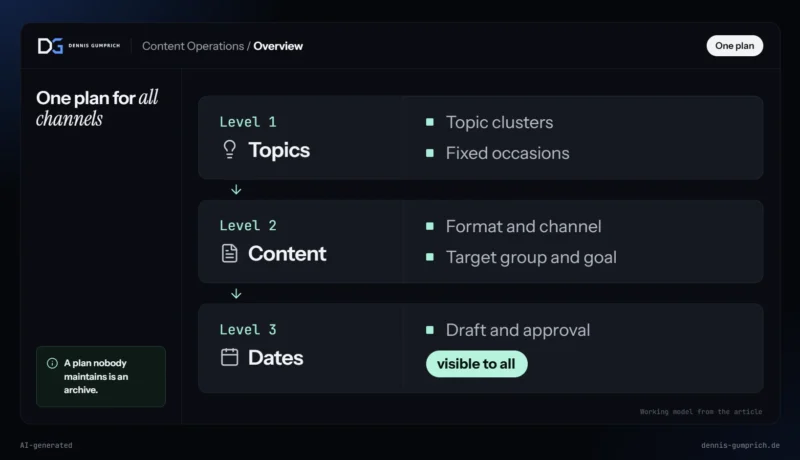

An editorial calendar defines which piece of content on which topic is created, approved and published in which channel, by whom and by when. A good template has twelve to fifteen fields, including topic, format, channel, target group, goal, responsibility, status and three dates for draft, approval and publication. Planning happens on four levels: year, quarter, month and week. Excel is enough as long as few people and channels are involved. As soon as specialist departments, several channels and approvals come in, the plan needs a shared place where the work also happens.
This article provides the template for the editorial calendar itself. When it pays to switch planning from channels to topics is shown in From editorial plan to topic plan.
What is an editorial calendar?
An editorial calendar is the time and organizational planning of content. It connects topics with formats, channels, responsible people and dates. It answers the question of what appears when and where, and who takes care of it.
In everyday work, several terms get mixed up: editorial calendar, content calendar, topic plan, content plan. They describe different levels of the same task. If you separate them, you can plan in a more targeted way and avoid discussing strategic questions in the weekly calendar.
| Term | Guiding question | Time horizon |
|---|---|---|
| Content strategy | Why and for whom do we publish? | One to three years |
| Topic plan | Which topics do we cover, with which priority? | Year and quarter |
| Editorial calendar | Which content is created when, where and by whom? | Quarter to week |
| Content calendar | What appears on which day in which channel? | Month and week |
The editorial calendar sits in the middle. It translates topics into concrete content and tasks. How a topic plan sets priorities upstream is described in the article From editorial plan to topic plan. How to evaluate topics comparably is covered in Topic scoring.
Which fields belong in an editorial calendar template?
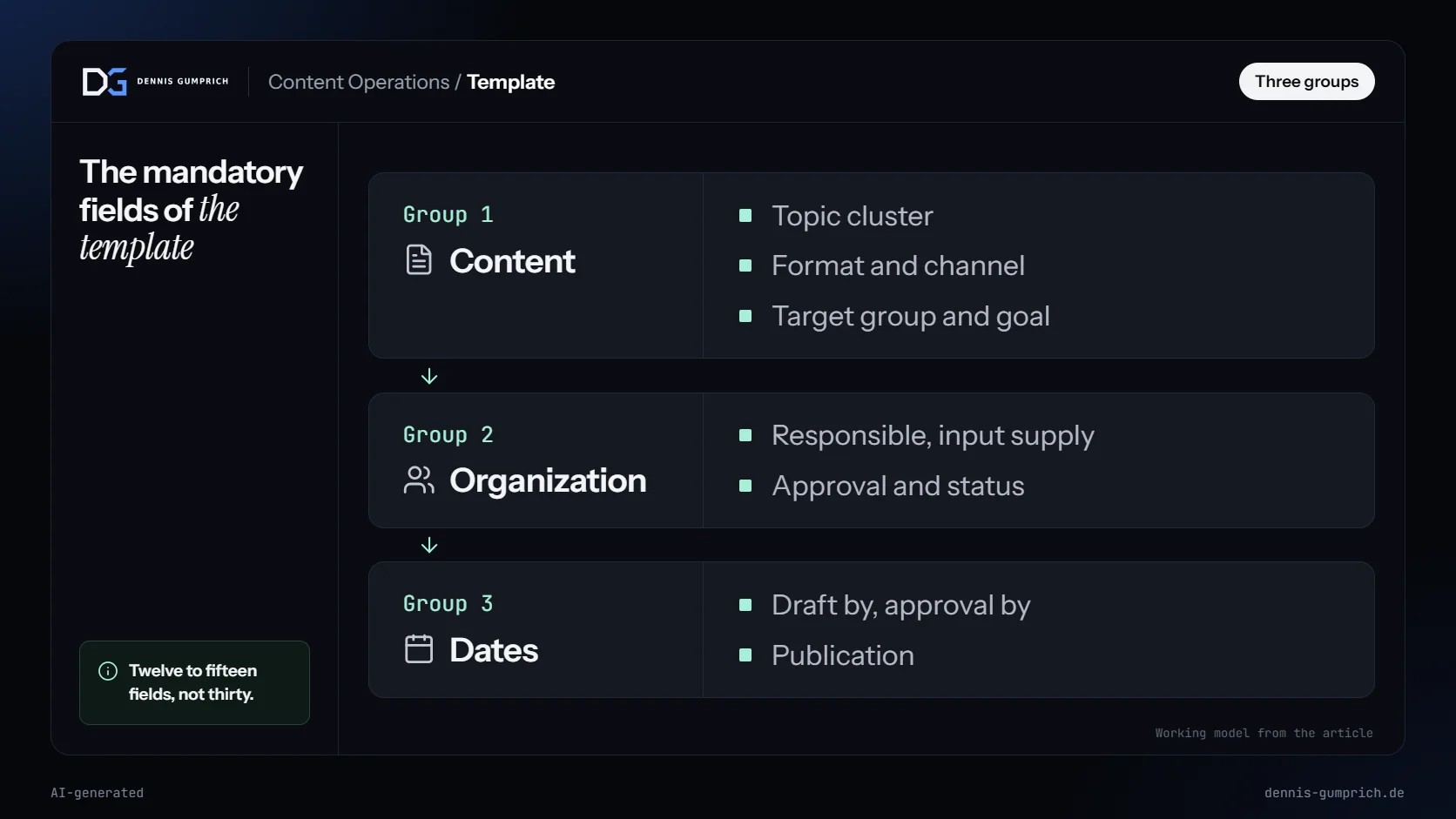
A practical template has twelve to fifteen fields in three groups: content, organization and dates. Fewer fields leave important questions open, and more fields don't get maintained in everyday work.
| Group | Field | Purpose |
|---|---|---|
| Content | Topic cluster | Assigns the content to a strategic topic |
| Working title | Makes the content clearly findable | |
| Format | Expert article, white paper, video, post, newsletter | |
| Channel | Website, LinkedIn, Instagram, newsletter, intranet | |
| Target group or persona | Who the content is for | |
| Goal | Awareness, inquiries, applications, retention | |
| Organization | Responsible | One person, not a team |
| Input supply | Specialist department or product management providing input | |
| Approved by | Who gives final approval | |
| Status | Idea, in progress, in approval, scheduled, published | |
| Dates | Draft by | Buffer for revision |
| Approval by | Realistic for the approval loop | |
| Publication | Date and time per channel |
Two fields are forgotten particularly often: input supply and goal. Without input supply, it remains unclear when the specialist department has to deliver its input, and the deadline slips. Without a goal, you can't say later whether the content worked. If you maintain these fields, you can derive reporting directly from the editorial calendar.
How do you structure an editorial calendar?
On four levels, from rough to detailed: the annual plan contains topic clusters and fixed occasions. In the quarter, these become content pieces. In the month, they get owners and dates. In the week, you publish and adjust.
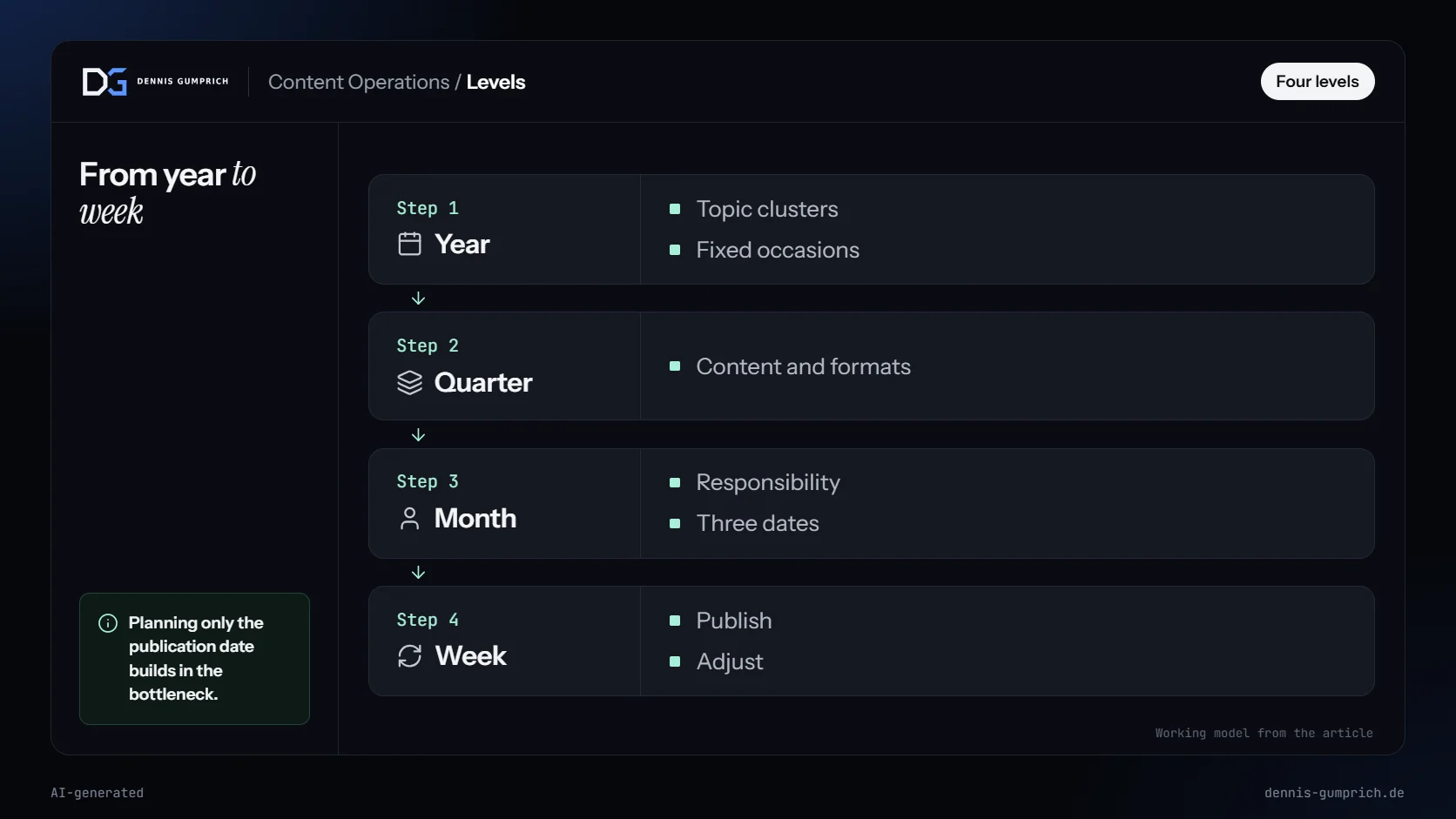
- Level 1Year: topic clusters and occasionsDefine three to six topic clusters and enter fixed occasions: trade fairs, product launches, anniversaries, seasonal topics. A trade fair cluster running from November to January needs its preparation in the summer.
- Level 2Quarter: content and formatsBreak each cluster down into concrete content: a white paper, three expert articles, eight LinkedIn posts, a newsletter focus. Check which formats can be derived from one core piece.
- Level 3Month: responsibility and datesEach piece of content gets a responsible person, an input supply and three dates. Plan approvals realistically. If an approval takes ten days on average, a draft deadline three days before publication is not planning.
- Level 4Week: publish and adjustIn a short weekly meeting, you check status, bottlenecks and current occasions. Short-term topics get space without the plan losing its direction.
In B2B in particular, a rhythm has proven itself: twice a year, marketing, product management and industry managers meet for a strategy session and define the topic clusters. During the year, planning, creation and approvals run in the editorial calendar. That keeps the plan connected to the business without every individual decision being made in a large group.
What is different about a social media editorial calendar?
A social media editorial calendar works with a higher frequency, short lead times and channel-specific formats. It needs additional fields for image format, hashtags, time and paid reach. The topics should still come from the same topic plan as the website and newsletter.
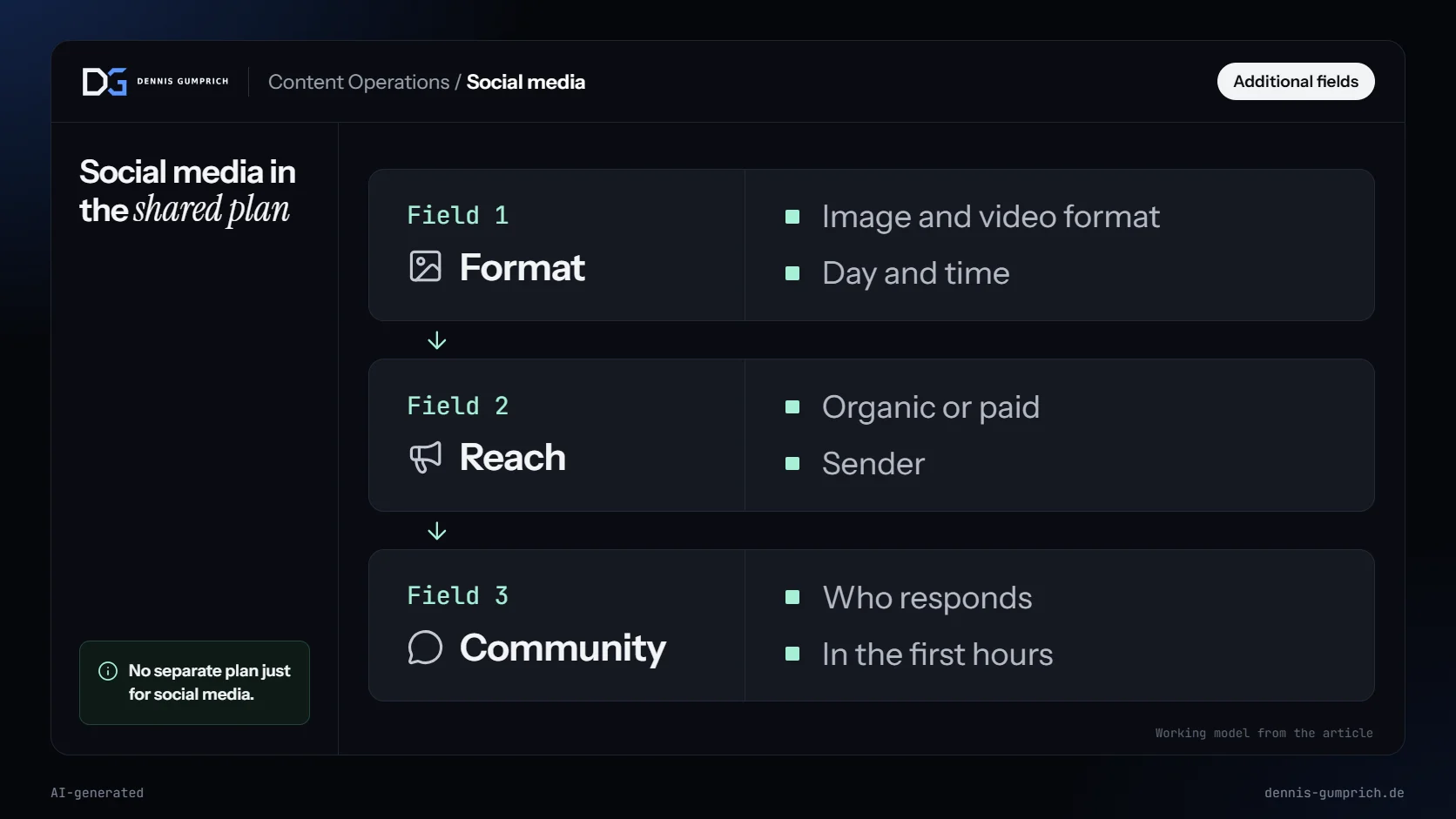
The most common mistake is a separate social media plan maintained independently of the rest of the editorial calendar. Then a topic is created for social media but not used equally for the website, newsletter or print. A shared plan with channel as a filter is better. That way, you see which topic runs in which channels and where it is still missing.
| Field | Purpose |
|---|---|
| Image and video format | Portrait, square, carousel, short video per channel |
| Publication time | Day and time based on the channel's experience |
| Organic or paid | Whether the post is promoted, with budget and duration |
| Sender | Company page or corporate influencer |
| Community management | Who responds to comments in the first hours |
The community management field is often underestimated. A post that triggers questions needs someone to answer. How to handle comments and messages from all channels centrally is described in the article Social inbox. For posts by employees, the guide to corporate influencers helps.
When is an editorial calendar in Excel no longer enough?
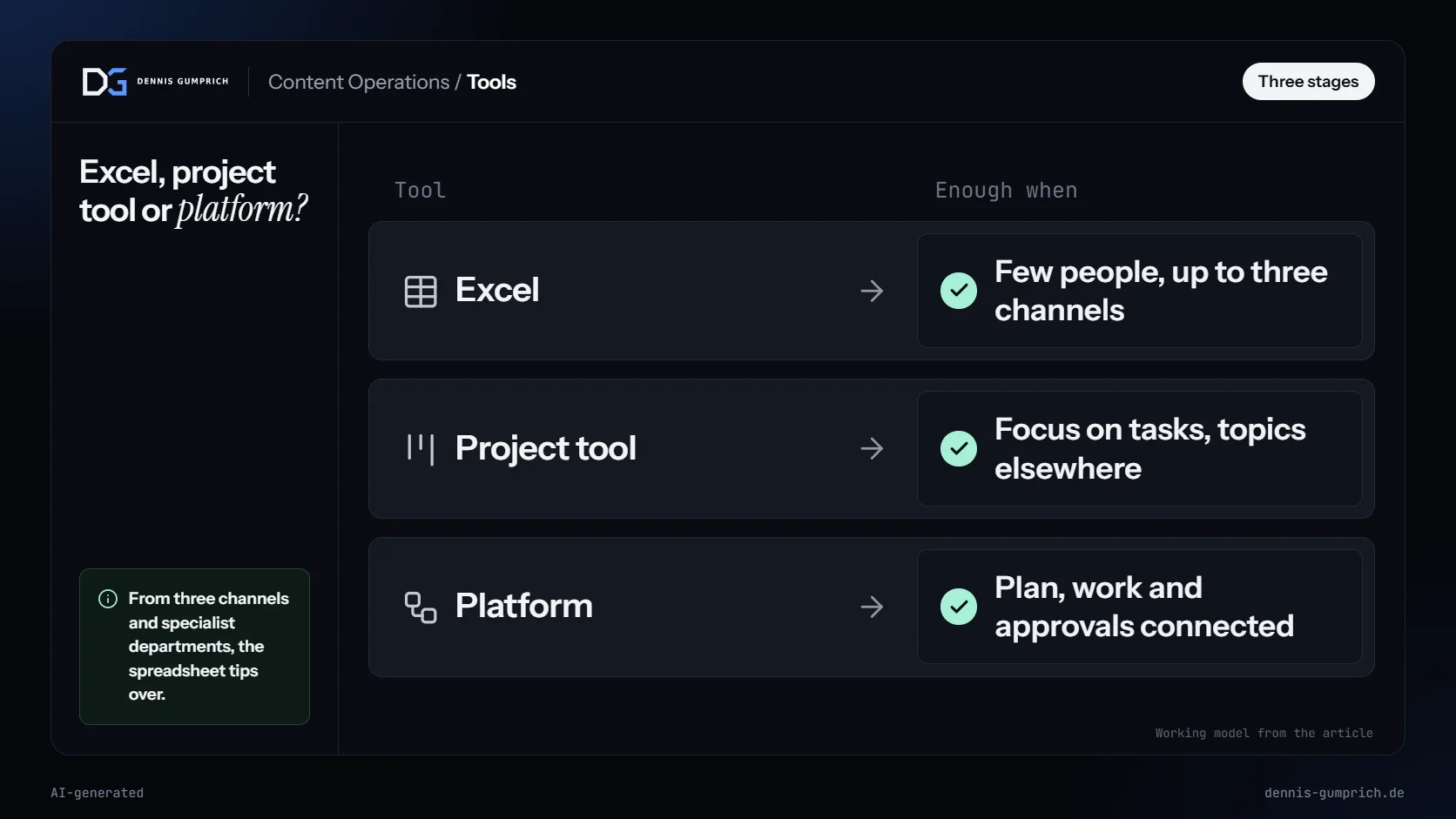
Excel is enough as long as few people, few channels and short approval routes are involved. From three channels, several specialist departments or approvals with more than one stage at the latest, the plan becomes a side task that nobody keeps up to date.
Typical signs that the spreadsheet is reaching its limits:
- The status in the plan no longer matches reality, because coordination happens via email and chat.
- Several versions of the file circulate, and nobody knows which one applies.
- Specialist departments don't see the plan, or only as an export they can't comment on.
- It is not apparent which topics are covered in which channels and where there are gaps.
- Approvals, drafts and images are stored separately from the plan.
- A topic is planned but not lived: the roadmap exists in theory, while everyday work runs alongside it.
Project management tools solve part of this, mainly tasks and responsibilities. What they usually lack is topic logic, channels, approvals and the connection to the actual content. Where the line lies is described in the articles Content planning in Excel and Asana, Notion or content platform.
Who maintains the editorial calendar, and how do specialist departments get involved?
One person is responsible for the plan, not for every piece of content. They keep status and dates up to date and lead the weekly meeting. Specialist departments should be able to see and comment on the plan without having to maintain it themselves.
In many organizations, content comes from specialist departments: product management, HR, sales, engineering. They provide input, check facts and approve. An editorial calendar that only marketing sees therefore creates follow-up questions and delays. Three rules help:
- Read access for everyone involved: specialist departments see when their topic is planned and when their input is needed.
- Input supply as a separate date: the specialist department's input has its own date, not just the publication date.
- Approval in preview: experts review the content as it will appear, not as text in an editor.
How handovers between marketing and specialist departments work without friction is described in the article Handovers without friction. Which roles a content team needs for this is covered in Who does what in the content team.
How does AI help with the editorial calendar?
AI can suggest topic ideas, derive content for several channels from one topic, detect gaps in the plan and prepare a weekly analysis before the editorial meeting. Deciding and prioritizing remain the team's job.
AI is particularly effective where the plan fails today because of effort. If drafts for the website, LinkedIn and newsletter are automatically created from an approved topic brief, already in the plan and assigned to the right person, an idea becomes a fully used topic faster. How to turn one briefing into several formats is described in the article One brief, five formats.
A second application is feedback. If the AI summarizes before the weekly meeting which content performed well and which topics are underrepresented, the conversation starts with facts instead of impressions. The prerequisite is that plan and analysis come together in one place.
Editorial calendar example: one quarter for a B2B team
An example shows how a topic cluster becomes a quarterly plan. An industrial company with four people in marketing plans the cluster "Energy efficiency in production" for the first quarter, with a trade fair in March as the highlight.
| Month | Content | Format and channel | Responsible | Input supply |
|---|---|---|---|---|
| January | Core piece: guide to energy efficiency | White paper, website | Content lead | Product management by January 10 |
| January | Three insights from the guide | Post series, LinkedIn | Social media | From the white paper |
| February | Customer case study | Expert article, website and newsletter | Editorial | Sales by February 1 |
| February | Trade fair invitation | Newsletter, LinkedIn | Marketing | Trade fair team by February 15 |
| March | Live coverage from the trade fair | Short videos, LinkedIn and Instagram | Social media | On site |
| March | Follow-up report with conversation topics | Expert article, website and intranet | Editorial | Sales after the trade fair |
The example shows three principles. First, a core piece is created first, from which further formats are derived. Second, every input supply has its own date, so product management and sales know when their contribution is needed. Third, the same topic runs across several channels instead of inventing a new topic for each channel.
Which KPIs belong to the editorial calendar?
Two kinds: process KPIs, such as on-time delivery and lead time, and impact KPIs, such as reach, inquiries or applications per topic. If you keep both in view, you can sharpen the plan specifically after each quarter.
The process KPIs show whether the plan is realistic. If approval deadlines regularly slip, the problem rarely lies with individuals, but with buffers that are too tight or unclear responsibilities. The impact KPIs show which topics carry. What matters is that they are assigned to the topic cluster, not just the channel. Then you see whether a topic works overall, even if it performs weaker in one channel. Which KPIs have proven themselves for content operations is described in the article Making content production measurable.
What mistakes do teams make with the editorial calendar?
Most editorial calendars don't fail because of the template, but because of maintenance, responsibility and a missing connection to everyday work.
- Too many fieldsA template with 30 columns stops being maintained after a few weeks. Start with the mandatory fields and only add what you actually evaluate.
- Planning only the publication dateIf you don't schedule draft, input supply and approval, you build in the bottleneck.
- Separate plans per channelSocial media, website and newsletter plan side by side. Topics aren't exploited, messages contradict each other.
- Nobody is responsibleA plan without a responsible person becomes outdated. The status is then wrong, and everyone asks by email again.
- Plan and work separatedIf drafts, approvals and images are stored elsewhere, the plan becomes documentation instead of a steering tool.
Self-check: how well does your editorial calendar hold up?
Tick everything that applies to you.
a short proposal on our content planning:
Our planning is currently spread across several tools and spreadsheets. As a result, we can't see at a glance what appears when in which channel, and specialist departments find out too late when their input is needed.
I suggest building a shared editorial calendar on four levels for the coming year: topic clusters for the year, content per quarter, owners and dates per month, and a short weekly meeting. Every piece of content gets its own dates for draft, approval and publication.
After one quarter, we check whether deadlines are met better and topics are used across all channels.
Conclusion: an editorial calendar only works when it is lived
A good editorial calendar template is built quickly. What is harder is keeping the plan accurate in everyday work: status and dates up to date, specialist departments delivering their input on time and topics used across all channels. If you plan on four levels, schedule approvals realistically, name a responsible person and bring plan and work together in one place, you turn a spreadsheet into a steering tool.
Start with the next quarter. Enter the topic clusters, break them down into content and plan three dates for each piece of content. After three months, you will know where the plan holds up and where it needs sharpening.
Frequently asked questions
What belongs in an editorial calendar?
At least topic, working title, format, channel, target group, goal, responsible person, input supply, approval, status and dates for draft, approval and publication. Additional fields are only worthwhile if you also evaluate them.
How far ahead should an editorial calendar reach?
Topic clusters and fixed occasions for a year, concrete content for a quarter, owners and dates for the coming month. Planning in more detail is rarely worthwhile, because topics and priorities shift.
Do we need a separate social media editorial calendar?
No, a shared plan with channel as a filter and additional fields for image format, time and promotion is better. That keeps topics connected across all channels.
Is Excel suitable for an editorial calendar?
For small teams with few channels, yes. As soon as several specialist departments, channels and approval stages are involved, Excel lacks the connection to drafts, approvals and status. Then a shared tool in which the work also happens is worthwhile.
Who should be responsible for the editorial calendar?
A person with an overview and dedicated time, often the head of editorial or content operations. They keep the plan up to date and lead the weekly meeting. The respective owners are responsible for the individual pieces of content.
Where does your content process lose time today?
In 30 minutes, we look together at where unnecessary coordination, manual tasks, tool switching or repetitive content work cost you time today.
If you want to set up your editorial calendar anew, we go through topics, channels and approval routes and sketch a template that fits your team.
Analyze your content process in 30 minutes Free of charge. You take away concrete starting points you can use internally right away.
Dennis Gumprich
Dennis helps marketing and communication teams fit generative AI into existing content processes without undermining quality, brand voice and approvals. Focus areas: content operations, AI governance and tool selection in mid-sized companies and corporations.
Transparency note: Dennis works for contentbird, a provider of AI-powered content software. Product mentions are marked in the article. More about Dennis (in German) · LinkedIn
Read more
Sources
- This article is based on consulting practice with marketing and communication teams. No external studies were used.
How this article was created
This article was created with the help of AI. Structure and draft wording were developed with AI support. Professional assessment, review of the statements and the final version are the responsibility of Dennis Gumprich. The English version was translated with AI and reviewed. Read the original German version.
How reliable are the statements?
The definitions, template, planning levels and additional fields are working models from consulting practice, not measured values. The challenges described come from conversations with marketing and communication teams in 2026.


