
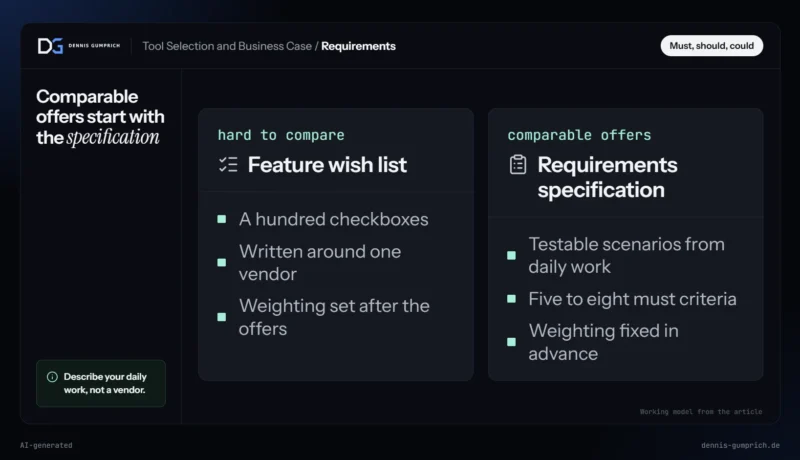

A requirements specification describes, from the buyer's point of view, what software should achieve, not how. A good requirements specification template for content software has eight chapters: background, goals, current process, functional requirements, non-functional requirements, interfaces, framework conditions and evaluation criteria. Each requirement is classified as must, should or could and written so that it can be checked in a demo or a test. Five to eight must criteria at most keep competition open. A robust specification is feasible in six weeks if business, IT and data protection are involved from the start.
What is a requirements specification, and how does it differ from a functional specification?
The requirements specification describes the buyer's requirements: what is needed and why. The functional specification describes the vendor's implementation: how the requirements are met. A requirements catalog is usually the core of the requirements specification, the prioritized list of all requirements. In German-speaking markets, this pair is known as Lastenheft and Pflichtenheft.
| Document | Who writes it? | Guiding question |
|---|---|---|
| Requirements specification | Buyer | What should the solution achieve, and why? |
| Requirements catalog | Buyer, as part of the requirements specification | Which requirements, in which priority? |
| Functional specification | Vendor | How exactly do we meet the requirements? |
With standard software delivered as a service, the functional specification is often dropped or replaced by the offer and a configuration description. The requirements specification remains important all the same: it forces the team to agree before the selection, and it makes offers comparable. If you run a public tender, you need it anyway as the basis of the service description.
How is a requirements specification for content software structured?
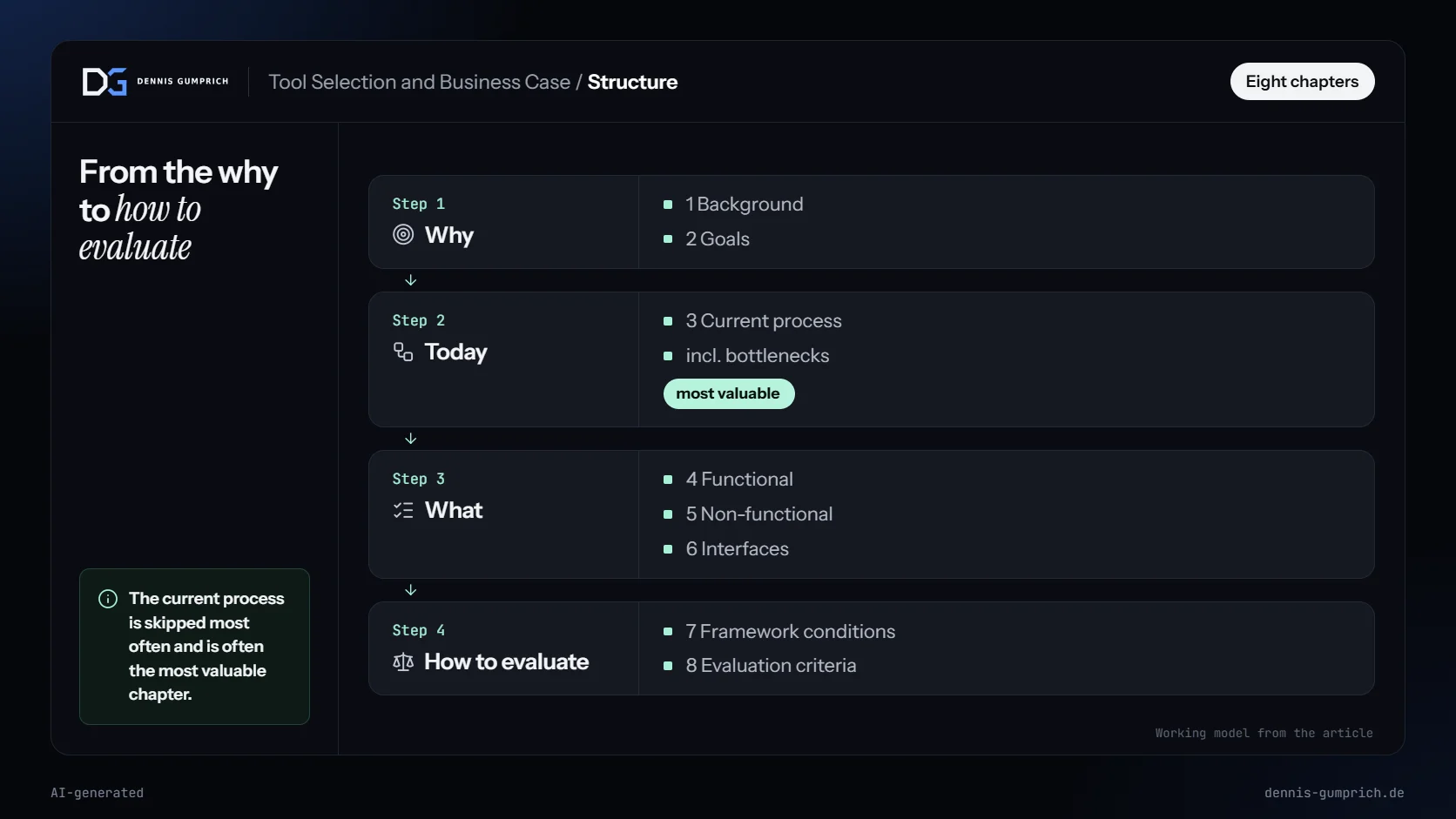
In eight chapters, from the why to how to evaluate: background, goals, current process, functional requirements, non-functional requirements, interfaces, framework conditions and evaluation criteria. A timeline for selection and rollout completes it.
- Chapter 1BackgroundWho are you, how many people work with content, in which channels, with which tools? Two pages are enough. Vendors understand from this what scale you are thinking in.
- Chapter 2GoalsWhat should be better after the rollout? Phrased measurably, for example: halve the cycle time per piece of content, plan topics transparently across all channels, involve departments without email loops.
- Chapter 3Current processHow is a piece of content created today, from idea to publication? Where does it get stuck? This description is more valuable to vendors than any feature list.
- Chapter 4Functional requirementsWhat must the software be able to do? Structured by areas such as planning, creation, AI, approval, publication and reporting, each with must, should or could.
- Chapter 5Non-functional requirementsData protection, information security, hosting, availability, accessibility, languages, support. This is often where the real exclusion criteria lie.
- Chapter 6InterfacesWhich systems need to be connected: CMS, intranet, PIM, social media channels, newsletter, analytics? In which direction does data flow?
- Chapter 7Framework conditionsNumber and type of users, roles and permissions, desired contract term, rollout and training, timeline.
- Chapter 8Evaluation criteriaHow are offers compared? Weighting of functionality, usability, security, cost and collaboration, set before the offers arrive.
The third chapter is skipped most often and is often the most valuable. Describing the current process forces vendors to demonstrate their solution against your bottlenecks rather than their favorite features. How to map the process beforehand is described in Measuring process maturity.
Requirements specification template: requirements by must, should and could
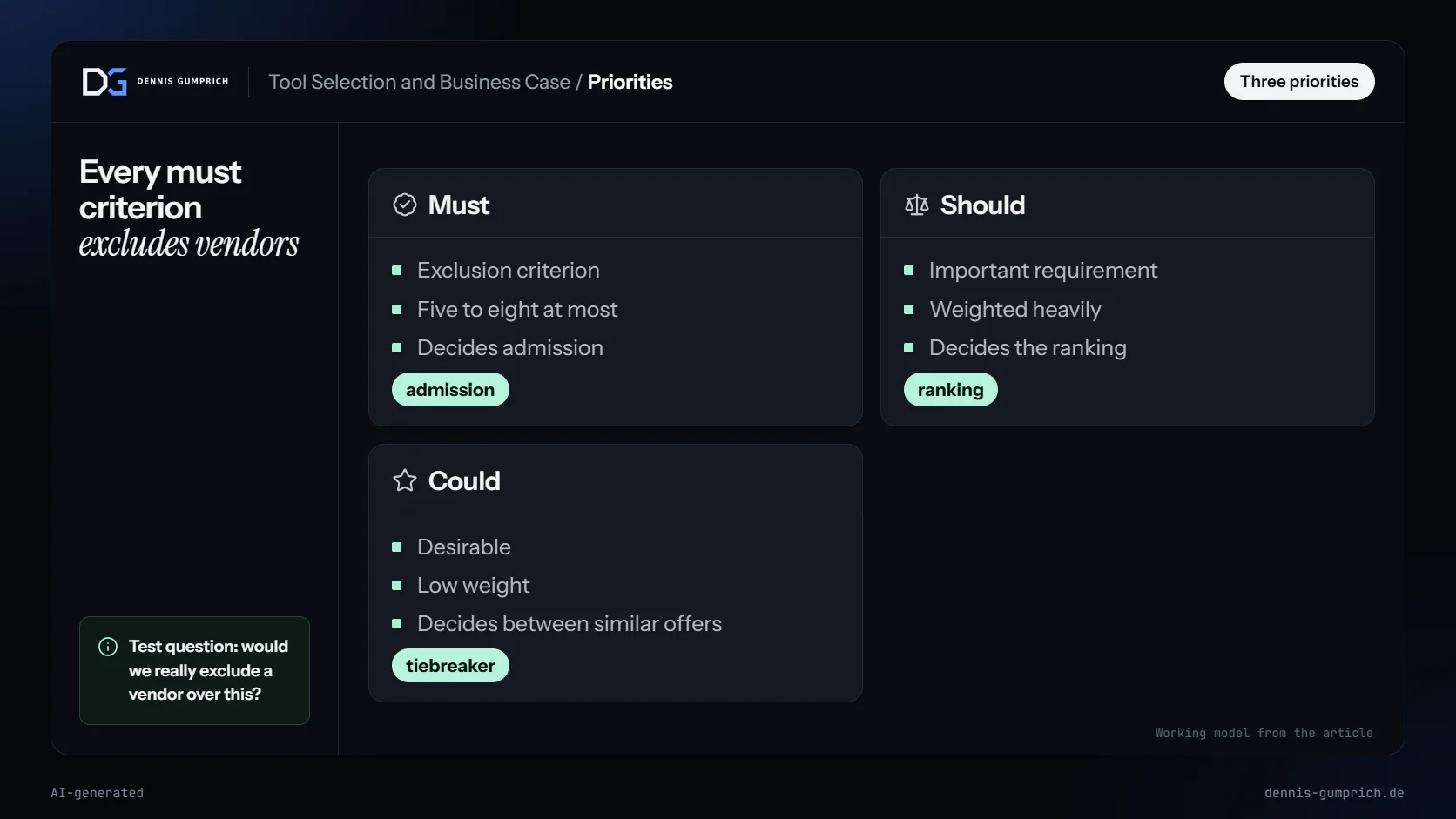
The following template shows typical requirements for content software, divided into must, should and could, similar to the MoSCoW method. It is a starting point, not a finished specification. Delete what you do not need and add what defines your daily work.
| Area | Requirement | Priority |
|---|---|---|
| Planning | Topics, content and channels are managed in a shared plan with status, responsibility and dates | Must |
| Planning | Topics can be structured hierarchically, for example topic area, topic, content | Should |
| Creation | Content is created and edited in the system, with version history | Must |
| AI | AI features use the stored brand voice and target groups | Must |
| AI | Drafts for several channels can be derived from one briefing | Should |
| AI | Inputs are not used to train the models | Must |
| Approval | Multi-stage approval with defined people and deadlines | Must |
| Approval | Departments comment and approve without a full user license | Should |
| Publication | Direct publication or draft handover to CMS and social channels | Should |
| Reporting | Metrics per piece of content and topic across all channels | Should |
| Reporting | Measure visibility in AI search systems | Could |
| Data protection | Data processing agreement under the GDPR, hosting in the EU | Must |
| Security | Role and permission concept, single sign-on | Should |
| Interfaces | Open API and standard connectors to common systems | Must |
| Community | Answer comments and messages from social channels centrally | Could |
| Rollout | Guided onboarding with training for the user groups | Must |
Watch the number of must criteria. In this template there are eight, and that is rather the upper limit. Every additional must excludes vendors and increases the risk that in the end nobody meets everything and you soften the criteria after all. A more detailed catalog specifically for newsroom organizations can be found in Newsroom software: the requirements catalog.
How do you write requirements so that they can be checked?
A good requirement describes an outcome, not a feature, and can be verified in a demo or a test. It states who, what and under which condition. Vague words such as "intuitive" or "flexible" cannot be evaluated. The international standard for requirements engineering, ISO/IEC/IEEE 29148, also lists verifiability as a characteristic of a well-formed requirement.
"The software should have an intuitive approval function and be flexibly adaptable to our processes."
"An editor can send a piece of content to two defined people in sequence for approval. The approvers see the content in preview, can comment and approve without their own full license. The editor can see at any time who currently has the content."
The second wording is longer, but every vendor can either show it in a demo or not. It helps to write requirements as small scenarios taken from your daily work. A scenario such as "One topic briefing produces a specialist article, three LinkedIn posts and a newsletter teaser" says more than ten individual features.
Three questions come up again and again in conversations with communications teams and therefore belong explicitly in the specification:
- Which systems can be connected without additional development effort? And what does a custom connection cost? The difference between an open API and a standard connector is explained in MCP or API.
- Who needs a license? Departments supply content and approve it, but rarely work in the system every day. Clarify whether there are roles for commenting and approving without a full license.
- How are AI features billed? Flat rate, per user or by usage? With usage-based models you need an estimate for your volume.
How do you evaluate the offers?
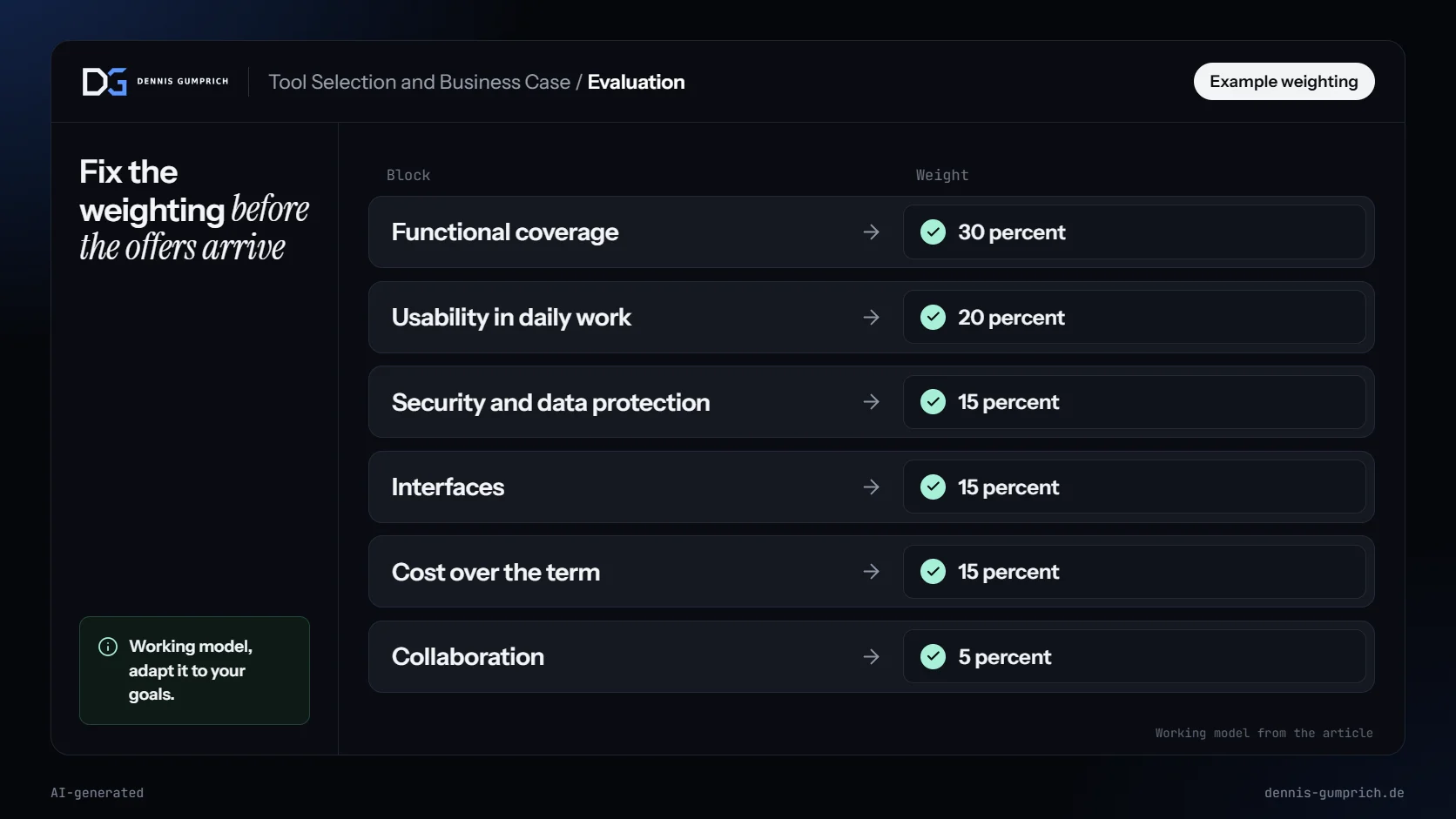
With weighted scoring, whose weighting you set before the offers arrive. Must criteria decide admission, should and could criteria decide the ranking. Cost is a block of its own, not a tiebreaker.
| Block | Weight | What is evaluated |
|---|---|---|
| Functional coverage | 30 percent | Fulfillment of should and could requirements |
| Usability in daily work | 20 percent | Test with your own content and future users |
| Security and data protection | 15 percent | Evidence, hosting, contracts |
| Interfaces | 15 percent | Connecting your own systems with reasonable effort |
| Cost over the term | 15 percent | Licenses, AI usage, rollout, connections |
| Collaboration | 5 percent | Onboarding, support, further development |
The most important block is usability in daily work, and it can only be tested with your own content. Demos with sample data look good with every vendor. So ask for a short test in which your editorial team runs a real piece of content from briefing to approval. How such a test is set up is described in Pilot and rollout. How to translate the cost over the term into a business case is covered in Business case for content software.
A requirements specification in six weeks
A robust requirements specification takes six weeks if business, IT and data protection are involved from the start and the work is split into clear stages.
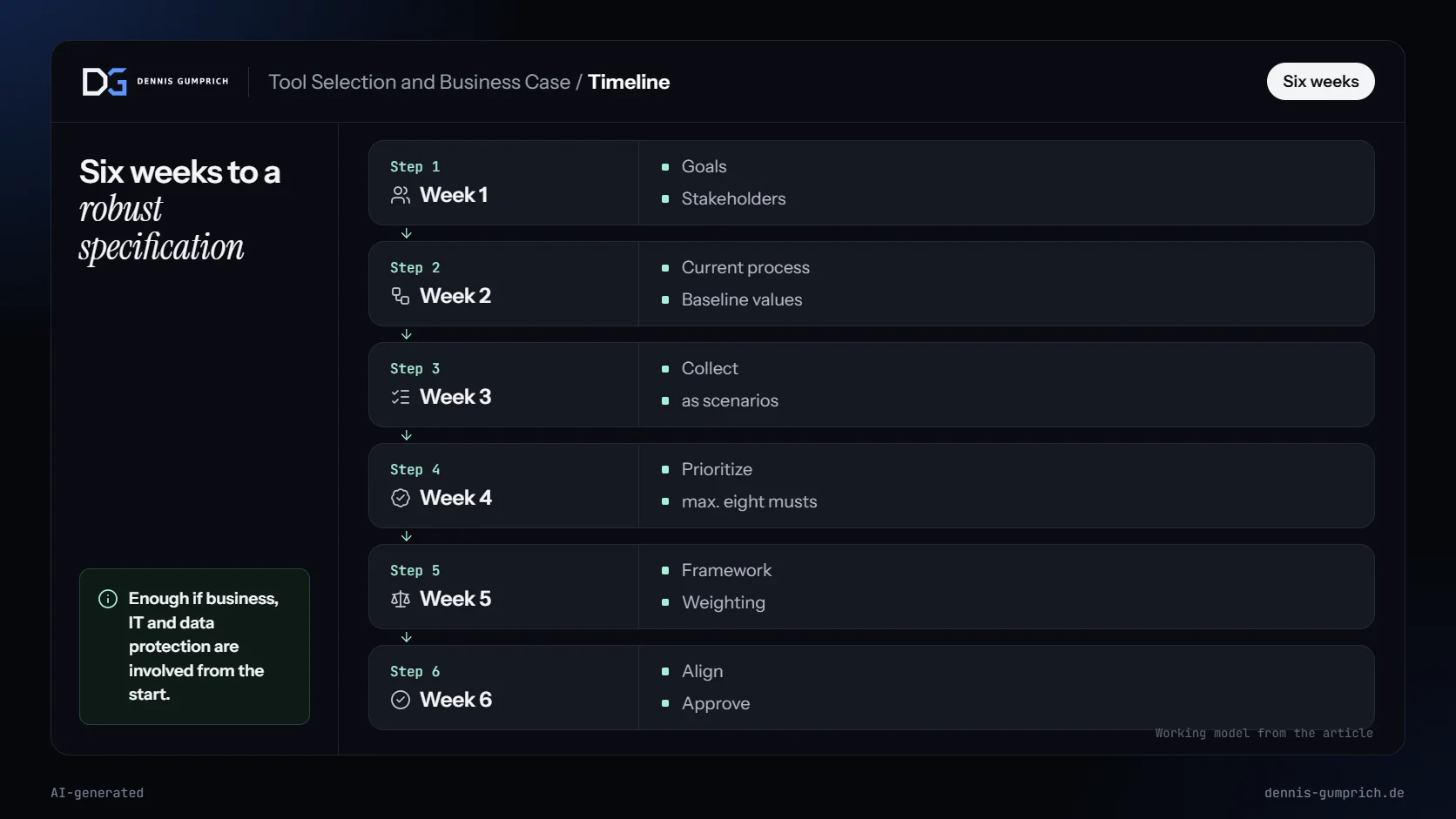
- Week 1Clarify goals and stakeholdersSet three to five measurable goals and name the stakeholders: business, future users, IT, data protection, procurement. Register the project early with IT and data protection, as described in Involve IT and data protection early.
- Week 2Describe the current processRun two typical pieces of content from idea to publication and note where things get stuck. Capture baseline values such as cycle time and approval duration along the way.
- Week 3Collect requirementsCollect requirements from all groups, phrase them as testable scenarios and assign them to the areas.
- Week 4PrioritizeClassify each requirement as must, should or could. Limit the must criteria to five to eight. Discuss every must with the question: would we really exclude a vendor who does not meet this?
- Week 5Set framework and evaluationAdd user numbers, roles, interfaces and timeline. Set the weighting of the evaluation before any offer is on the table.
- Week 6Align and approveHave all stakeholders review the specification and approve it. Then vendor outreach begins.
Which non-functional requirements belong in the specification?
Everything that concerns operation rather than function: data protection, information security, hosting, availability, accessibility, languages and support. In many organizations this is where the real exclusion criteria lie, and this is where IT and data protection ask their questions.
| Area | Typical requirement | Evidence |
|---|---|---|
| Data protection | Processing under the GDPR, data processing agreement, list of subprocessors | Contract documents |
| AI use | No use of inputs for training, documented models and providers | Vendor's AI policy |
| Hosting | Data centers in the EU, backup and recovery | Technical description |
| Security | Encryption, roles and permissions, login via single sign-on | Security concept, certificates where applicable |
| Availability | Guaranteed availability and response times | Service level agreement |
| Accessibility | Operable by keyboard and screen reader, where required for your organization | Vendor statement |
| Support | Contact person in your language, training, documentation | Support concept |
Precision pays off especially with AI features. Do not only ask whether data is used for training, but also which models are used, where processing takes place and how AI features can be restricted for individual user groups. What matters in the detailed review is described in GDPR-compliant content marketing software.
How do you describe interfaces in the specification?
As a list of systems with the direction and purpose of the data flow: which system, which data, which direction, how often. The vendors supply the technical details, you describe what needs to flow.
A simple table is enough: CMS, intranet, employee app, social channels, newsletter tool, product database, image database, analytics tools. For each system, note whether content is to be sent in, data fetched or both, and whether this happens manually, with one click or automatically. The key question is which connections are included in the offer and which have to be developed or paid for separately. This distinction often determines the total cost more than the license price. How content gets into the target system after approval without copying is described in The last mile.
Which mistakes do teams make with the requirements specification?
Most mistakes make specifications too narrow, too vague or aligned too late.
- Feature lists instead of processesA hundred checkboxes say little about whether your editorial team gets faster. Describe scenarios from daily work.
- Too many must criteriaBeyond about eight exclusion criteria, hardly any vendor is left. In the end, criteria are softened and the process loses credibility.
- Describing a specific solutionWriting the specification around one vendor's features prevents real competition and overlooks better approaches.
- IT and data protection too lateIf security requirements only appear after the selection, the process starts over.
- Setting the weighting after the offersIf you only fix the weighting once the offers are in, you unconsciously score in favor of a favorite.
Self-check: how robust is your requirements specification?
Tick everything that applies to you.
A short proposal on how to approach the software selection:
Before we request offers for content software, we should create a requirements specification. It describes our goals, the current process and the requirements, divided into must, should and could. This makes offers comparable and prevents late requirements from IT or data protection from delaying the process.
I suggest a period of six weeks, with the business side, future users, IT, data protection and procurement. We set the weighting for the evaluation before offers arrive.
After that we can approach three to four vendors in a targeted way and agree on a short test with our own content.
Conclusion: a good requirements specification describes your daily work, not a vendor
A requirements specification for content software is less a feature list than a description of what should be better after the rollout. If you phrase goals measurably, describe the current process realistically, write requirements as testable scenarios, limit must criteria and set the evaluation in advance, you get comparable offers and a decision that holds up later.
Use the template as a starting point. Consistently delete what you do not need and add the two or three requirements that really define your daily work. These are what ultimately decide whether the rollout succeeds.
Frequently asked questions
What belongs in a requirements specification?
Background, goals, current process, functional and non-functional requirements, interfaces, framework conditions such as user numbers and timeline, and the criteria by which offers are evaluated.
Who creates the requirements specification?
The buyer, meaning the company that wants to introduce the software. The business side usually leads, supported by IT, data protection and procurement. External consulting can help but should not adopt the requirements of a particular vendor.
How many pages should a requirements specification have?
As many as necessary, as few as possible. For content software, ten to twenty pages plus a requirements table are often enough. What matters is that every requirement can be checked.
Is the requirements specification template available as Word or Excel?
The tables in this article can be copied directly into Word or Excel. A combination has proven effective: chapters 1 to 3 and 7 as a text document, the requirements and the evaluation as a table with columns for area, requirement, priority and fulfillment per vendor.
What is the difference between must, should and could criteria?
Must criteria are exclusion criteria: a vendor that does not meet them is out. Should criteria are important and carry a lot of weight in the evaluation. Could criteria are desirable and decide between otherwise similar offers.
Where does your content process lose time today?
In 30 minutes, we look together at where unnecessary coordination, manual tasks, tool switching or repetitive content work cost you time today.
You get a concrete assessment of which tasks you can simplify, automate or organize better, and where AI and tools actually help instead of adding complexity.
Analyze your content process in 30 minutes Free of charge. You take away concrete starting points you can use internally right away.
Dennis Gumprich
Dennis helps marketing and communication teams fit generative AI into existing content processes without undermining quality, brand voice and approvals. Focus areas: content operations, AI governance and tool selection in mid-sized companies and corporations.
Transparency note: Dennis works for contentbird, a provider of AI-powered content software. Product mentions are marked in the article. More about Dennis (in German) · LinkedIn
Read more
Sources
- International Organization for Standardization (ISO): ISO/IEC/IEEE 29148:2018 Systems and software engineering: Life cycle processes, Requirements engineering, international standard on requirements engineering, including the characteristics of well-formed requirements such as verifiability. Accessed November 26, 2026.
- European Union: Regulation (EU) 2016/679 (General Data Protection Regulation), in particular Article 28 on processors and the data processing agreement. Accessed November 26, 2026.
How this article was created
This article was created with the help of AI. Structure, research and draft wording were developed with AI support. Professional assessment, review of the statements and the final version are the responsibility of Dennis Gumprich. The English version was translated with AI and reviewed. Read the original German version.
How reliable are the statements?
Backed by sources are the reference to verifiability as a characteristic of well-formed requirements in ISO/IEC/IEEE 29148 and the data processing agreement under Article 28 GDPR. The structure, example requirements, priorities, weighting and timeline are working models from consulting practice, not collected measurements. The questions on interfaces, licenses and AI billing come from conversations with communications teams in 2026. This article does not replace advice on public procurement law.


