

Claude Skills are stored work instructions for Claude: a folder with a SKILL.md file that describes how a specific task is done, plus templates, examples or scripts where needed. Claude loads a skill on its own as soon as a request matches its description. For marketing teams, skills pay off for tasks that run the same way every time and have clear quality rules, such as briefs, brand voice checks or approval summaries. Brand voice and facts do not belong in the skill but in the project knowledge. At the end of the article you will find four skills to download.
Three prompts, three results
Monday, 9:10 a.m. Three people on the team need a brief for a blog post. The first writes a long prompt with target group and tone. The second copies a prompt from last week's chat history. The third writes one sentence. The result is three briefs that are structured differently, contain different amounts of context and need different amounts of rework.
That is not a problem with the people, and not with the model either. What is missing is a shared standard for how this task gets done. That is exactly what Claude Skills are for: they capture a way of working once, so the result no longer depends on who happens to be prompting.
What are Claude Skills?
A Claude Skill is a folder with a file called SKILL.md. It contains a short description of when the skill is needed and instructions for how Claude proceeds. The folder can optionally hold further files: templates, examples, reference knowledge or scripts.
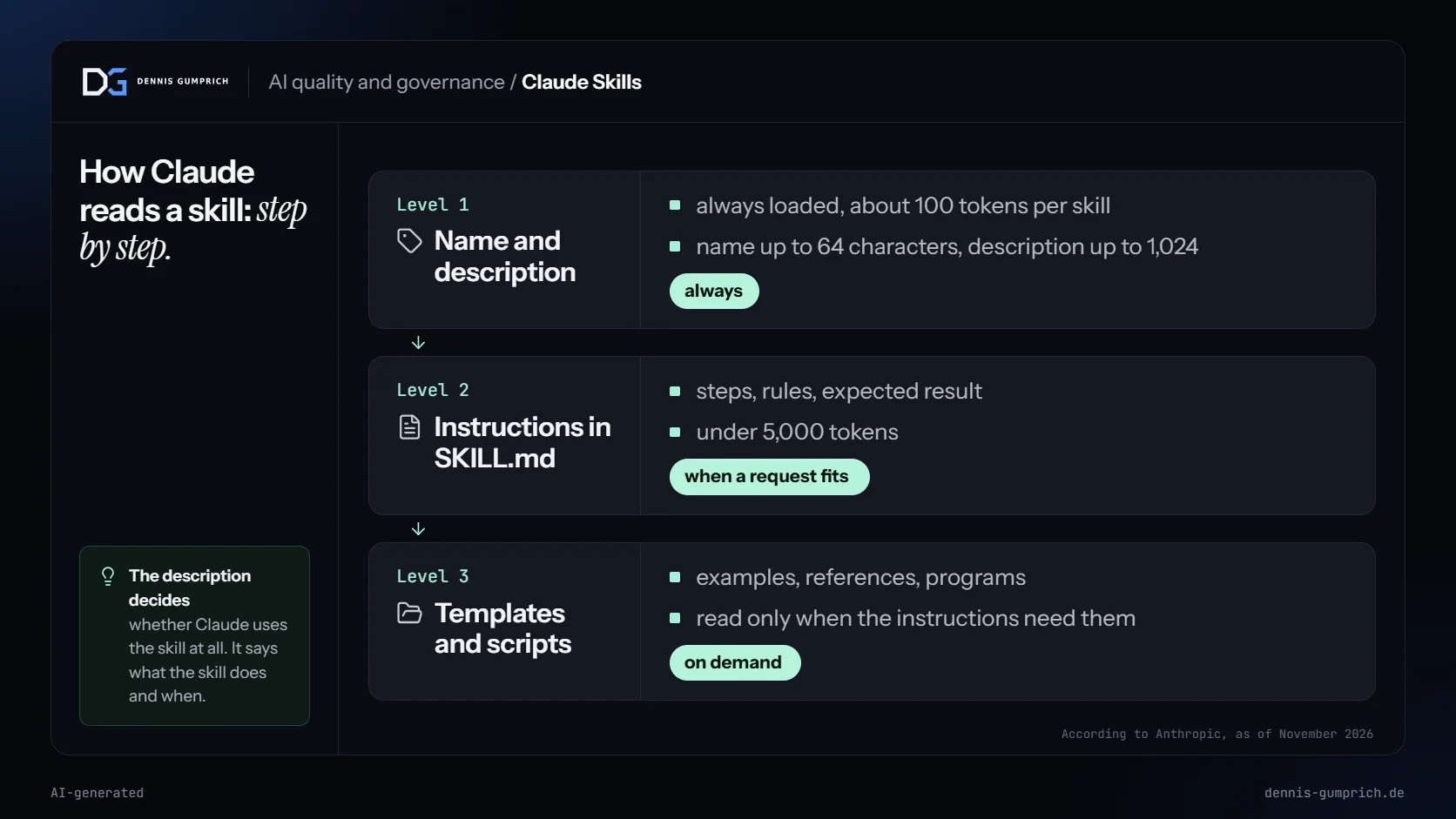
Anthropic calls the principle "progressive disclosure": Claude does not read every skill in full, only name and description at first. Only when a request matches does Claude load the instructions and, if needed, the additional files. That way many skills can be installed without overloading every conversation with instructions.
| Part | When it is loaded | Size |
|---|---|---|
| Name and description | always, for all installed skills | about 100 tokens per skill |
| Instructions in SKILL.md | when a request matches the description | under 5,000 tokens |
| Templates, references, scripts | only when the instructions need them | no context until Claude reads them |
What matters in practice: the description decides whether a skill is used at all. It has to say what the skill does and when it is needed. A vague description means Claude does not find the skill even though it is installed.
Skill, prompt or project knowledge: what goes where?
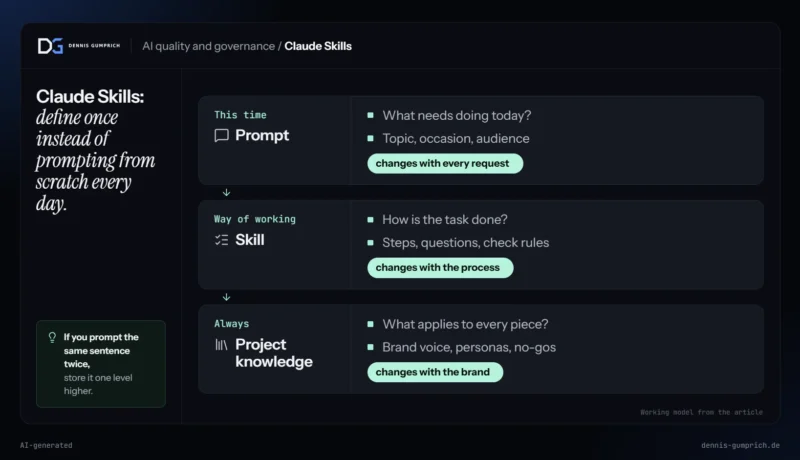
A skill defines how the work is done. A prompt says what needs doing this time. The project knowledge holds what always applies: brand voice, target groups, products, no-gos. If you mix these three levels, you build skills that go out of date with every brand change.
Many teams start with a prompt library: tested templates that each person copies and adapts. Skills go one step further. Claude recognises on its own when a skill fits, asks the necessary questions and follows check rules, without anyone having to dig out the template.
| Level | Answers | Example | Changes |
|---|---|---|---|
| Prompt | What needs doing this time? | "Brief on approval processes, target group heads of marketing" | with every request |
| Skill | How is this task done? | Brief from a fixed template, with core message, outline and open questions | when the way of working changes |
| Project knowledge | What always applies? | Brand voice, personas, products, banned terms | when the brand or offer changes |
The rule of thumb: if you write the same sentence into a prompt for the second time, store it one level higher. Work steps move into a skill, brand rules into the knowledge base. How to store your brand voice so it applies to team and AI alike is covered in a separate guide.
Which marketing tasks work as a skill?
A task works as a skill if it comes up regularly, has a clear quality rule and is done by several people. If one of the three is missing, a good prompt or a template is usually enough.
- Criterion 1The task repeatsAt least weekly, ideally daily. One-off tasks do not justify the effort.
- Criterion 2There is a quality ruleYou can describe what a good result looks like: structure, length, required details, check points. Without that rule, a skill does not know what good is either.
- Criterion 3Several people do itOnly when different people take on the same task do the differences arise that a skill evens out.
Consulting conversations with marketing and communication teams keep producing the same candidates:
| Task | What the skill defines |
|---|---|
| Writing a brief | Template with goal, target group, key statements, outline and open questions |
| Checking brand voice | Check areas, location, rule and suggestion for each deviation |
| Preparing approval | five check points so the approver can decide in one minute |
| Deriving content for channels | Format, length and structure per channel from an approved text |
| Checking environmental claims | Evidence required for every claim, review note instead of rewording |
| Filling the editorial calendar | Topics per month by campaigns, occasions and target groups |
| Measuring AI visibility | Prompt set, measurement rules, measurement sheet and metrics |
Creating Claude Skills: how a SKILL.md is structured
A SKILL.md starts with a short header containing name and description. Below it come the instructions in Markdown: goal, steps, rules and the expected result. Longer templates or examples go into separate files that the instructions refer to.
The header follows fixed rules. The name may be at most 64 characters long and may only contain lower-case letters, digits and hyphens. The words "claude" and "anthropic" are not allowed in the name. The description may be at most 1,024 characters long and must say what the skill does and when it should be used.
| File | Content |
|---|---|
| brief-from-strategy/SKILL.md | Header with name and description, then a six-step process, default lengths per content type and rules such as "invent nothing" |
| references/brief-template.md | the template with seven sections and a completed example |
Three points decide the quality in practice:
- Limit the questions: define which details are required and what the skill may assume itself. Otherwise Claude asks too much or too little.
- Make gaps visible: a rule such as "mark figures without a source as an open question" prevents invented details more reliably than any appeal in the prompt.
- Describe the result: specify the structure and form of the output, ideally with an example. That makes results comparable.
Installing Claude Skills
In Claude.ai you upload a skill as a ZIP file, in Claude Code you place the folder in a skills directory. Custom skills are not synced between these surfaces, so you install them where you work.
- Claude.ai, step 1Enable code executionUnder Settings, Capabilities, "Code execution and file creation" has to be switched on; in newer versions the option is called "Create and edit files". On Team and Enterprise plans, the admins enable skills for the organisation.
- Claude.ai, step 2Upload the ZIPUnder Customize, Skills, click "+", choose "Create skill" and then "Upload a skill". The folder in the ZIP must have the same name as the skill and contain the SKILL.md file.
- Claude.ai, step 3TestMake a request that matches the description and check whether Claude uses the skill. If it stays unused, the description is usually the cause.
- Claude CodePlace the folderPersonal skills go into ~/.claude/skills/, skills for a project into the .claude/skills/ folder in the project directory. No upload is needed.
On Team and Enterprise plans, skills can also be shared with colleagues or provided to the whole organisation. That way the team works with the same version, and changes reach everyone.
Finding and checking ready-made skills
Ready-made skills are available in GitHub collections, on marketplaces and from Anthropic itself. Most are aimed at developers. For marketing tasks it often pays to take a third-party skill as a starting point and adapt it to your processes.
A skill is more than text: it can instruct Claude to use tools, read files or run scripts. Anthropic therefore recommends installing skills only from trusted sources and checking all files beforehand. Treat a third-party skill like new software.
- Origin: who wrote the skill, and is it maintained?
- Content: do all instructions fit the stated purpose? Does the skill request network access or load content from external addresses?
- Scripts: what do bundled programs do, and do you need them at all?
- Data: what information does the skill process, and is that allowed under your AI policy?
From skill to process
A skill makes a single task reliable. A process only emerges when the result lands where it is edited further, approved and published. That requires a connection to the system in which your content is created.
As long as a brief stays in the chat window, someone has to copy it, file it and pass it on. Each of these steps is a handover where information gets lost. Through an interface such as the Model Context Protocol, Claude can work directly in a content platform: check topics, create briefs, assign content to a workflow. When such a connection makes sense is covered in the article MCP or API.
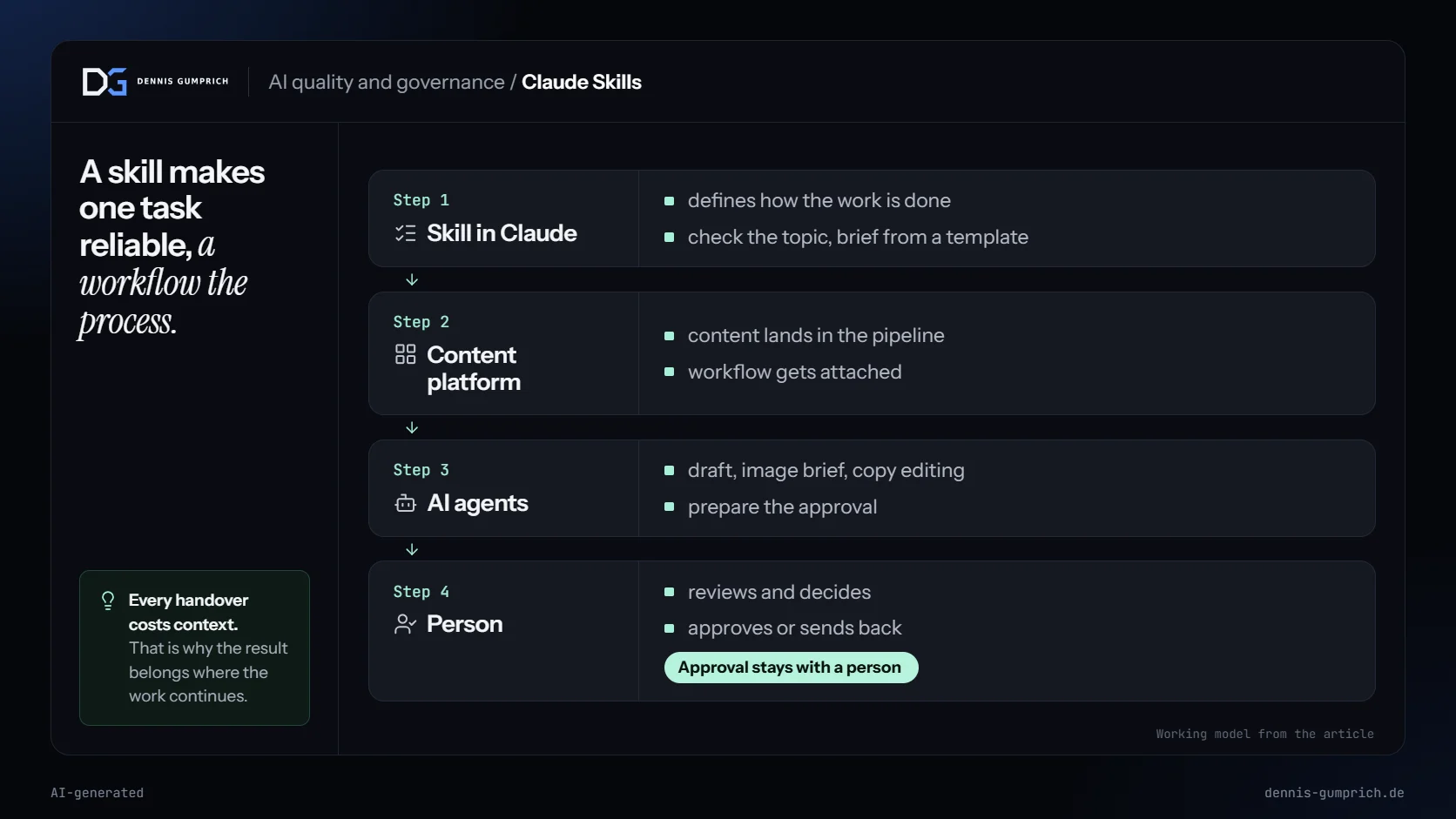
An example from my work: the skill "contentbird-editorial" creates contents directly in the contentbird content pipeline and attaches a workflow in which six AI agents prepare topic research, brief, first draft, image brief, copy editing and approval. The approval itself stays with a person. What AI agents in the content team can reliably take over today is covered in a separate article. Transparency note: contentbird is my employer.
Claude Skills for marketing to download
Four skills that grew out of work with marketing teams. Each download contains the skill folder as a ZIP, ready to upload to Claude.ai or to place in Claude Code.
| Skill | What it does | Requirement |
|---|---|---|
| contentbird-editorial | Topic, brief and content in contentbird, handover to six AI agents up to approval | contentbird account with MCP connector |
| brief-from-strategy | Brief from a fixed template based on strategy, target group and topic | none |
| brand-voice-check | checks texts against brand voice, wording and no-gos | your brand guidelines |
| ai-visibility-check | Prompt set, measurement sheet and four metrics for visibility in AI answers | access to the AI systems being checked |
You will find all four together in the skill library.
Where does your content process lose time today?
In 30 minutes, we look together at where unnecessary coordination, manual tasks, tool switching or repetitive content work cost you time today.
If you already use AI, we go through your recurring tasks and look at which of them can be defined as a skill or as a step in the workflow.
Analyze your content process in 30 minutes Free of charge. You take away concrete starting points you can use internally right away.
Dennis Gumprich
Dennis helps marketing and communication teams fit generative AI into existing content processes without undermining quality, brand voice and approvals. Focus areas: content operations, AI governance and tool selection in mid-sized companies and corporations.
Transparency note: Dennis works for contentbird, a provider of AI-powered content software. Product mentions are marked in the article. More about Dennis · LinkedIn
Read more
Sources
- Anthropic, Claude Platform Docs: Agent Skills, Overview, structure of SKILL.md, progressive disclosure, use in Claude.ai, Claude Code and the API, security notes. Retrieved November 28, 2026.
- Anthropic, Claude Help Center: What are Skills?, activation, upload as ZIP, sharing in organisations, security notes. Retrieved November 28, 2026.
How this article was created
This article was created with the help of AI. Structure, research and draft wording were developed with AI support. Professional assessment, review of the statements and the final version are the responsibility of Dennis Gumprich. The English version was translated with AI and reviewed. Read the original German version.
How reliable are the statements?
Details on structure, limits, installation and security of skills come from Anthropic's documentation as of the retrieval date. Menu paths and plans can change. The split into prompt, skill and project knowledge, the three criteria and the skill candidates are working models from consulting practice, not measured values.


