

A shirt that used to be listed in the shop as an item group is to be findable individually in all 15 colors from the new season on. Each variant gets its own page. The copywriter opens the existing description, copies it, swaps the color and saves. Fifteen times. Then come the flannel shirts, which hardly differ from one another and still shouldn't carry the same text fifty times.
At the same time, the team is waiting for texts from an agency whose approval takes weeks. And another department in the company is already testing AI, just without a connection to the product data.
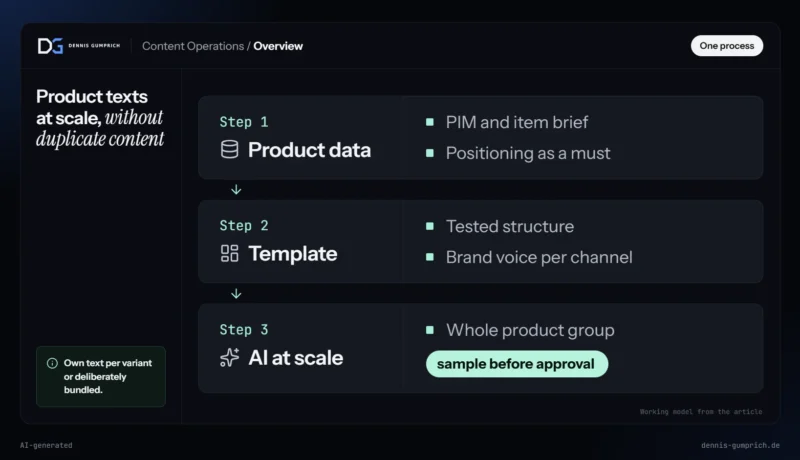
A good product description answers the questions customers ask themselves before buying: what is it, what do I need it for, what makes it better, how does it fit and how do I care for it. With many items and variants, quality doesn't come from writing each text individually, but from a process: clean product data from the PIM, a tested template, stored brand voice, AI-supported creation at scale, sample checks and approval. For variants, you decide deliberately whether each one gets its own page with its own text or points to a main page via canonical. Both are possible, but not half of both.
What makes a good product description?
A good product description combines facts with benefits. It names material, dimensions and properties, but translates them into situations that are relevant to buyers. It is written independently, clearly structured and sounds like the brand, not like the manufacturer.
Many product texts fail at one of two extremes. Either they are a list of technical features that nobody can put into context. Or they are advertising prose without reliable information. Neither helps with buying or in search. In its SEO Starter Guide, Google explicitly recommends original, helpful and easy-to-read content. That applies to product pages just as much as to guides.
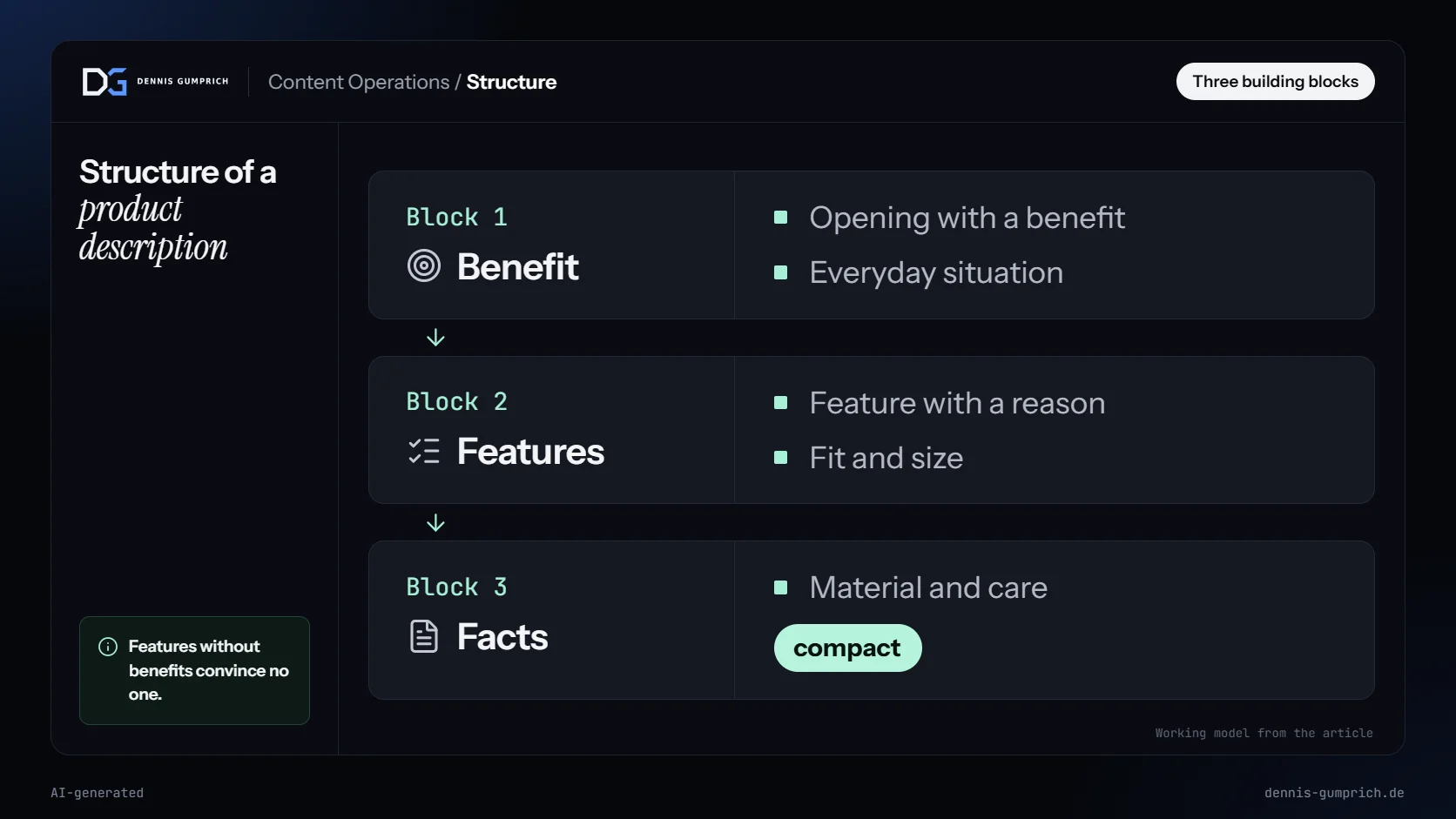
| Building block | Customer question | Example |
|---|---|---|
| Opening with a benefit | Why should I care? | A shirt that still looks like it did in the morning after a long travel day |
| Everyday situation | When and where do I use it? | At the office, on business trips, under a sweater |
| Features with reasons | What makes it better? | Non-iron thanks to a special finish on the cotton |
| Fit and size | Will it fit me? | Regular fit, true to size |
| Material and care | How do I treat it? | 100 percent cotton, machine washable at 40 degrees |
| Facts at a glance | Everything at a glance | Bullet points for collar style, sleeve length, colors |
Product description: an example of the difference
The difference between an interchangeable and a convincing product description rarely lies in its length. It lies in whether the text describes a concrete situation and gives reasons for features.
"High-quality men's shirt made of cotton. Non-iron. Kent collar. Available in many colors. A classic for every occasion."
"Out of the suitcase in the morning, still in the meeting at night: this pure cotton shirt is finished so that it stays smooth without an iron. The Kent collar works with or without a tie. Regular fit, washable at 40 degrees."
The second text is barely longer, but answers four questions: when, why, how it fits and how to care for it. These are exactly the questions buyers ask themselves, and exactly such concrete passages are what AI search systems pick up when they formulate product recommendations. How content becomes citable is described in the article Visible in ChatGPT, Perplexity and AI Overviews.
Why does volume become a problem?
Because product ranges grow faster than copy teams. Variants, seasonal goods, items carried over from earlier seasons and additional channels multiply the demand. At two to three hours per text from creation to publication, this can no longer be done by hand.
In conversations with retail and industrial companies, the same causes come up again and again:
- Variants are needed individually: items previously set up as a group should stand individually in the shop for better findability, in all colors, sizes and versions.
- Copy-paste as the standard: texts are copied from the main variant and adjusted by hand. That takes hours and creates nearly identical pages.
- Data is scattered: the product managers' item brief sits in the PIM, material details in a spreadsheet, the positioning in the product manager's head.
- Long routes via service providers: texts are created externally, checked and approved internally and then transferred to the shop system by hand.
- Other channels are missing: social media, newsletters and category pages need the same products in a different form, without a break in the language.
The result: the best people spend their time transferring instead of writing. One team lead summed it up in a conversation: the time saved should go into quality, into individual texts that AI can't write yet.
Duplicate content with product variants: what you need to decide
Nearly identical texts on many variant pages are not grounds for a penalty, but they help no one. Google then picks one page itself and filters out the others. So decide deliberately: either each variant gets its own page with its own text, or the variants point to a main page via canonical.
In its documentation on consolidating duplicate URLs, Google describes how to specify a preferred page with rel="canonical". For shops with variants, there is also structured data for product variants, which you can use to show Google which items belong to a group. Which way fits depends on whether the variants have their own search queries.
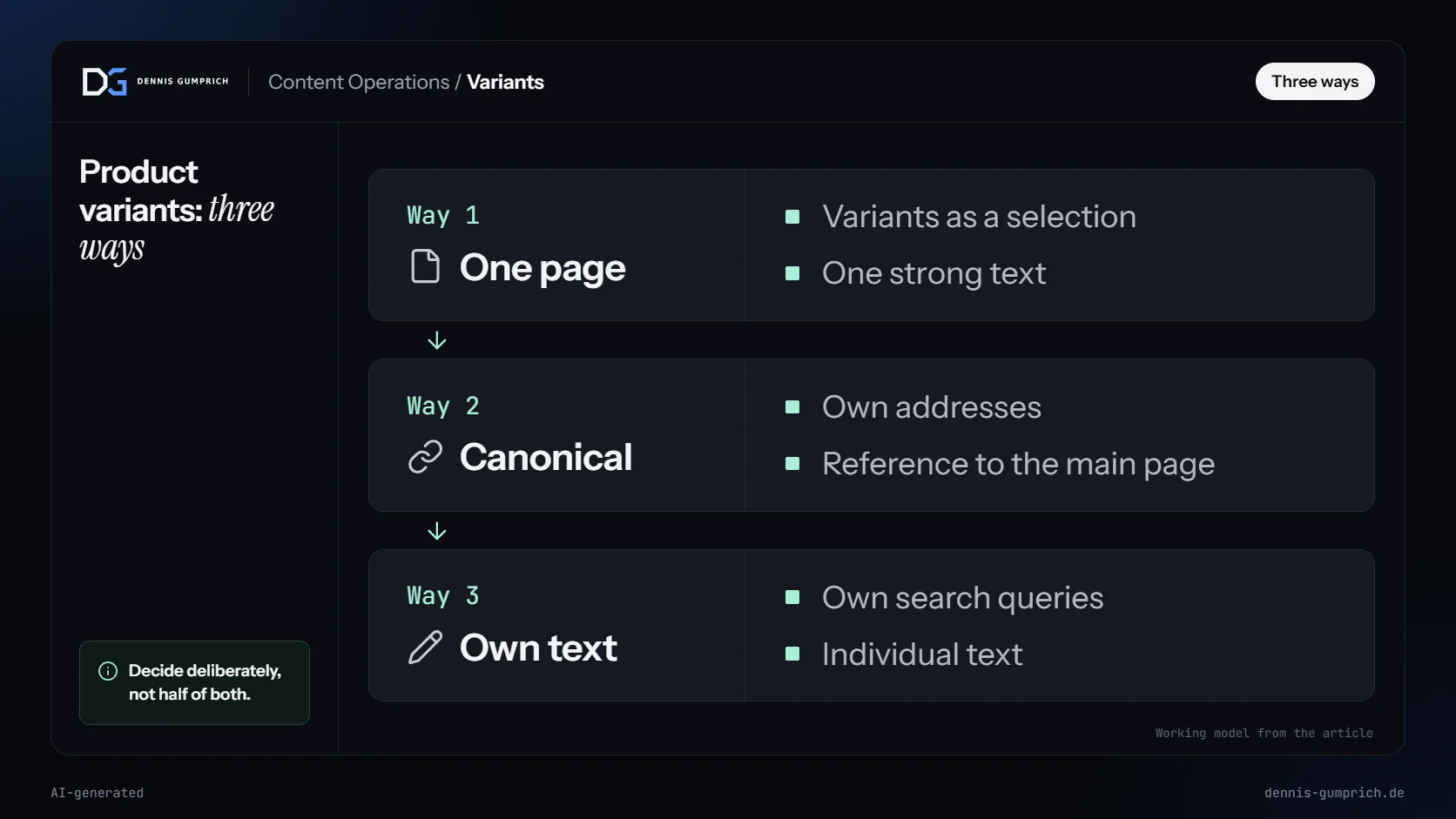
| Way | Fits when | Consequence for the text |
|---|---|---|
| One page, variants as a selection | Variants differ only in color or size, nobody searches for them specifically | One strong text for the group |
| Own pages with canonical | Variants need their own URLs for advertising or filters, but should not rank individually | Base text of the main variant, canonical to the main page |
| Own pages with own text | Variants have their own search queries, such as "green flannel shirt", or differ in material and use | Individual text per variant, shared facts, own situations |
The third way takes the most effort and is where AI helps most. What matters is that the differences are real. A text in which only the color word was swapped is not original content. A shared fact base with variant-specific elements works better: what does this color go with, for which occasion, with which other items in the range.
Where does the data for product descriptions come from?
From the PIM or ERP, supplemented by the product managers' knowledge. A fixed field for positioning is decisive: how should the product be perceived, who is it for, what does it set itself apart from. Without this information, every AI and every person writes past the intention.
In many companies, product managers create an item brief that is stored in the PIM. It is often the only source for the text, sometimes detailed, sometimes thin. Added to this are master data such as material, workmanship, dimensions and category, as well as experience from earlier seasons. For production at scale, this information should be available in a structured form:
- Master data: item number, variant, material, dimensions, care, category.
- Brief: target group, positioning, most important selling points.
- Context: related items, collection, season.
- Mandatory information: legally required notes, for example on material composition or environmental claims.
At the start, a spreadsheet export from the PIM that is imported into the text creation tool is often enough. In the long run, an interface pays off so that new items arrive automatically and finished texts flow back. Which technical route fits is described in the article MCP or API. How approved texts get into the target system without copying is covered in The last mile.
How do you create product descriptions at scale with AI?
In five steps: prepare the data, build a tested template, store the brand voice, generate texts at scale and check samples, then approve and hand over to the shop system. The AI writes the drafts, the team concentrates on quality and exceptions.
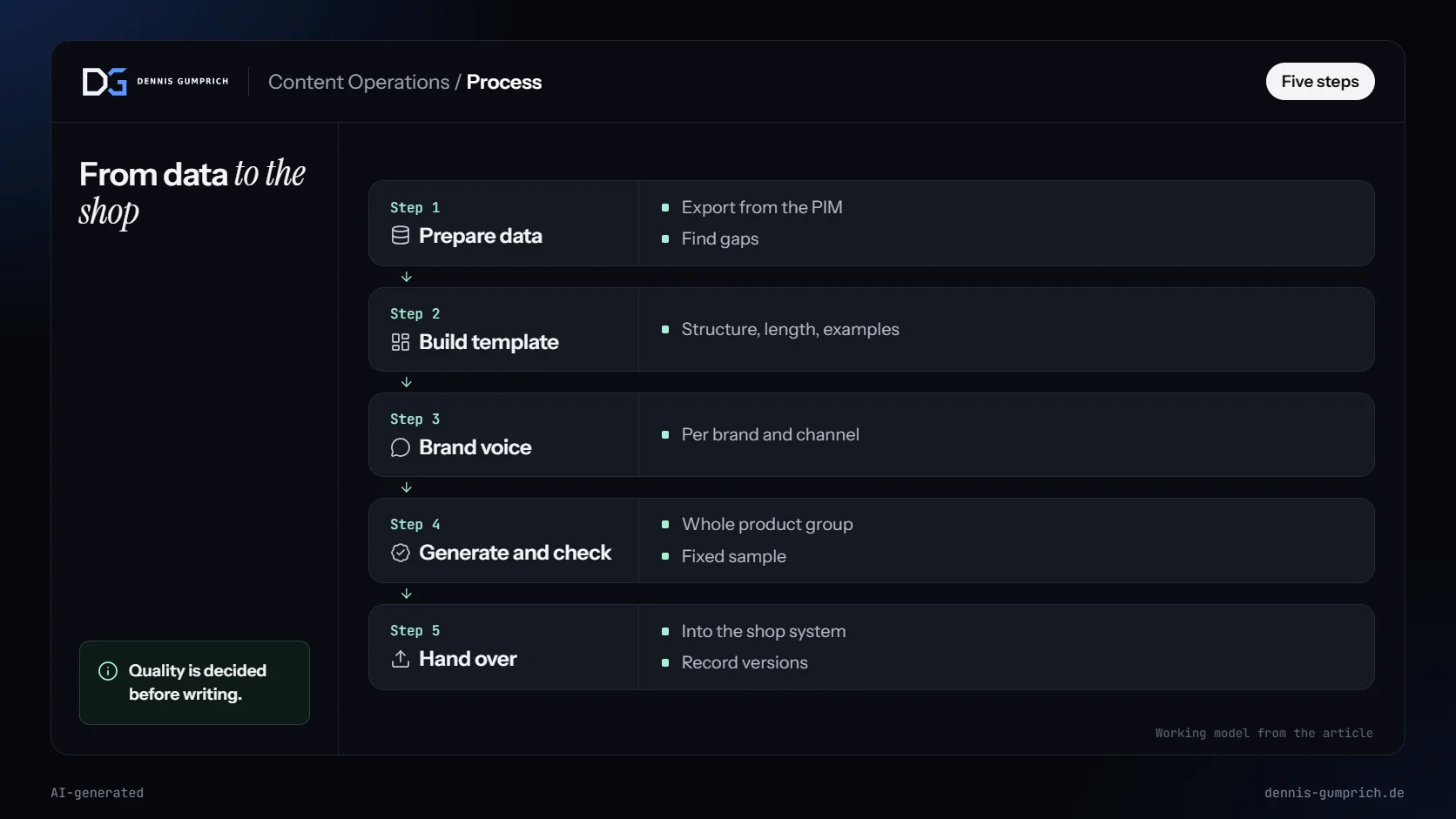
- Step 1Prepare dataExport master data and item briefs for one product group. Check which fields are often empty. Gaps in the brief lead to generic texts, no matter how good the template is.
- Step 2Build a templateDefine structure, length and mandatory building blocks, such as opening with a benefit, everyday situation, features, fit, care. Add two to three good example texts from your existing stock. The template belongs in your shared prompt library, not in a private chat.
- Step 3Store the brand voiceTone, typical phrases and banned terms belong in a central place, per brand and, if needed, per channel. An online shop sounds different from an Instagram post about the same product. How this works is shown in the article Storing your brand voice.
- Step 4Generate at scale and checkGenerate the texts for the whole product group in one run. Fully check a fixed sample, for example every tenth text, plus all texts with special features. The pre-approval checklist provides the criteria.
- Step 5Approve and hand overApprove the texts and transfer them to the shop system via interface or import. Record which version was published when, so later changes remain traceable.
One advantage of this process shows later: when a social media team needs an Instagram post for the same shirt, it draws on the same tested product text and doesn't have to come up with anything new. The post is linked to the product, and later it is traceable which text ran in which channel. Existing archives, such as Instagram texts from several years, thus become the basis for the brand voice instead of an unused folder.
Category texts: the often forgotten second part
Category pages such as "flannel shirts" or "transitional jackets" often attract more searches than individual products. A good category text helps with the choice, describes typical situations and links to suitable subcategories. It is created from the same data and the same brand voice as the product texts.
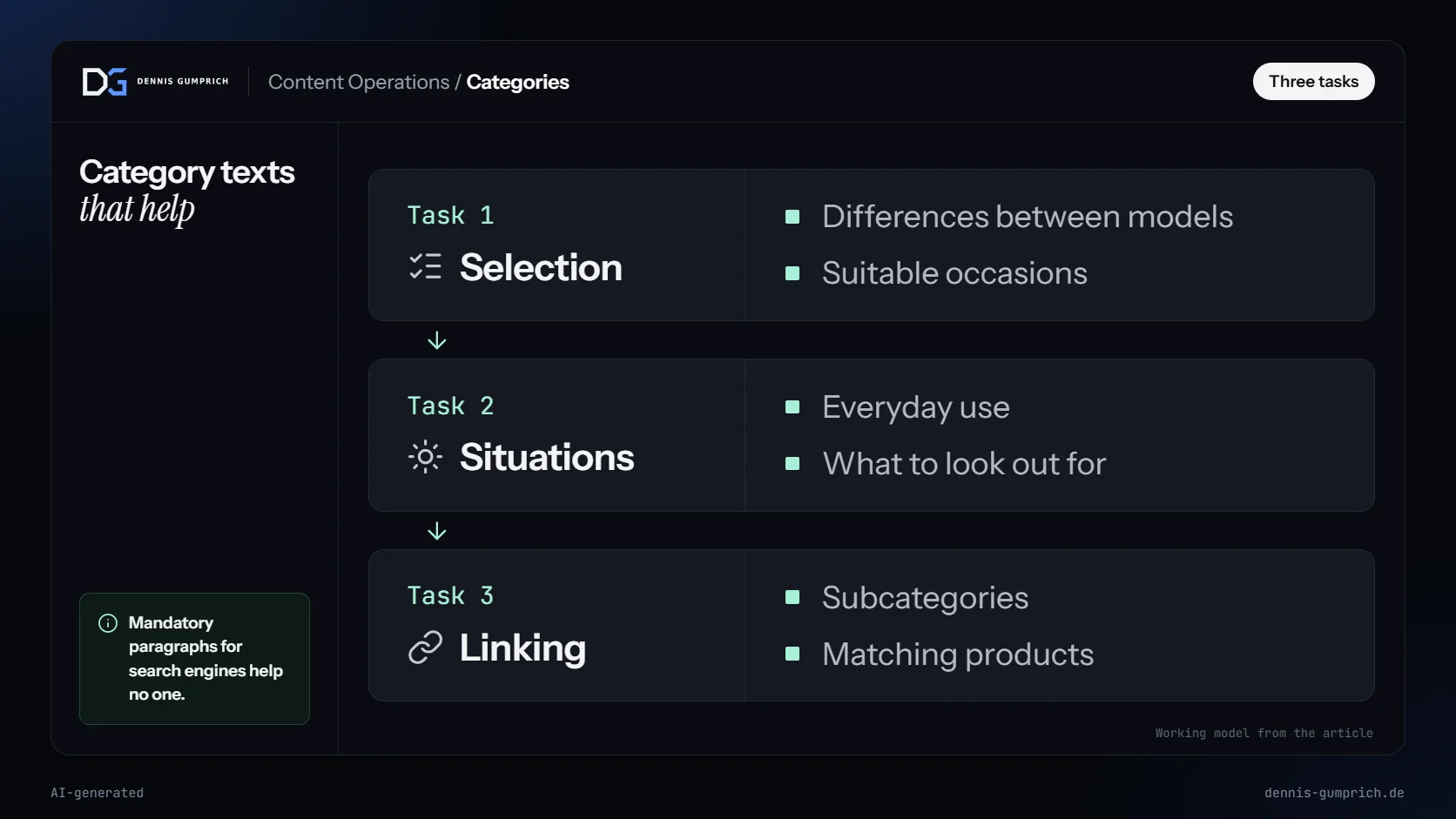
Many shops either have no category texts at all, or a mandatory paragraph at the bottom of the page that was written for search engines years ago. Texts that answer real selection questions work better: how do the models differ, which one suits which occasion, what should you look out for in the material. Such passages are also what AI search systems draw on as an answer to questions like "Which shirt for business trips?"
Because category texts are created less often than product texts, a separate template is worthwhile. Once created, you can revise all existing category texts in a short time following the same pattern.
Outsource product descriptions or write them yourself?
Both have their place. Agencies bring capacity and writing craft, but rarely know the product range and customers as well as your own team. With an AI-supported process, many teams can create texts at scale themselves and use external support specifically for special projects.
| Criterion | Agency | Own team with AI |
|---|---|---|
| Product knowledge | Must be handed over every time | Sits in-house and in the knowledge base |
| Lead time | Briefing, creation, review, transfer: often weeks | Days, sometimes hours for series |
| Costs | Per text, rising with volume | License and team time, falling per text with volume |
| Brand voice | Depends on individual copywriters | Stored centrally, the same for everyone |
| Makes sense for | Campaigns, launches, peak loads | Range maintenance, variants, carry-over items |
A note from practice: agencies today also often create product texts with AI support. The difference then lies mainly in who has the product knowledge and who checks the quality. Which figures you need for a comparison is described in the article Business case for content software.
What applies legally to product texts?
Product descriptions must be true and verifiable. Environmental claims are particularly strict: since September 27, 2026, the EmpCo Directive has imposed tighter rules on terms such as "sustainable" or "environmentally friendly". If you generate texts at scale, you need a fixed review rule for this.
With handwritten texts, problematic statements are often noticed during approval. With a hundred texts a day, they are not. So store banned terms, or terms only permitted with evidence, as a rule that is checked automatically before approval. What applies under the new directive is described in the article on the EmpCo Directive. This article does not replace legal advice.
Which terms are critical and how to phrase environmental claims in product texts concretely and verifiably is shown in the free work aid EmpCo in practice.
What mistakes do teams make with product descriptions at scale?
The most common mistakes happen before the texts are written: in the data, the template and the decision about variants.
- Only swapping the color wordTexts that differ only in the color name are worthless to customers and search engines. Decide deliberately on the variant approach.
- Starting with empty briefsIf the item brief is thin, the text will be thin too. Add a mandatory field for positioning and target group.
- Not storing examplesA template without two or three good example texts leads to average results. Examples show the AI how your brand sounds.
- Wanting to check everything or nothingOne hundred percent review destroys the time saved, zero percent is risky. A fixed sample plus review rules is the middle way.
- Thinking in separate channelsShop, newsletter and social media rewrite the same product three times. A shared product text as a basis saves work and keeps the language consistent.
Self-check: how ready are your product texts for scale?
Tick everything that applies to you.
a short proposal on our product texts:
With the item groups being split up, we need far more product descriptions than we can write by hand. Today we copy texts and swap colors. That takes time and creates nearly identical pages.
I suggest a test with one product group: export data from the PIM, build a template with our brand voice, generate the texts at scale with AI support and check samples. In parallel, we decide which variants get their own pages with their own text.
After four weeks, we compare time and quality with the previous approach.
Conclusion: good product descriptions come from the process, not the single text
Writing a single good product description is craft. Delivering hundreds of good descriptions for variants, seasons and channels is a question of organization. If you capture product data cleanly, use a tested template with brand voice, decide deliberately on variants and use AI for creation at scale, you gain time for the texts where people make the difference.
Start with the product group where the pressure is greatest today. After four weeks, you will know how much time the process saves and where the data or template still needs sharpening.
Frequently asked questions
How long should a product description be?
As long as necessary to answer the buying questions. For simple items, 80 to 150 words plus bullet points are often enough, for products that need explaining more. A fixed word count is not a quality criterion, not even for search engines.
Is duplicate content harmful for product variants?
It doesn't lead to a penalty, but Google usually shows only one of the nearly identical pages. So set a main page via canonical, or give variants that have their own search queries an original text.
Can AI write product descriptions that don't sound generic?
Yes, if it gets good data, a clear template with examples and your stored brand voice. Generic texts almost always come from thin briefs and missing context, not from the model.
How do we get the data from the PIM into text creation?
To start, via spreadsheet export and import. In the long run, an interface pays off so that new items arrive automatically and finished texts flow back into the PIM or shop system. Involve IT early on.
Do we need separate product texts for each channel?
You need a shared basis and a derivative for each channel. The shop text provides facts and benefits, from which newsletter teasers and social media posts are created in the respective tone.
Where does your content process lose time today?
In 30 minutes, we look together at where unnecessary coordination, manual tasks, tool switching or repetitive content work cost you time today.
If you want to create product descriptions at scale, we go through your product data, variants and approval routes and sketch a process for a first product group.
Analyze your content process in 30 minutes Free of charge. You take away concrete starting points you can use internally right away.
Dennis Gumprich
Dennis helps marketing and communication teams fit generative AI into existing content processes without undermining quality, brand voice and approvals. Focus areas: content operations, AI governance and tool selection in mid-sized companies and corporations.
Transparency note: Dennis works for contentbird, a provider of AI-powered content software. Product mentions are marked in the article. More about Dennis (in German) · LinkedIn
Read more
Sources
- Google Search Central: SEO Starter Guide, documentation: original, helpful and easy-to-read content. Accessed November 7, 2026.
- Google Search Central: How to specify a canonical URL with rel="canonical" and other methods, documentation: consolidating duplicate URLs. Accessed November 7, 2026.
- Google Search Central: Product variant structured data, documentation: marking up product variants as a group. Accessed November 7, 2026.
How this article was created
This article was created with the help of AI. Structure and draft wording were developed with AI support. Professional assessment, review of the statements and the final version are the responsibility of Dennis Gumprich. The English version was translated with AI and reviewed. Read the original German version.
How reliable are the statements?
Building blocks, variant approaches, process and comparison are working models from consulting practice, not measured values. The information on time spent and challenges comes from conversations with retail and industrial companies in 2026. The notes on duplicate content are based on Google Search Central documentation. This article does not replace legal advice.


