

For three months, two posts a week have been appearing on the managing director's LinkedIn profile, written by an agency. The likes are fine. Nobody in sales has ever had a prospect mention one of them.
At the same time, the head of application engineering explains in every customer meeting why half of all projects in the industry fail at the same point. He has ten years of figures on it. Nobody has written it down.
Thought leadership is content that offers its own well-founded view on the important questions of your target group, backed by experience and data. In B2B it works: in the 2025 Edelman-LinkedIn report, 95 percent of the decision-makers surveyed considered high-quality thought leadership more effective than classic marketing and product information. In companies, it rarely fails because of a lack of knowledge, but because of the path there: the expertise sits in heads that have no time to write. A fixed process of interview, condensing, approval and multiple formats solves this.
What does thought leadership mean?
Thought leadership means taking your own well-founded position with content on questions that concern your target group. A thought leader is a person or company whose assessment others seek out, cite and pass on.
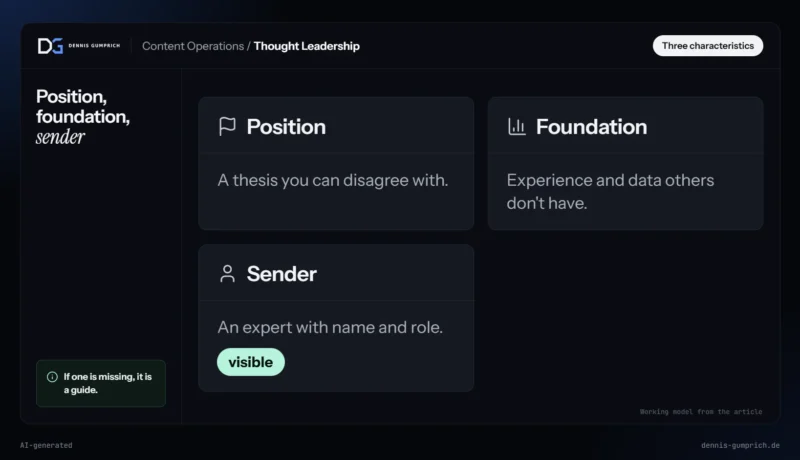
The difference from ordinary content lies in three points. Thought leadership has a position, meaning a statement you can disagree with. It has a foundation, meaning experience, data or observations that others don't have. And it has a recognizable sender, a person with name and role. A guide that summarizes what is written everywhere is useful, but it is not thought leadership.
Why does thought leadership work in B2B?
Because B2B decisions are made in committees, and there trust in a vendor's competence counts. In the 2025 Edelman-LinkedIn report, 79 percent of respondents said they were more willing to support a vendor in a tender if it regularly publishes high-quality content.
Almost 2,000 executives were surveyed for the report, including so-called hidden decision-makers from finance, procurement, legal and compliance. They never appear in a sales meeting, but they influence the decision. 63 percent of this group spend more than an hour a week with thought leadership content. 91 percent want pointers to hidden risks or opportunities, 86 percent want perspectives that challenge their assumptions. And according to the report, more than 40 percent of B2B deals stall because the buying committee cannot agree internally.
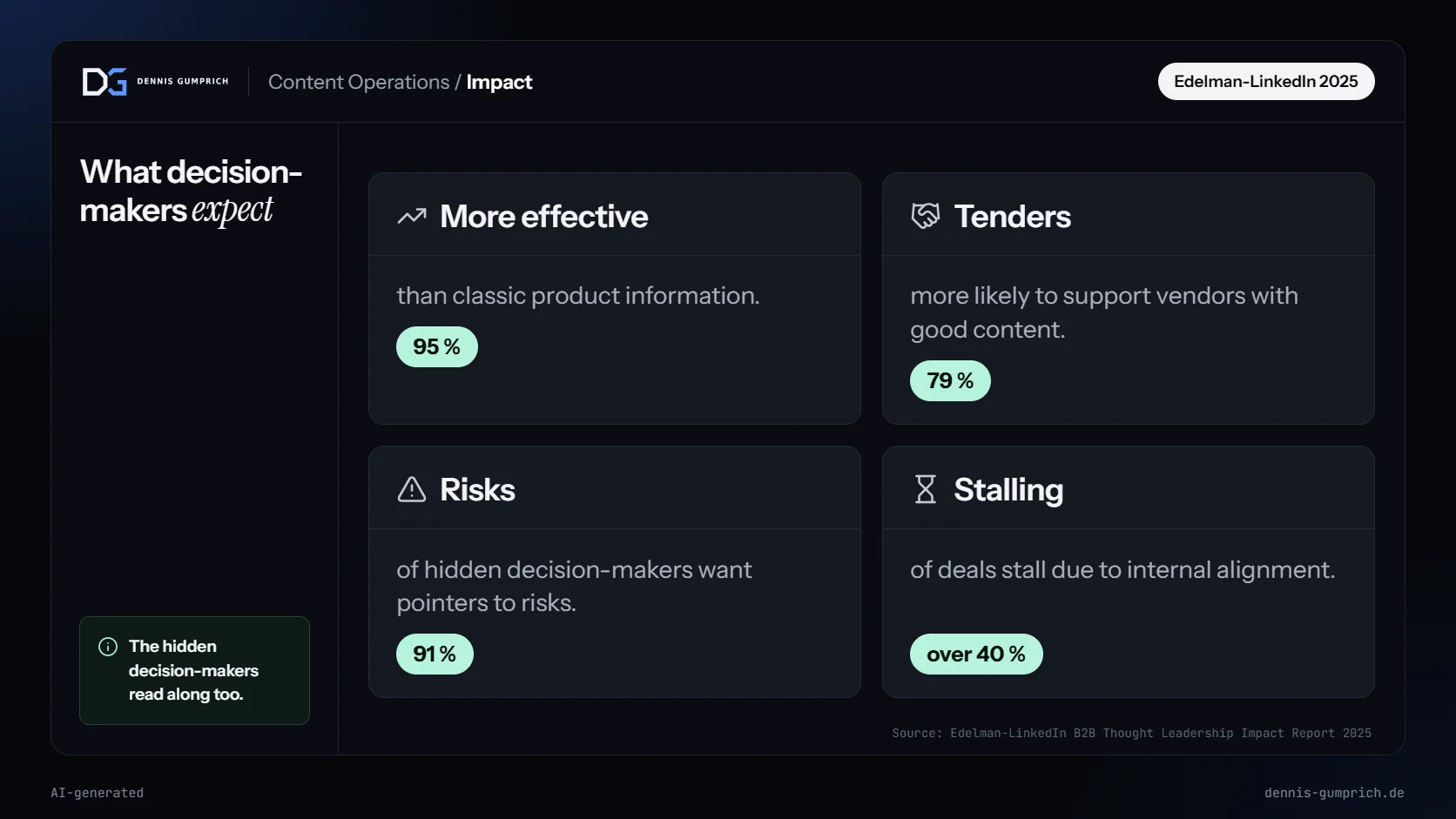
Thought leadership therefore reaches exactly the people your sales team never meets. A good expert article gets forwarded internally and provides arguments when your contact in the committee is lobbying for approval. However, the report's authors also point out that low-quality content can harm the vendor.
What distinguishes thought leadership from normal content?
Starting point, foundation and sender. Normal content answers questions with available knowledge. Thought leadership answers them with its own knowledge and a clear assessment that one person stands behind.
| Characteristic | Product content | Guide | Thought leadership |
|---|---|---|---|
| Starting point | Own offering | Target group's question | Target group's question |
| Foundation | Product data | Available knowledge | Own experience and data |
| Position | We are good | This is how it works | This is how we see it and why |
| Sender | Company | Editorial team | Named expert |
| Interchangeable | Compared to competitors | High | Low |
The last row becomes more important with generative AI. General guides can now be created in minutes, and there are correspondingly many of them. In its guide to generative search, Google explicitly distinguishes between interchangeable content based on general knowledge and content with its own expert or experience perspective. Thought leadership is exactly what remains scarce.
A position that people in the industry often disagree with me on: AI alone is not enough. Without structure, AI tools create complexity instead of solving it. And a software demo needs a business case, not a feature show.
Who is a thought leader in the company?
Not only management. Often it is experts from development, application engineering, project management or service who know customers' problems from many cases. What matters is experience, a clear opinion and the willingness to stand behind it by name.
Three questions help with the selection. Who in the company do customers ask for advice, not just for quotes? Who has data or observations from many projects? Who can sum up an assessment in two sentences? Two to four such people are enough to start. How to make employees visible without losing control of the brand voice is covered in Corporate influencers without losing control.
How does expert knowledge get into the content process?
Through interviews instead of writing assignments. Experts rarely have time to write, but almost always have 30 minutes to talk. The editorial team condenses the conversation, the expert approves the key statements, and one conversation produces several formats.
- Step 1Define the core topicOne thesis on which your expert has a well-founded opinion. Without a thesis, the interview turns into a guide.
- Step 2Conduct the interview30 minutes with prepared questions: What do you observe, what do most people get wrong, which figures do you have, where do you disagree with the common view?
- Step 3CondenseThe editorial team writes an expert article from the transcript. AI helps with structuring, the statements come from the conversation.
- Step 4Approve key statementsThe expert checks three to five key statements, not every sentence. That takes minutes instead of days.
- Step 5Publish multiple timesExpert article on the website, LinkedIn posts by the person, guest article in a trade medium, talk. One conversation, five formats.
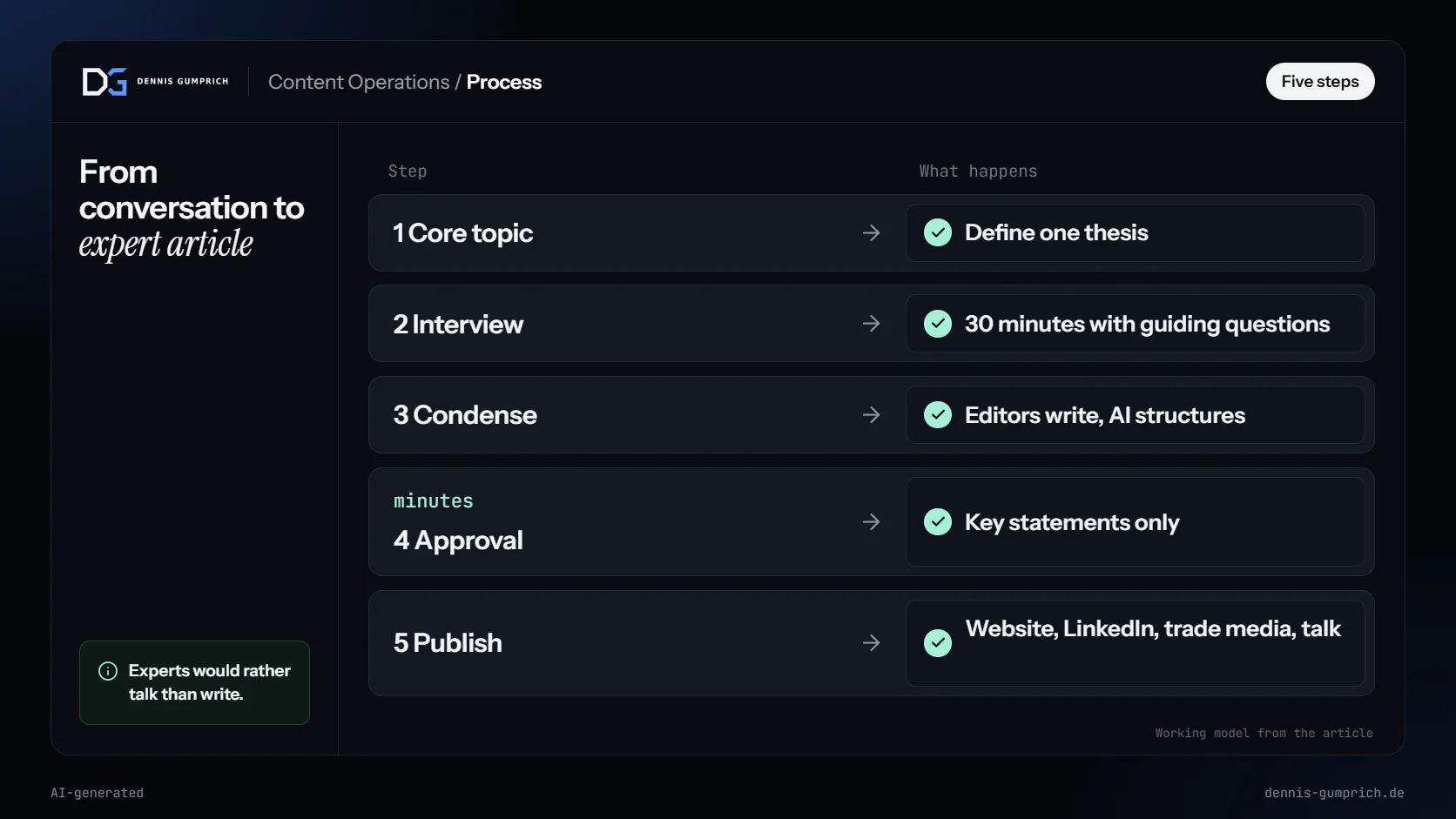
So that the knowledge is not lost after the article, every interview belongs in your knowledge base. How to derive several formats from one core is described in One brief, five formats.
I get to experts' knowledge through formats that are created anyway: podcast transcripts become a blog post, a LinkedIn post and a newsletter. The experts don't write themselves, they approve in the workflow.
How do you measure the success of thought leadership?
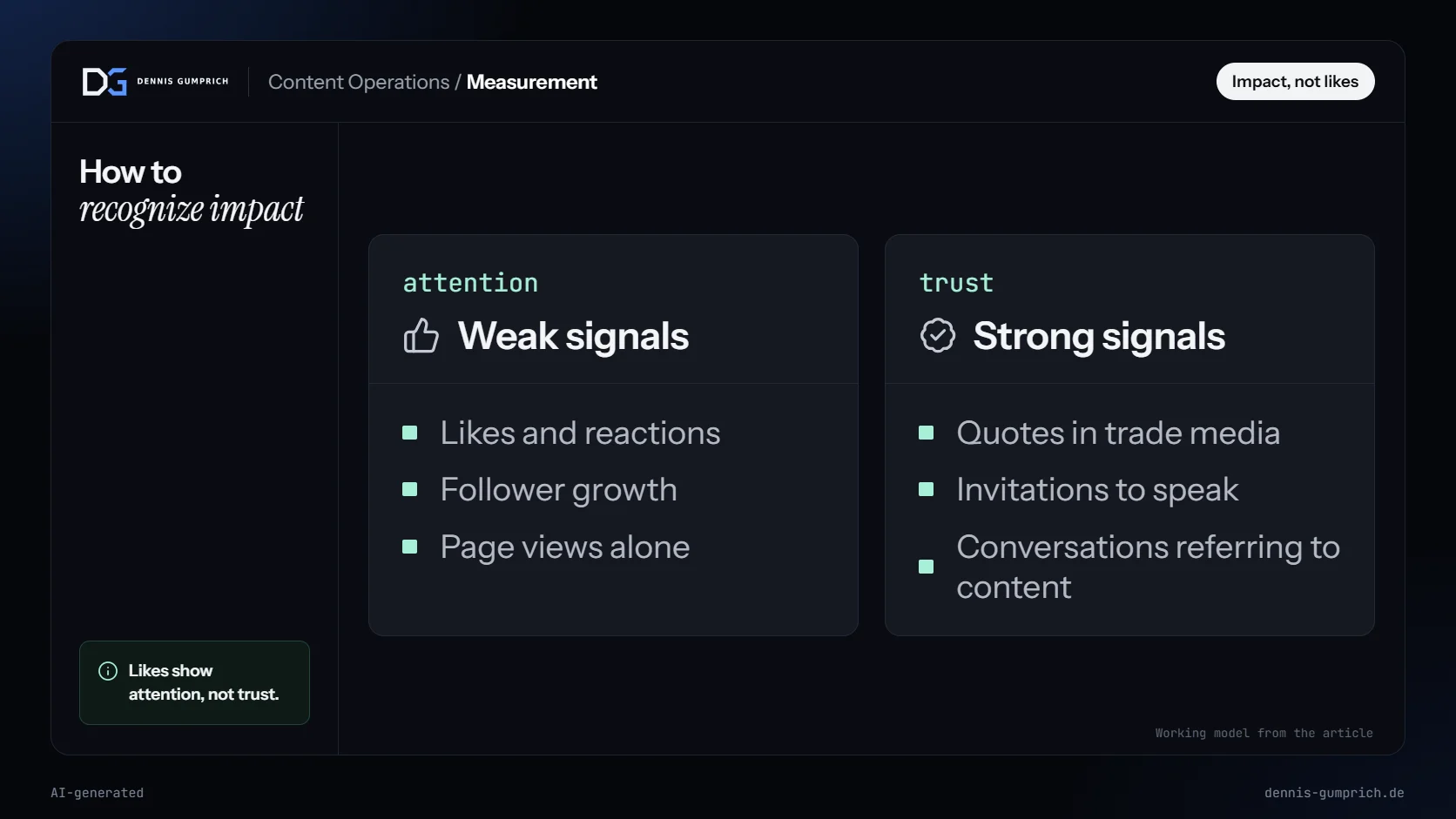
By effects that reach doesn't show: mentions and quotes in trade media, invitations to speak, conversations in which prospects bring up content, and mentions in AI answers on your topics. Likes are a weak signal.
| KPI | Source | Frequency |
|---|---|---|
| Mentions and quotes in trade media | Media monitoring | Quarterly |
| Requests for talks and guest articles | Inbox, PR | Quarterly |
| Conversations referring to content | Sales, CRM field | Monthly |
| Mentions in AI answers on the topic | Prompt set | Monthly |
| Forwards and downloads | Web analytics | Monthly |
The simplest measuring instrument is a field in the CRM: "Did the prospect refer to a piece of content, and which one?" After a quarter, it shows which topics land in sales. How mentions in AI answers are measured is covered in Measuring AI visibility.
Five mistakes in thought leadership
- Not taking a positionIf you agree with everyone, you are not a thought leader. A well-founded thesis is the core.
- Only making management visibleExperts often have the stronger observations and more time for conversations with customers.
- Ghostwriting without substancePosts that an agency writes without a conversation sound like an agency. Every statement needs a source in the person's head.
- Approving every sentenceIf you have every sentence checked, you get polished-down texts. Approve the key statements.
- Confusing reach with impactLikes show attention, not trust. Measure mentions, invitations and conversations.
Self-check: do you have a thought leadership process?
Tick everything that applies to you.
a short note on thought leadership:
In the 2025 Edelman-LinkedIn report, 95 percent of the decision-makers surveyed considered high-quality thought leadership more effective than classic product information. It also reaches the decision-makers in procurement, finance and legal whom our sales team never meets.
Our strongest expertise sits with experts who have no time to write. I suggest holding a 30-minute interview with two people each month, deriving expert articles and LinkedIn posts from it, and having only the key statements approved.
Conclusion: thought leadership is a process, not a profile
Thought leadership does not come from frequent posting, but from content with position, foundation and sender. In B2B it reaches decision-makers who never have a sales conversation, and it stays valuable as general content becomes arbitrary through AI. For it to be created reliably, you need a fixed process: thesis, interview, condensing, approval of the key statements, multiple formats.
Frequently asked questions
What is thought leadership?
Thought leadership is content with which a person or company takes its own well-founded position on the important questions of its target group. It is based on experience and data that others don't have.
What is a thought leader?
A person whose assessment of a field others seek out, cite and pass on. In German, the term is often rendered as Vordenker, literally someone who thinks ahead.
How do you become a thought leader?
With a clear thesis on a topic you know from your own experience, and with regular content that supports this thesis. In a company, a process helps that taps knowledge through interviews and brings it into several formats.
Is thought leadership only for LinkedIn?
No. LinkedIn is an important channel for individuals, but expert articles on the website, guest articles in trade media, talks and studies often have a longer impact and are more likely to be cited, including by AI systems.
May AI help with thought leadership?
With structuring, condensing and deriving formats, yes. The statements must come from the person's experience. Content that an AI generates from general knowledge is not thought leadership.
Where does your content process lose time today?
In 30 minutes, we look together at where unnecessary coordination, manual tasks, tool switching or repetitive content work cost you time today.
If you want to reliably turn expert knowledge into content, we sketch an interview process together that fits your experts.
Analyze your content process in 30 minutes Free of charge. You take away concrete starting points you can use internally right away.
Dennis Gumprich
Dennis helps marketing and communication teams fit generative AI into existing content processes without undermining quality, brand voice and approvals. Focus areas: content operations, AI governance and tool selection in mid-sized companies and corporations.
Transparency note: Dennis works for contentbird, a provider of AI-powered content software. Product mentions are marked in the article. More about Dennis (in German) · LinkedIn
Read more
Sources
- Edelman, LinkedIn: 2025 B2B Thought Leadership Impact Report, reported by Demand Gen Report on July 8, 2025: almost 2,000 executives surveyed, 95 percent consider high-quality thought leadership more effective than marketing and product information, 79 percent more willing to support a vendor in tenders, 63 percent of hidden decision-makers spend more than an hour a week, 91 percent want pointers to risks and opportunities, 86 percent perspectives that challenge their assumptions, over 40 percent of deals stall due to internal alignment. Study by an agency and a platform. Accessed November 7, 2026.
- Google Search Central: Optimizing your website for generative AI features on Google Search, guide, as of July 10, 2026: distinction between interchangeable content based on general knowledge and content with its own expert or experience perspective. Accessed November 7, 2026.
How this article was created
This article was created with the help of AI. Structure, research and draft wording were developed with AI support. Professional assessment, review of the statements and the final version are the responsibility of Dennis Gumprich. The English version was translated with AI and reviewed. Read the original German version.
How reliable are the statements?
The figures come from a survey jointly published by a communications agency and a business platform, reported by a trade medium. The statement on interchangeable content comes from Google's documentation. The comparison table, process, KPIs and list of mistakes are working models from consulting practice with marketing and communication teams in 2026.


