

The marketing department of a machine builder consists of two people. The big trade fair is ten weeks away, and almost the entire budget is committed to the booth, travel and brochures. Content happens on the side.
In the sales meeting, a sentence comes up that both of them know: the blog posts are nice, but too general. Customers ask for application examples, for figures, for experience from similar projects. Application engineering has exactly that, only nobody has written it down.
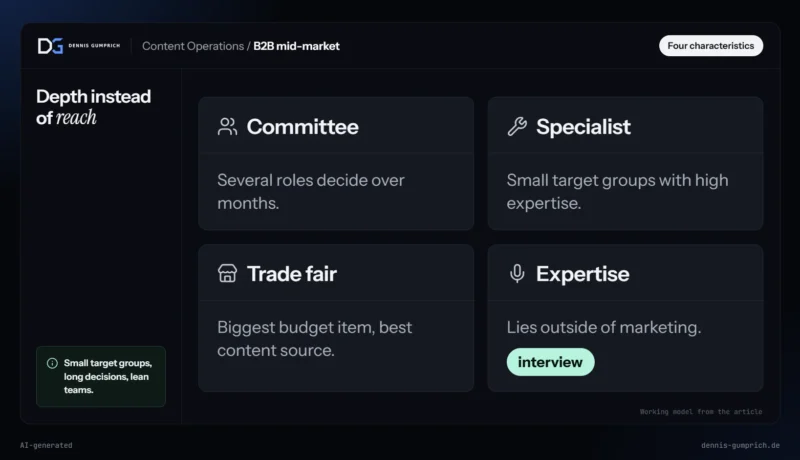
B2B content marketing in mid-sized companies differs in four ways: decisions are made in committees over months, target groups are small and highly specialized, teams are small and trade fairs tie up a large part of the budget, and the most important knowledge sits with experts outside marketing. According to bvik, the German association for industrial communication, almost 40 percent of German industry's B2B marketing budgets went into trade fairs and events in 2025, while budgets fell overall for the first time in years. The consequence: fewer but deeper pieces of content, trade fairs as a content source and a process that taps expert knowledge through interviews.
What is B2B content marketing?
B2B content marketing refers to content with which companies inform and convince other companies and accompany them through a buying decision: expert articles, application reports, guides, webinars, studies or decision aids. The goal is trust in your competence, not a quick deal.
The difference from consumer business lies less in the formats than in the decision they accompany. In B2B, a single person rarely buys alone. Several people from engineering, procurement, finance and management review, compare and have to agree. Content therefore has to answer several questions and be easy to pass on internally.
What is different in B2B mid-sized companies?
Four characteristics shape content marketing in B2B mid-sized companies: committee decisions, small specialized target groups, small teams with a high share of trade fairs, and expert knowledge outside marketing. Each characteristic has a clear consequence for content.
| Characteristic | Consequence for content |
|---|---|
| Committee decisions over months | Content for every role in the committee, easy to forward |
| Small, highly specialized target groups | Less reach, more depth and technical language |
| Small teams, high share of trade fairs | Use trade fairs as a content source, reuse content several times |
| Expert knowledge outside marketing | Interviews instead of writing assignments, short approvals |
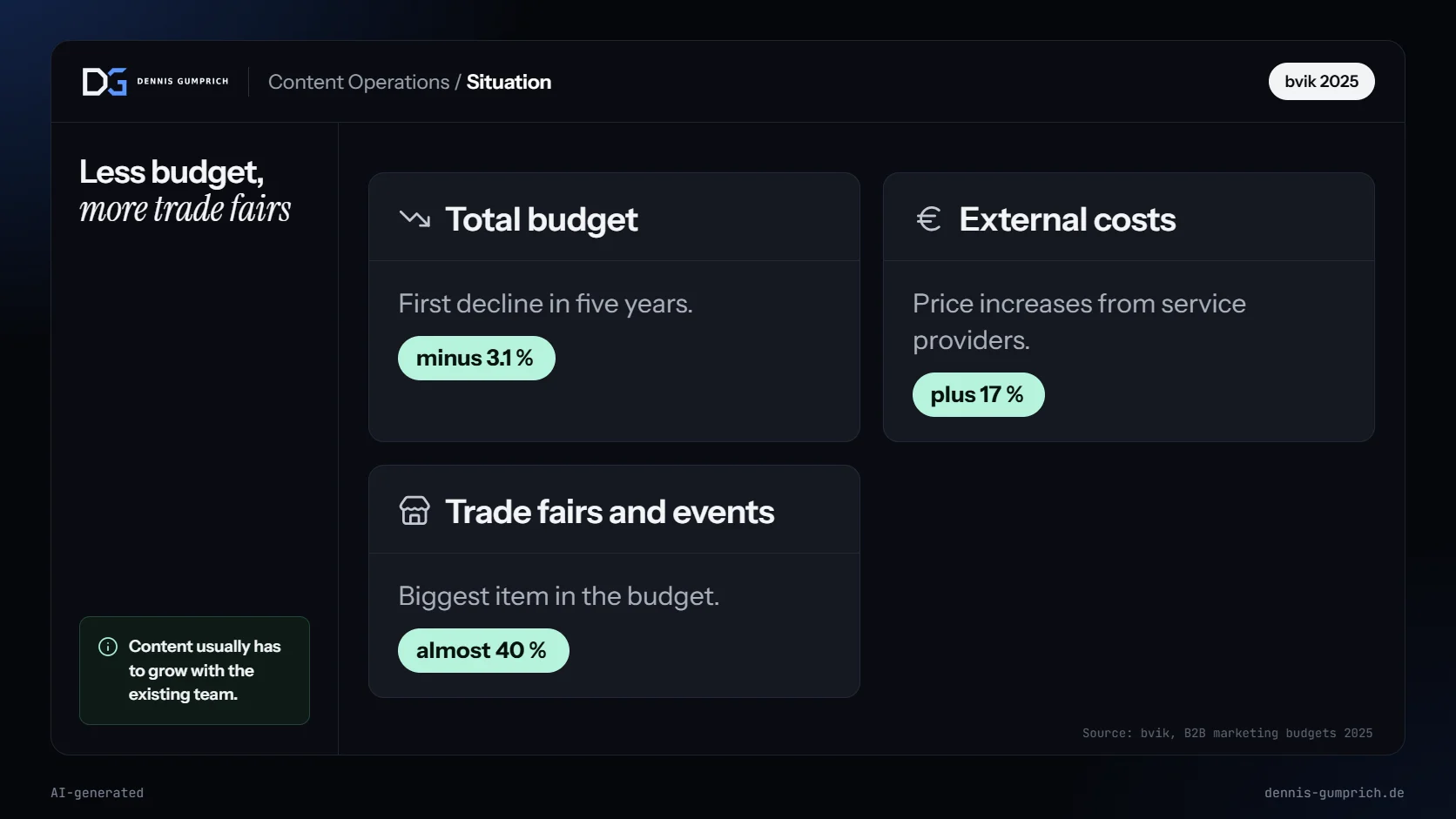
The budget situation makes the third point more acute. According to the study by bvik, B2B marketing budgets in German industry fell by 3.1 percent in 2025, the first decline in five years. At the same time, the costs of external service providers rose by an average of 17 percent. Trade fairs, events and customer events remained the biggest item at almost 40 percent. So if you want to expand content, you usually have to do it with the existing team.
In my projects, the difference from corporations is mainly one of size. Mid-sized companies have very small teams: around 2.5 full-time positions at a manufacturer of special vehicles, or two people at a regional association. Decisions are made quickly, the budget is tight. In corporations, headquarters and country organizations work on a hub-and-spoke principle, procurement evaluates with a matrix, IT and data protection review, and cycles are longer.
Which content works in B2B mid-sized companies?
Content that answers technical questions with experience and can be passed on within the committee: application reports, technical guides, decision aids with criteria and figures, expert articles with a clear position and content around trade fairs.
| Content | For whom in the committee | Effect |
|---|---|---|
| Application report with figures | Engineering, management | Proof that it works |
| Technical guide | Engineering, users | Competence, trust |
| Decision aid with criteria | Procurement, finance | Comparability, justification |
| Business case as a template | Management, finance | Argument for approval |
| Expert article with a position | Everyone | Distinctiveness |
The decision aid is forgotten most often. Procurement and finance rarely appear in sales meetings, but they have a say in the decision. In the 2025 Edelman-LinkedIn report, more than 40 percent of respondents said that B2B deals stall because the buying committee cannot agree internally. Content that gives your contact arguments for this internal alignment is therefore particularly valuable. What such a business case looks like is shown in Calculating a business case for content software, and how thought leadership reaches committees is covered in Thought leadership for companies.
How do you connect trade fairs and content?
By planning the trade fair as a content source, not just as a presence. Before the fair, you create content on the booth's topics, during the fair you collect questions and conversations, and afterwards you turn them into articles for the following months.
- BeforeDefine the booth's topicsTwo to three core topics with an expert article or decision aid published in advance. The invitations refer to it.
- DuringCollect questions and voicesNote the most frequent questions at the booth, conduct short interviews with your own experts and, where possible, with customers.
- AfterDerive content for monthsQuestions become FAQ sections and guides, talks become expert articles, interviews become application reports.
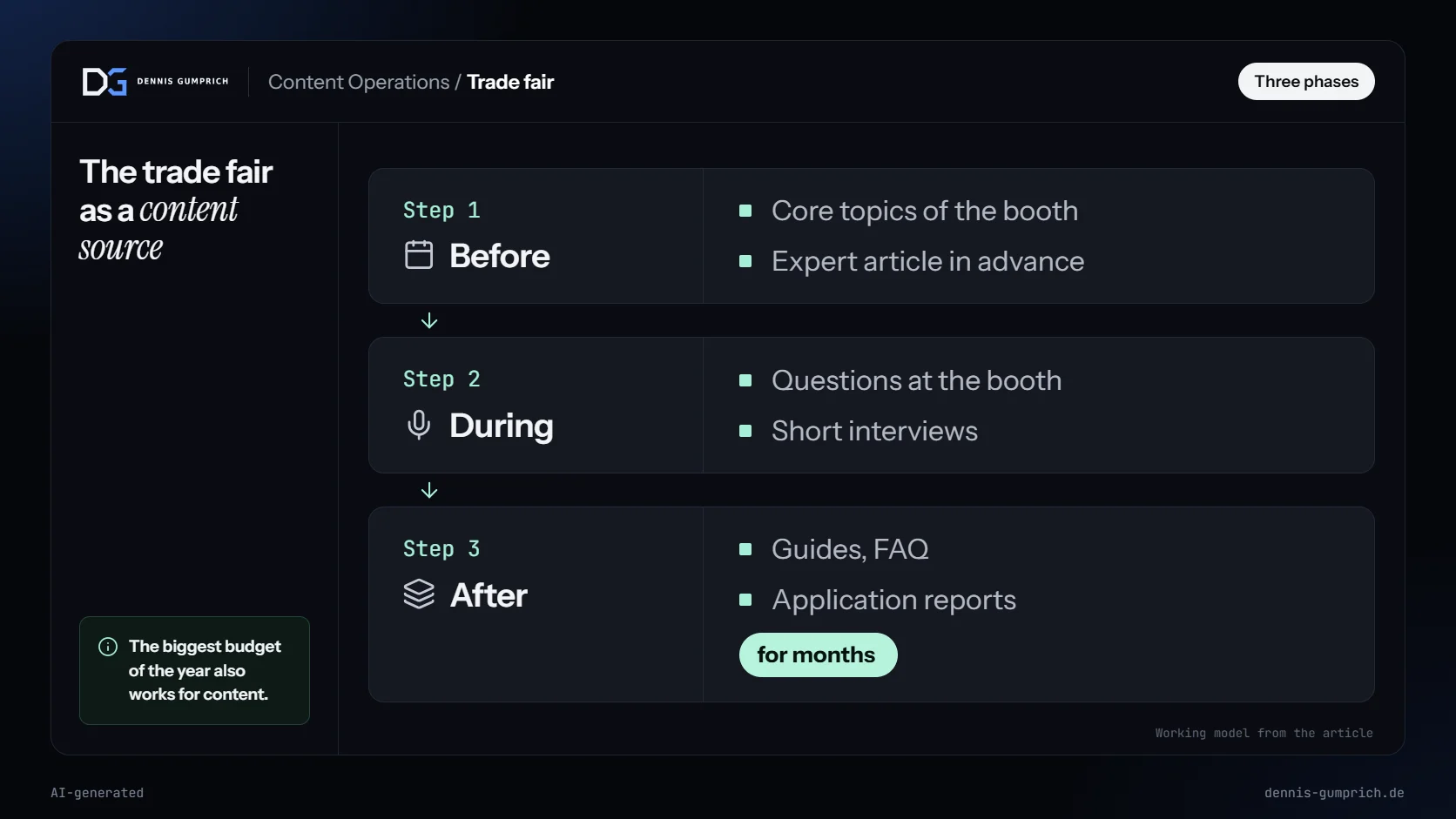
That way, the biggest budget of the year also works for content. How to derive several formats from one core is described in One brief, five formats.
The expert knowledge sits with engineers, product managers, research and development, and the field sales force. At a manufacturer of measuring and testing technology, new colleagues need about a year to understand the systems. The knowledge is scattered across Monday, ChatGPT projects, Teams minutes and the CMS. What works: the experts don't write themselves, they approve in the workflow.
How can a small team manage B2B content marketing?
With a few core topics, a fixed interview rhythm, consistent reuse and AI that works with your knowledge. Two people achieve more this way than a larger team without a clear process.
- Three to five core topics from the content strategy, not 40 individual topics.
- One interview per month with an expert, resulting in one expert article and several short formats.
- Short approvals for key statements instead of entire texts, see Shortening approval processes.
- AI with a knowledge base for drafts, variants and translations, see Having AI write texts.
- A topic plan instead of a channel calendar, so each topic is developed once and used several times.
I advise small teams to start with three users and a single use case, and to bring in the specialist departments with read and comment access.
How do you measure B2B content marketing?
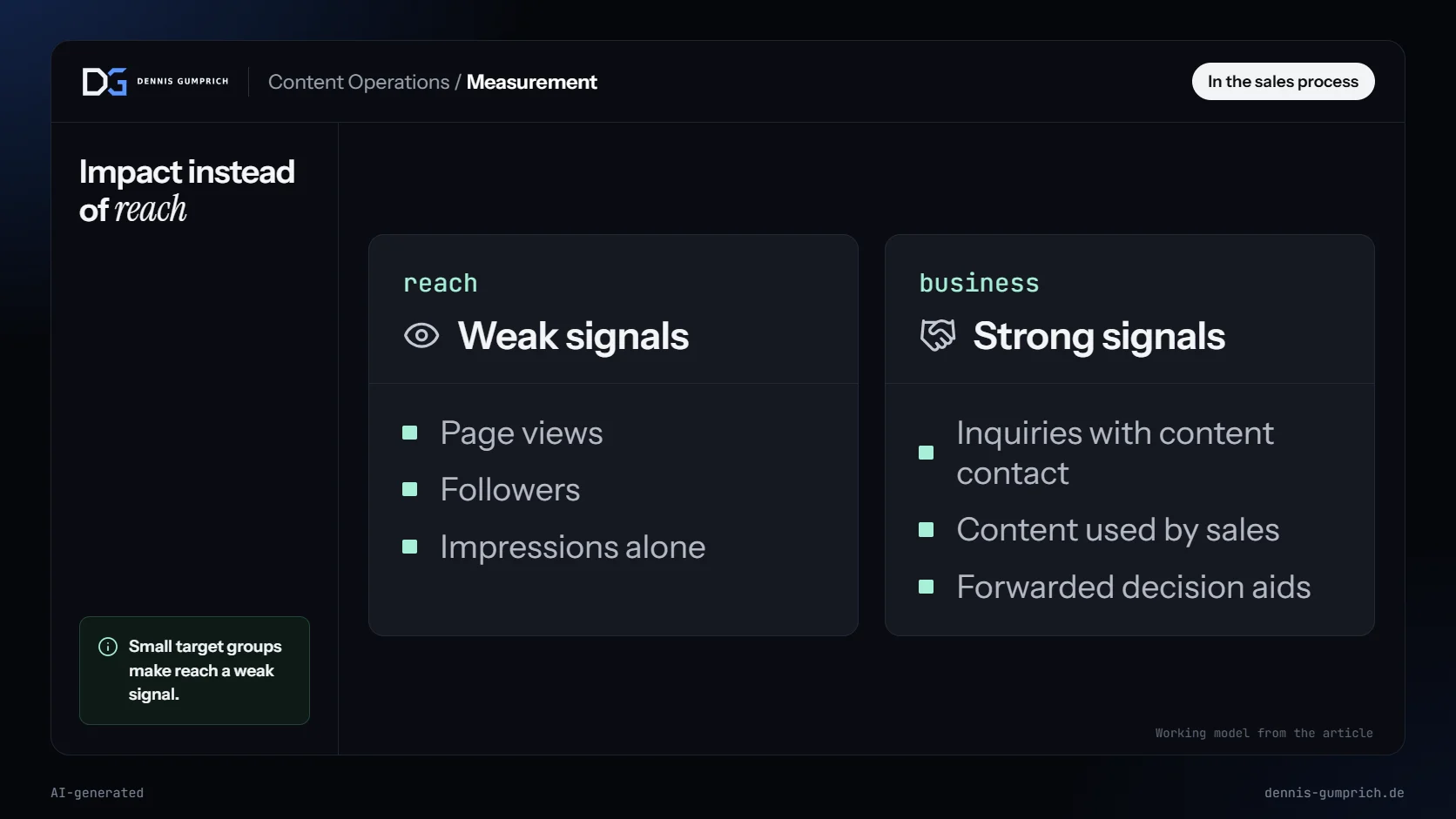
By its effects in the sales process: inquiries with content contact, content that sales uses in offers and conversations, and decision aids that get passed on in committees. Reach is a weak signal in B2B mid-sized companies, because the target groups are small.
A simple way to start is two fields in the CRM: "Which content did the contact have before the inquiry?" and "Which content did sales send during the process?". After two quarters, they show which content supports business. How to turn this into reporting for management is covered in Proving content impact.
Five mistakes in B2B content marketing for mid-sized companies
- Writing too generallySmall specialist target groups recognize platitudes immediately. Depth beats reach.
- Writing only for engineeringProcurement, finance and management have a say. They need decision aids and figures.
- Separating trade fairs and contentIf you don't plan the trade fair as a content source, you waste the biggest budget of the year.
- Letting experts writeWriting assignments to engineering get left lying around. Interviews deliver better content faster.
- Reach as the measure of successIn B2B, what counts is whether content is used in the sales process, not how many people see it.
Self-check: does your content fit B2B mid-sized companies?
Tick everything that applies to you.
a short note on our content marketing:
Our customers decide in committees, and our strongest knowledge sits in engineering, not in marketing. At the same time, the trade fair ties up most of our budget. Sales wants more concrete content with application examples and figures.
I suggest focusing on three core topics, conducting one interview per month with an expert and planning the next trade fair specifically as a source of content. In the CRM, we record which content is used in the sales process.
Conclusion: depth, committee and expertise instead of reach
B2B content marketing in mid-sized companies works differently from what most guides suggest. The target groups are small, the decisions long, the teams lean and the trade fair expensive. If you create fewer but deeper pieces of content, serve every role in the committee, use the trade fair as a source and tap expert knowledge through interviews, you achieve a lot with a small team. Success is measured not by reach, but by whether sales uses the content.
Frequently asked questions
What is B2B content marketing?
Content with which companies inform other companies and accompany them through a buying decision, such as expert articles, application reports, guides and decision aids. The goal is trust in your competence.
What is the difference between B2B and B2C content marketing?
In B2B, several people usually decide over a longer period, and the target groups are smaller and more specialized. Content has to serve several roles and be easy to pass on internally.
Which formats are suitable for B2B content marketing?
Application reports with figures, technical guides, decision aids with criteria, business case templates and expert articles with a clear position. Add webinars and content around trade fairs.
Is content marketing worthwhile for small B2B teams?
Yes, if it is focused: a few core topics, a fixed interview rhythm, consistent reuse and AI that works with your knowledge. Two people can regularly deliver high-quality content this way.
How do you measure the success of B2B content marketing?
By inquiries with content contact, by content that sales uses in the process and by decision aids that get passed on in the committee. Two fields in the CRM are enough to start.
Where does your content process lose time today?
In 30 minutes, we look together at where unnecessary coordination, manual tasks, tool switching or repetitive content work cost you time today.
If your team is small and the trade fair is big, we look together at how you can use both for your content.
Analyze your content process in 30 minutes Free of charge. You take away concrete starting points you can use internally right away.
Dennis Gumprich
Dennis helps marketing and communication teams fit generative AI into existing content processes without undermining quality, brand voice and approvals. Focus areas: content operations, AI governance and tool selection in mid-sized companies and corporations.
Transparency note: Dennis works for contentbird, a provider of AI-powered content software. Product mentions are marked in the article. More about Dennis (in German) · LinkedIn
Read more
Sources
- Bundesverband Industrie Kommunikation (bvik): B2B marketing budgets 2025 study, reported by Verbandsbüro (in German) on September 9, 2025, updated February 12, 2026: B2B marketing budgets in German industry down 3.1 percent, the first decline in five years, costs of external service providers up 17 percent, trade fairs, events and customer events the biggest item at almost 40 percent. Accessed November 7, 2026.
- Edelman, LinkedIn: 2025 B2B Thought Leadership Impact Report, reported by Demand Gen Report on July 8, 2025: more than 40 percent of B2B deals stall due to internal alignment in the buying committee. Accessed November 7, 2026.
How this article was created
This article was created with the help of AI. Structure, research and draft wording were developed with AI support. Professional assessment, review of the statements and the final version are the responsibility of Dennis Gumprich. The English version was translated with AI and reviewed. Read the original German version.
How reliable are the statements?
The budget figures come from an association study on German industry, reported in a press release; the statement on buying committees comes from an international survey by an agency and a platform. Characteristics, content types, trade fair process and list of mistakes are working models from consulting practice with marketing teams in mid-sized companies in 2026, not measured values.


