

Annual planning. The managing director leafs through the editorial plan: 48 topics, neatly spread over twelve months and four channels. Then she asks which of these topics contributes to which company goal.
The answer takes longer than planned. Some topics came from sales, others from last year, a few from an AI brainstorm. A content strategy exists somewhere as a presentation from 2023. Nobody has opened it since.
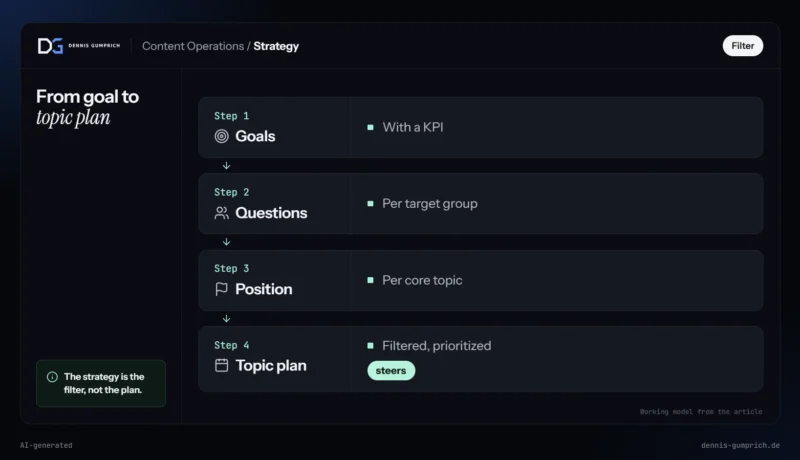
A content strategy defines which goals your content should achieve, for whom, on which topics, with which stance, in which channels, with which resources and how you measure success. It is the filter for the topic plan, not the topic plan itself. With AI it becomes more important: in the CMI and MarketingProfs trend study for 2026, nine out of ten B2B marketers use AI for content, but fewer than four out of ten see better results from it. A usable strategy fits on one page and takes about six weeks to develop.
What is a content strategy?
A content strategy is the written decision about why a company creates content, for whom, on which topics and how it measures success. It answers the why and what. The editorial or topic plan answers the when and who.
In everyday work, two terms are often mixed up. The content marketing strategy refers to content that supports marketing goals, such as awareness and inquiries. The content strategy in the broader sense covers all of a company's content, including the website, product texts, service and internal communication. For most marketing teams, the first is the right starting point, but it should fit the other content.
Whether a team has a strategy or just a topic plan, I clarify with one question: "Do you work topic-centered, and which company goal does each topic pay into?" A health insurer I work with assigns every story to one of three strategic fields. That is strategy. An editorial plan in Excel without this link is a topic plan.
Why do you need a content strategy, especially with AI?
Because AI speeds up production but sets no direction. Without a strategy, more content gets created faster on the wrong topics. In the CMI and MarketingProfs trend study for 2026, nine out of ten B2B marketers use AI for content creation, and fewer than four out of ten say their results have improved as a result.
More than 1,000 B2B marketers were surveyed for the study. The publishers conclude that successful teams work on the fundamentals first and then use AI in a targeted way. A content strategy is that foundation: it tells the editorial team and the AI tools which topics matter, who you are writing for and what stance your company takes. How to translate these guidelines into a knowledge base is described in Building a knowledge base.
When teams introduce AI, what is missing most often is a shared knowledge base. Brand voice, personas and guidelines are scattered across PowerPoint, OneNote, SharePoint and individual ChatGPT projects. The result: every person gets a different quality from the AI. One team phrased exactly this as its goal: "Use AI consistently across the whole team."
What building blocks make up a content strategy?
Six building blocks: goals, target groups with their questions, core topics with your position, channels and formats, resources and process, and measurement. Each building block answers a guiding question and ends in a decision, not a description.
| Building block | Guiding question | Result |
|---|---|---|
| Goals | What should content achieve for the company? | Two to three goals with a KPI |
| Target groups and questions | Who decides, and what does this person want to know? | Two to four target groups with a question list |
| Core topics and position | What do we want to stand for, and how do we see it? | Three to five core topics with a thesis |
| Channels and formats | Where do we reach the target groups, and with what? | Channel profiles with purpose and frequency |
| Resources and process | Who does what, how is content approved? | Roles, process, budget |
| Measurement | How do we recognize progress? | KPIs per goal, reporting rhythm |
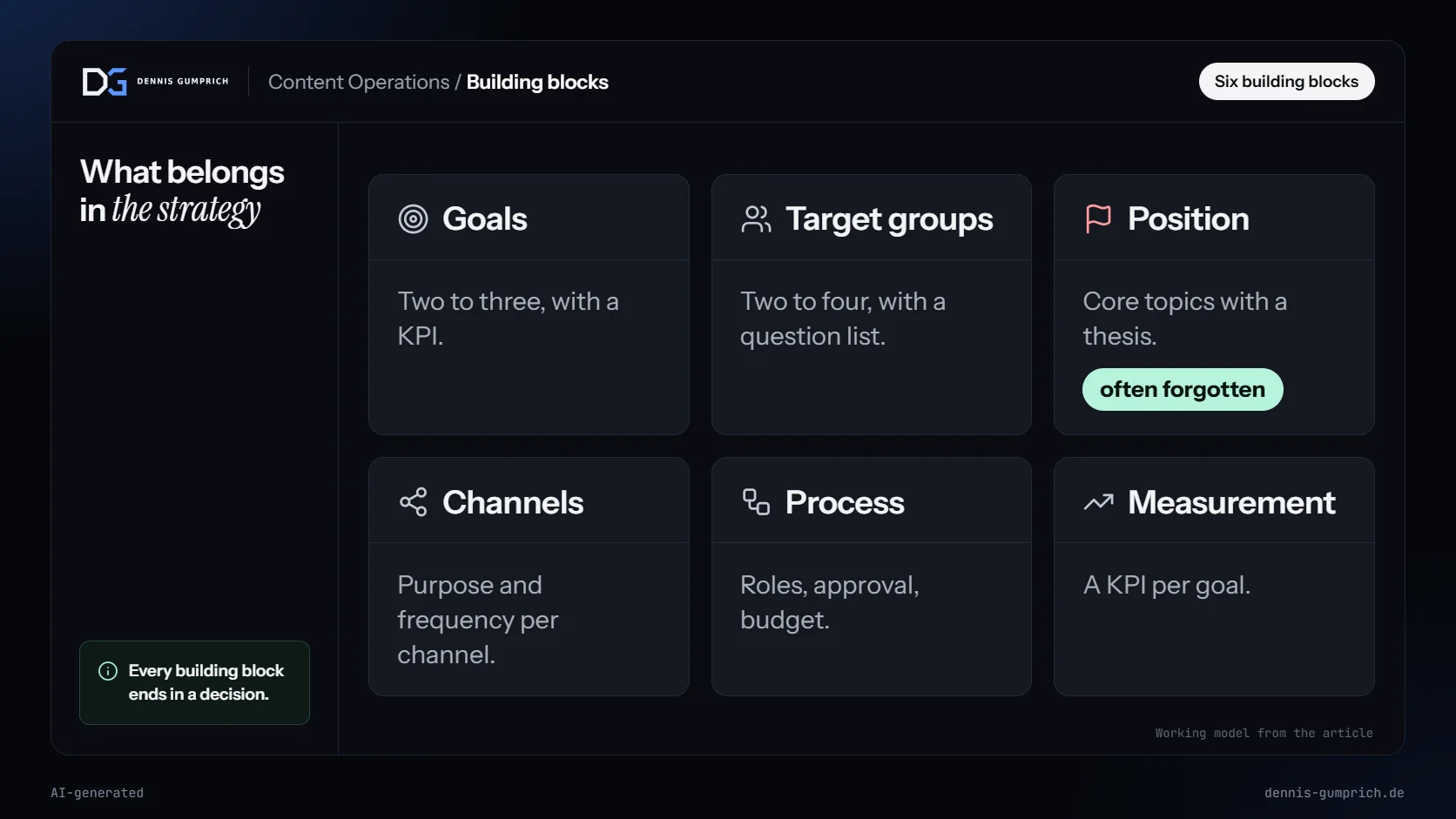
The third building block is skipped most often. Many strategies list topics, but no position. "Digitalization in mid-sized companies" is a topic. "Digitalization in mid-sized companies rarely fails because of technology, but because of unclear responsibilities" is a position. Only the second makes content distinguishable and gives the editorial team a direction. More on this in Thought leadership for companies.
How do you develop a content strategy in six weeks?
With one building block per week and a short meeting with the right participants. After six weeks, you have a one-page document that management, sales and the editorial team understand equally well.
- Week 1Goals and starting pointA conversation with management about company goals, plus a content inventory of the existing stock.
- Week 2Target groups and questionsOne conversation each with sales and service: Who decides, which questions are asked, where do conversations stall?
- Week 3Core topics and positionWorkshop with experts: three to five core topics, each with a thesis. Topics without a thesis are dropped.
- Week 4Channels and formatsDefine purpose, target group and frequency for each channel. Pause channels without a clear purpose.
- Week 5Resources and processClarify roles, approval routes and budget, see Roles in the content team.
- Week 6Measurement and documentOne KPI per goal, a reporting rhythm, then summarize everything on one page and approve it.
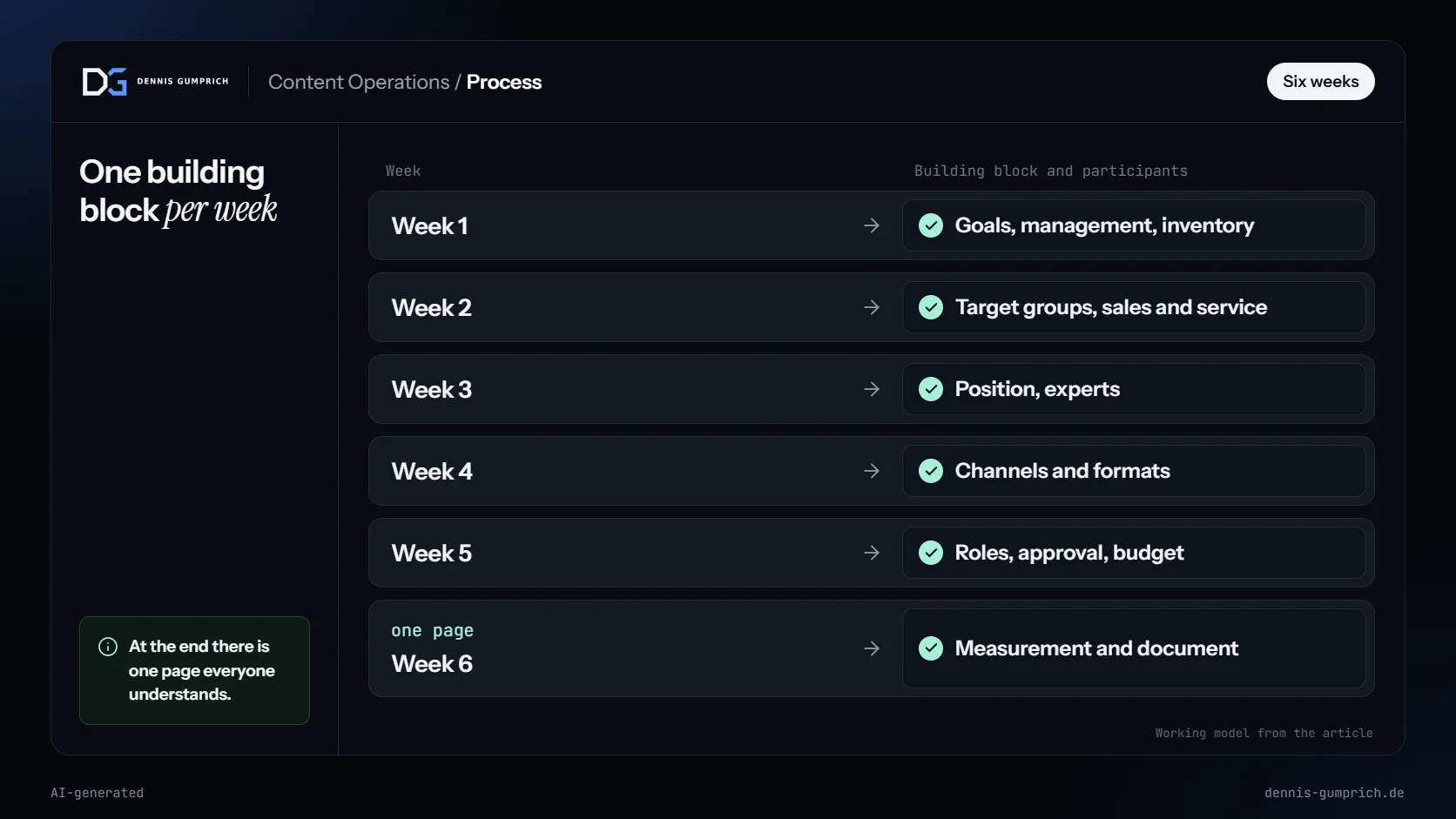
The limit of one page is intentional. A 40-slide document is presented once and then forgotten. One page hangs in the team channel, gets opened during topic planning and can be carried over into the guidelines for AI tools.
How does the strategy become a topic plan?
By turning the strategy into a filter: every topic must be assigned to a goal, a target group and a question, and must fit a core topic. Whatever fails this check does not go into the plan.
In practice, this means: the building blocks become criteria for topic scoring. Strategic relevance and target group relevance get the highest weight. The plan itself changes from a channel calendar into a topic plan, in which each topic is developed once and then prepared for several channels. How this switch succeeds is covered in From editorial plan to topic plan.
How do you measure whether the content strategy works?
On two levels: whether the content achieves the goals and whether the plan follows the strategy. The second level is often forgotten, but it is the earliest sign that a strategy doesn't hold up in everyday work.
| Level | Example KPI | Frequency |
|---|---|---|
| Impact | Inquiries with content contact, visibility for core topics, mentions in AI answers | Quarterly |
| Steering | Share of published content clearly tied to a goal and core topic | Monthly |
| Steering | Share of topics that came from sales and service | Quarterly |
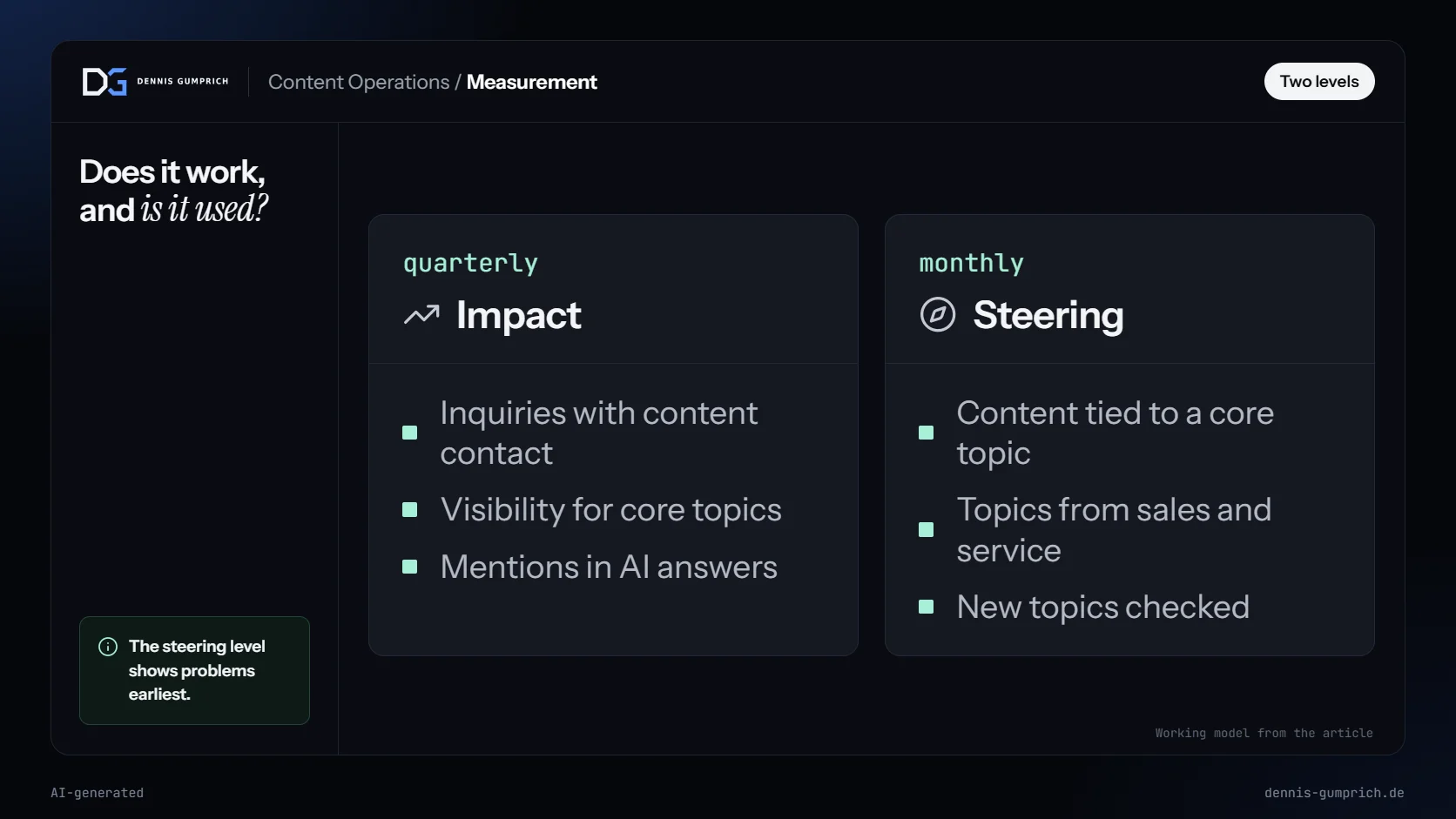
If less than half of the published content can be assigned to a core topic, that is not a problem of the editorial team, but of the strategy. Usually it is then too general or not well enough known. Which KPIs work for content operations overall is described in Making content production measurable.
Five mistakes in content strategy
- Topics instead of positionsA list of topics is not a strategy. Every core topic needs a thesis.
- Too many target groupsIf you write for everyone, you reach no one. Two to four target groups are enough.
- Goals without a KPI"Increase visibility" cannot be checked. Every goal needs a number and a time frame.
- Strategy as a presentationWhat is only presented steers nothing. The strategy belongs on one page and in topic planning.
- AI before strategyAI tools without strategic guidelines produce more content, but not the right content.
Self-check: does your content strategy steer?
Tick everything that applies to you.
a short note on our content strategy:
We produce content regularly, but not every topic can be assigned to a company goal. With AI this becomes more important, because we can produce more faster, including on the wrong topics.
I suggest developing a one-page content strategy in six weeks: goals with KPIs, target groups with their questions, core topics with our position, channels, roles and measurement. After that, we check every new topic against this page.
Conclusion: one page that gets opened every week
A content strategy doesn't have to be extensive, it has to be binding. Six building blocks, each with a decision, summarized on one page and used as a filter in topic planning. That turns the editorial plan into a plan that achieves goals, and AI into a tool that works in the right direction.
Frequently asked questions
What belongs in a content strategy?
Goals with KPIs, target groups with their questions, core topics with your position, channels and formats, resources and process, and measurement. Every building block should end in a clear decision.
What is the difference between content strategy and content marketing strategy?
The content marketing strategy refers to content for marketing goals such as awareness and inquiries. The content strategy in the broader sense covers all of a company's content, including product texts, service and internal communication.
How long does it take to develop a content strategy?
About six weeks with one building block per week. What matters is not the duration, but that management, sales, service and experts are involved at the right points.
How often should the content strategy be revised?
Thoroughly once a year before annual planning, plus whenever there are major changes such as new products, markets or target groups. Check the KPIs quarterly.
Who is responsible for the content strategy?
The head of content or marketing develops it, management approves goals and positions. Sales, service and experts provide questions and theses.
Where does your content process lose time today?
In 30 minutes, we look together at where unnecessary coordination, manual tasks, tool switching or repetitive content work cost you time today.
If you want to set up your content strategy anew, we go through the six building blocks together and look at where your biggest gap is.
Analyze your content process in 30 minutes Free of charge. You take away concrete starting points you can use internally right away.
Dennis Gumprich
Dennis helps marketing and communication teams fit generative AI into existing content processes without undermining quality, brand voice and approvals. Focus areas: content operations, AI governance and tool selection in mid-sized companies and corporations.
Transparency note: Dennis works for contentbird, a provider of AI-powered content software. Product mentions are marked in the article. More about Dennis (in German) · LinkedIn
Read more
Sources
- Content Marketing Institute, MarketingProfs: B2B Content and Marketing Trends: Insights for 2026, press release of October 8, 2025: more than 1,000 B2B marketers surveyed, nine out of ten use AI for content creation, fewer than four out of ten see better results, successful teams work on fundamentals first. Study supported by a software vendor. Accessed November 7, 2026.
How this article was created
This article was created with the help of AI. Structure, research and draft wording were developed with AI support. Professional assessment, review of the statements and the final version are the responsibility of Dennis Gumprich. The English version was translated with AI and reviewed. Read the original German version.
How reliable are the statements?
The figures on AI use come from an annual survey of B2B marketers, mostly from North America, and can only be transferred to German mid-sized companies to a limited extent. The building blocks, six-week process, measurement levels and list of mistakes are working models from consulting practice with marketing and communication teams in 2026, not measured values.


